Edinburgh’s Egypt: the thread about the Morningside “Bible Belt” and Scotland’s earliest Gypsies
This thread was originally written and published in March 2020.
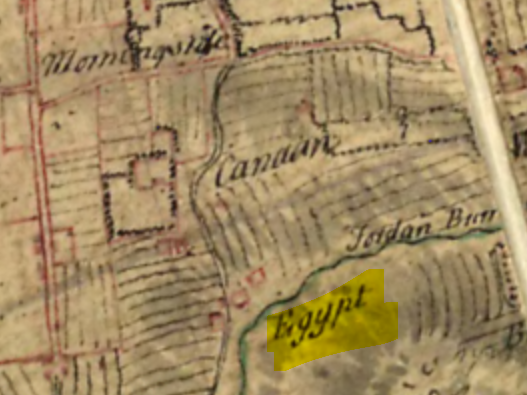
There is a part of Edinburgh described by the travel writer Wilfred Taylor as its “bible belt”, not on account of it being particularly religious but on account of its unusual concentration of place names recalling the Holy Land; Egypt, Canaan, Jordan and more.
William Roy’s Lowland map of Scotland, c. 1750, showing Canaan, Jordan and Egypt. Reproduced with the permission of the National Library of Scotland
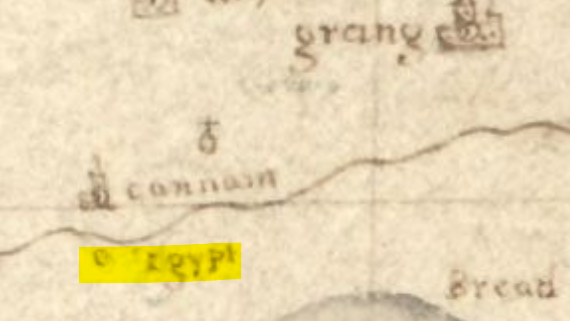
In fact in cartographic terms, these are older placenames than Morningside itself, with Canaan and Egypt first appearing in Adair’s map of 1682, a full 55 years before Morningside. Egypt is the oldest of these names, recorded in documents back to 1585 .
Adair’s map of 1682, showing Egypt, Canaan and Grange. Reproduced with the permission of the National Library of Scotland
The name comes from the medieval idea that the Romany people came from Egypt; a Gipcyan or Gypsy being someone of Egypt in old English. What became Egypt Farm was at this time Little Egypt, just outside the Edinburgh boundary which was the rivulet of the Jordan or Pow Burn. This was held in tradition to be a gathering place of the Lowland Scottish Gypsies. In 1717, the location was on the “march line” or the boundary between jurisdictions and was described as Egypt village in the burgh records.
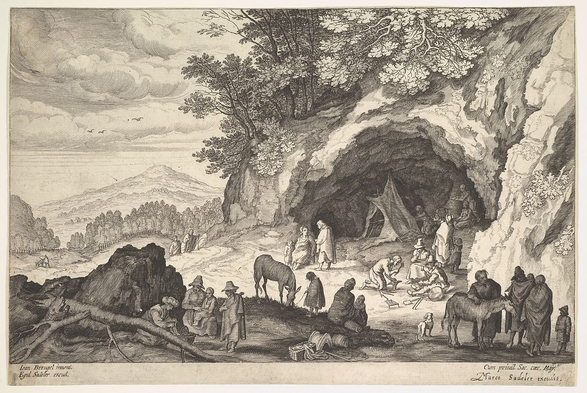
Mountainous Landscape with a Group of Gypsies, early 17th century Dutch print by Aegidius Sadeler from collection of The Met Museum
Romany Gypsies probably first arrived in Scotland at the end of the 15th century, being received by the court of King James IV in 1505. The Stuart King is recorded as corresponding with the “King of Rowmais” (Romanies) and at this time they were looked upon favourably. Their dance, dress and music would have been exotic to the aspiring Renaissance monarch and the King presented them with 10 French Crowns. His son, James V, made payment to them as court dancers in 1529. In 1540 he granted a letter to Johnne Faw (Johnnie Faa) making him “King of the Gypsies“. This letter was addressed to “oure louit Johnne Faw, lord and erle of Litill Egipt” (“our beloved Johnne Faw, Lord and Earl of Little Egypt“). This granted Faa’s authority over all Gypsies in Scotland and sheriffs were obliged to assist “in executione of justice upoun his company and folkis“, who were in turn to “conforme to the lawis of Egipt“. That is, Gypsies lived under their own authority, granted by the crown and their King was based at a settlement or encampment was known as Little Egypt.
However in 1541 the Town Council of Edinburgh expelled the Gypsies from their jurisdiction on accusations of “great thiftis and scaithis done”; great theft and damage done, and it is the supposition that this caused them to move their encampments across the Jordan Burn from the city’s land of the Burgh Muir to the Braid estate on the other. By 1585, Robert Fairlie, the Laird of Braid, granted the city the use of his house called “Littil Egypt” for brewing ale outside the city boundary for the residents on the Burgh Muir afflicted by the plague.
Queen Regent Mary of Guise renewed the status of the “Egyptians” in 1553, when “John Faw, Lord and Earl of Little Egypt” was engaged by her government to assist in the apprehension of dealing with Gypsy rebels. However her grandson, King James VI, chose to persecute “the idle people calling themselves Egyptians”, with strong support from The Kirk, effectively expelling those “following the Gypsy way of life” from Scotland. This was on pain of being nailed to a tree by their ears and then having their ears cut off. In 1603 James’ Privy Council made an order raising the punishment to pain of death, ratified by Parliament with an “Act Anent the Egiptians” in 1609. This act did not have the desired effect of eradicating the Gypsies as a race of people from Scotland, but it forced them to live a more “settled” way of life that required the tolerance and guarantee of a laird, and pushed them and their way of life to the very edges of society.
“A family of gypsies sit in their camp with a child they have stolen”. Confirming the prevalent public attitude of Gypsies as thieves outwith society. Engraving by W. & F. Holl, 1840. From the Wellcome Collection
The Gypsies were forced to live “under the radar” of the Kirk and state in Scotland and retreated south, particularly to the area around Yetholm. But their name lived on in the south of Edinburgh and as a place name Egypt Farm existed until the 1880s or so at which point it was encroached upon and built over by the expanding Victorian suburb of Morningside. Although Egypt was lost as a placename, the street of Nile Grove commemorated it and it was fully rehabilitated a century later in 1985, when the redevelopment of an old Mews at the end of Cluny Place was named Egypt Mews.
Egypt Farm, 1851-56 Ordnance Survey 6 inch map. Reproduced with the permission of the National Library of ScotlandNile Grove, 1892-1905 OS 25 inch survey. Reproduced with the permission of the National Library of ScotlandEgypt Mews. Open Streetmap.
Back to the Holy Land place name theme, it is likely this was established as a precedent by Little Egypt. Canaan is recorded as far back as 1661 when the city leased the grazing for 11 years to a woman called Margaret Whilleis. Its lands originally constituted an estate of 65 acres feud off of the Burgh Muir in 1586. Canaan is appropriately on the opposite bank of the “Jordan burn” watercourse from Egypt. For a time, the neighbourhood was known as the Land of Canaan.
The Jordan burn‘s alternative name is the Pow Burn, Pow being a Scots word (from the old British or Gaelic “poll” for a slow moving river, pool or mire); see also places like Polmont. The Pow is a collective term for the whole length of this burn, from its origin until it joins the Braid Burn at Duddingston. Only the section south of Morningside, between Egypt and Canaan, was known as the Jordan. To the east of this it is known as the Cameron Burn (around the locality of Cameron Toll), with Cameron likely comes from the British Cam Rynn, referring to a bog in the crook of a river.
William Roy’s Lowland map of Scotland, c. 1750, showing Cameron. Reproduced with the permission of the National Library of Scotland
When the Georgians began to split the Canaan estate up into plots for fashionable villas, the theme for biblical names was continued.
The land of Eden. See also Eden Terrace and Eden Lane. Reproduced with the permission of the National Library of ScotlandHebron, off of Canaan Lane. Reproduced with the permission of the National Library of ScotlandGoshen, between Canaan and Jodan Lanes, Goshen was the land given to the Hebrews by the pharaoh. Reproduced with the permission of the National Library of ScotlandSalem, a biblical town of King Melchiezedek. Reproduced with the permission of the National Library of Scotland
Other names in the area, not shown on these maps, were the villas of Arkland and Mount Zion on Canaan Lane and to put a cherry on the top of this biblical smorgasbord, what is now The Canny Man’s pub was originally a villa called… Paradise!
Note to readers: unfortunately in April 2026, a third-party plug-in more than exceeded its authority and broke many of the image links on this site. No images were lost but I will have to restore them page-by-page, which may take some time. In the meantime please bear with me while I go about rectifying this issue.
If you have found this site useful, informative or amusing then you can help contribute towards its running costs by supporting me on ko-fi. This includes my commitment to keeping it 100% advert and AI free for all time coming, and in helping to find further unusual stories to bring you by acquiring books and paying for research.
Or please do just share this post on social media or amongst friends and like-minded people, sites like this thrive on being shared.
Explore Threadinburgh by map:
Travelers' Map is loading...
If you see this after your page is loaded completely, leafletJS files are missing.
These threads © 2017-2026, Andy Arthur.
NO AI TRAINING: Any use of the contents of this website to “train” generative artificial intelligence (AI) technologies to generate text is expressly prohibited. The author reserves all rights to license uses of this work for generative AI training and development of machine learning language models.
#Lochend #Logan #Restalrig #StMargaret Sim Barr
 Reclusive Leftist
 Andy Arthur - Threadinburgh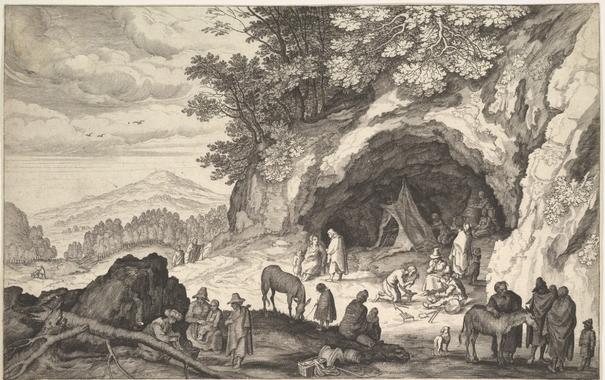
 Paper Moon
 wolf of the wisp
 Radio Zoo 📻 Global Broadcast
 demian 😷☭⚧ (he/they)

 Stelliform Press