We lost the word femĭna in Portuguese. They kept it in Gallia: femme (Fr.). I'm not sure about Italian, although the common word for woman is donna (from domĭna). In Portuguese we use mulher (from mulier), that is correlated to uir. Femina is correlated to homo. We kept adjectives, though.

homme, femme
uomo, donna (femminile)
homem, mulher (feminino)

#wordsinPortuguese #Romancelanguages #olivesspeaks 💬

Is burra where we get "pull the wool over someone's eyes" from?

ETA: Probably not.

#linguistics #RomanceLanguages #idiom

That reminds me! Since I moved from #Akkoma to #Firefish and had to switch subdomains, I think a new #introduction is in order!

Hi, my name is Carlos Solís, from Costa Rica (or Rich Coast, for the Spanish-challenged in the audience
😉). I'm a computer science graduate and have been working in the digital area for ten years now. I've been on the #FreeSoftware scene since my college days on and off for over ten years now, and in fact I've taken it so seriously, that this message has been posted from my #SelfHosted server in my own house in Santa Ana.

My other interests include
#Linguistics, especially #Auxlangs and #Conlangs (besides of my native Spanish, the related #RomanceLanguages such as Portuguese and Italian which I can sort of understand, and the bits of German and Japanese that I learned online, I also know the basics of #Esperanto and #Idolinguo, plus I've dabbled in more obscure languages such as #LingwaDePlaneta and #Uropi), #FreeCulture and #Copyleft works (though for historic reasons I've drifted away from some projects such as the SCP Foundation), #Accessibility / #A11Y (especially relevant since I work a lot on frontend online tools), and #Cybersecurity (again, relevant as I sometimes work full-stack).

Pronouns if you need them: "He" is best, "they"/"it"/"one" are odd but understandable in context, "she" is very much a miss (pun a bit intended there!)
That reminds me! Since I moved from #Akkoma to #Firefish and had to switch subdomains, I think a new #introduction is in order!

Hi, my name is Carlos Solís, from Costa Rica (or Rich Coast, for the Spanish-challenged in the audience
😉). I'm a computer science graduate and have been working in the digital area for ten years now. I've been on the #FreeSoftware scene since my college days on and off for over ten years now, and in fact I've taken it so seriously, that this message has been posted from my #SelfHosted server in my own house in Santa Ana.

My other interests include
#Linguistics, especially #Auxlangs and #Conlangs (besides of my native Spanish, the related #RomanceLanguages such as Portuguese and Italian which I can sort of understand, and the bits of German and Japanese that I learned online, I also know the basics of #Esperanto and #Idolinguo, plus I've dabbled in more obscure languages such as #LingwaDePlaneta and #Uropi), #FreeCulture and #Copyleft works (though for historic reasons I've drifted away from some projects such as the SCP Foundation), #Accessibility / #A11Y (especially relevant since I work a lot on frontend online tools), and #Cybersecurity (again, relevant as I sometimes work full-stack).

Pronouns if you need them: "He" is best, "they"/"it"/"one" are odd but understandable in context, "she" is very much a miss (pun a bit intended there!)

@wordofthehour

From Old French viande, from Late Latin *vīvanda, alteration of Latin vīvenda, from the neuter plural form of vīvendus, from vīvere (“to live”). Compare English viand, Italian vivanda, Portuguese vivenda, Spanish vivienda. Not used to mean 'meat' until the 16th century.

#étymologie
#viande
#OldFrench
#Latin
#RomanceLanguages

#ADHD: I want things to be different.
#Autism: I want things to stay the same.

Compromise: learn more #RomanceLanguages

(explanation: different romance languages often feel like dialects of a broader language)

@linguistics

@languagelovers

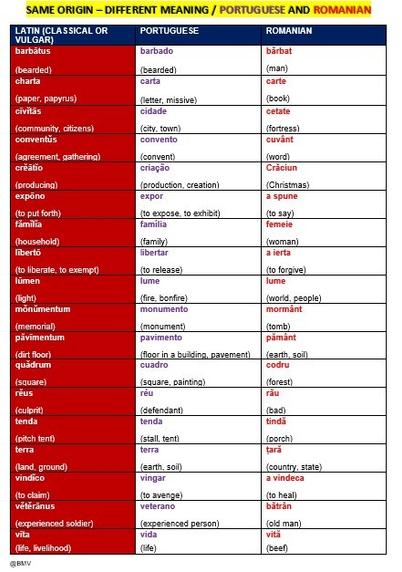
#Portuguese and #Romanian are geographically the most distant of the major Romance languages, so it is only normal that they have had developed in different ways. The following image highlights a few of the many words which, in spite of sharing the same origin in Classical or Vulgar Latin, have evolved and acquired distinct meanings in Portuguese and Romanian.

#Romancelanguages #languages #languagelearners #langtoot #languagelearning

@linguistics @languagelovers #languagelearning #langtoot

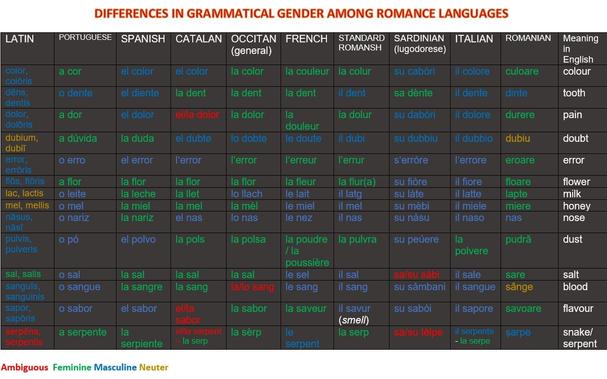
Mastering one of the #Romancelanguages will certainly speed up the process of learning another language of the same family but you will find some stumbling blocks along the way: changes in pronunciation, false friends, varying usage both in prepositions and in the subjunctive mood, as well as diverging grammatical gender of many similar words as shown in the following chart. 

I really love languages and especially (because I've studied some of them) romance or neo latin languages. We know about or learn some of the most known romance languages like French, Italian or Spanish and Portuguese. But there are others too! Like Catalan, Romanian, Sardinian, Romansh or Ladin e.g. Very beautiful languages: https://en.m.wikipedia.org/wiki/Romance_languages #romancelanguages #NeoLatin #languages #study
Romance languages - Wikipedia

I figure now's a good time for my #introduction:
I am a young #translator based in Madrid who's dabbled in biomedical, technical and audiovisual translation as well as #localization. I enjoy learning about the world, its history, its natural and technological wonders, and its #languages. I am also deeply invested in class politics. I speak Spanish natively, English proficiently, and I am... okay? at French, Catalan and Galician. #Romancelanguages are my jam. May subject you to random fun facts.