While #OpenScience provides substantial opportunities for researchers in #LMICs, this paper highlights core global barriers and inequities
https://journals.sagepub.com/doi/full/10.1177/25152459251357565
It is also a good general introduction into OS!
It is important to recognise that current OS practices may not suit local contexts in #LMICs given how strongly they have been shaped (so far!) by researchers in #HICs. There is ample opportunity for #HICs to learn and improve practices from this dialogue!
The #HealthEquity Research Production Model focuses on research production using a framework of accountability and aims to remediate the compounded effects of privilege through systems and systems change.
https://equityhealthj.biomedcentral.com/articles/10.1186/s12939-025-02524-0
Privilege—special advantages, opportunities or honors granted only to specific persons or groups, such as cisgender men—is one of the primary causes of structural inequality and health inequality. More specifically, privilege feeds structural inequities that result in adverse health outcomes disproportionately impacting minoritized and marginalized communities. As structural inequality increases globally, there will undoubtedly be an increase in health inequity; this has driven a commensurate increase in health equity research. The increased focus on health equity may lead to evidence-based policy changes, potentially leading to changes in health and reductions in inequities in health. However, it is not enough to rectify health inequities. This paper introduces the Health Equity Research Production Model (HERPM), designed to promote equity, fairness, and justice in the production of research. While grounded in the fields of public health and health equity research, the model is broadly applicable across disciplines, particularly for researchers and institutions seeking to adopt more equitable research practices. To date, there is no current model in the literature focused on research production, despite its critical role in shaping evidence and determining who benefits from its dissemination. The goal of the Health Equity Research Production Model is to re-orient the field towards accountability for prioritizing equity in academic research in an existing system structured on inequality by centering minoritized and marginalized academic scholars and researchers including to expand pathway to reflect communities in need of research and creating equity in research production while improving the quality of the health equity research produced. The Health Equity Research Production Model focuses on research production using a framework of accountability and aims to remediate the compounded effects of privilege through systems and systems change. It prioritizes equity in the: (1) engagement with and centering of communities studied in research in all phases, (2) identities represented within research teams, (3) consideration of identities and groups awarded research grants, and (4) consideration of identities and groups considered for research products, such as peer-reviewed publications. This multi-component strategy for health equity and inclusive scientific approach–which directly addresses privilege inherent within the existing research production model—aims to deconstruct existing individual systems. This writing highlights the production of research products, which is evidence used in policy-decision making and directly associated with academic research success—compounding benefits bestowed upon non-minoritized and non-marginalized academic scholars and researchers.
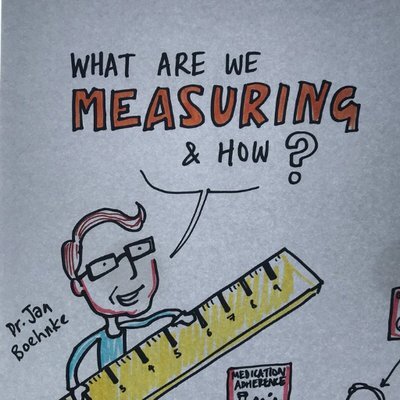
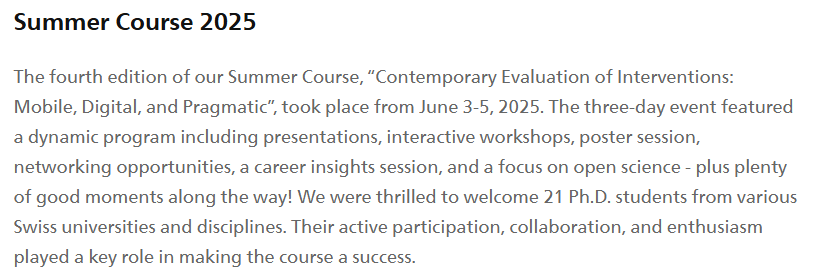
I really enjoyed participating in and presenting at the Summer Course 2025 of the Brain and Behavioral Sciences doctoral program at @unibern
I have written two brief summaries, one about the overall programme
https://www.linkedin.com/feed/update/urn:li:activity:7345468437407694850/
and one about my inputs:
https://www.linkedin.com/feed/update/urn:li:activity:7345830294224093184/
If interested, you can find a picture, a description of the course, and future plans of the local team here:
https://www.bbs.unibe.ch/training/summer_course/past_summer_courses/index_eng.html
Does anyone have a good resource on planned missingness designs?
#research #missingdata #researchdesign #AskingForAFriend #statistics
Laura Kampf on how kids need to see makers making cool / real stuff (instead of only childproof and safe stuff) to get interested in making:
"They can watch professional ski jumpers and they are allowed to watch them. So they can watch us, too."
https://youtu.be/xQDn6vw1Iqo?t=856
How do we teach research to our students?
Some #WeekendInspiration:
Simone Giertz received an honorary doctorate 👏🎉
https://www.youtube.com/shorts/Lztt0KYUpRU
and I enjoyed her lecture (engl. https://www.his.se/mot-hogskolan/aktiviteter/kalender/2025/simone-giertz-hedersdoktor-forelasning/ )
#Hedersdoktor #ResearchDesign #Skövde
I often look toward design research & practice for my own research and especially teaching. 🙇 It is great to see someone this inspiring honoured in this way!
And there was even a bit to train my Swedish on 😅
https://www.his.se/mot-hogskolan/aktiviteter/kalender/2025/simone-giertz-hedersdoktor-forelasning/
Mirjam Stieger (Lucerne Uni) and I are invited to present
"Contemporary #Evaluation of Interventions: Mobile, Digital, and Pragmatic"
at @unibern
https://www.bbs.unibe.ch/training/summer_course/index_eng.html
This is the annual Summer Course of the Doctoral Program Brain and Behavioral Sciences, and comprises a mixture of keynotes, masterclasses, hidden curriculum etc.
I am very much looking forward to it, and also very honoured to be invited once again to Bern to train #ECRs!
💡In this series, we are introducing the importance of the Sex and Gender dimensions in research and innovation.
For the last installment, we are exploring the European Commission's committment to promoting gender equality in research and innovation.
💡In this series, we are introducing the importance of the Sex and Gender dimensions in research and innovation.
Reflecting the sex and gender dimensions in project design is the only way to avoid gaps in the research results. We explore a few steps that could be taken while designing a research project.