EU Court of Justice determines that data anonymisation “might work, but then again it might not”
https://alecmuffett.com/article/114848
#DataProtection #LinkedData #anonymisation #eu #pii #privacy #reidentification
EU Court of Justice determines that data anonymisation “might work, but then again it might not”

It follows from the provisions of that regulation as interpreted  in case-law that pseudonymisation may, depending on the circumstances of the case, effectively prevent persons other than the contr…

Dropsafe

EU Court of Justice determines that data anonymisation “might work, but then again it might not”

It follows from the provisions of that regulation as interpreted  in case-law that pseudonymisation may, depending on the circumstances of the case, effectively prevent persons other than the controller from identifying the data subject in such a way that, for them, the data subject is not or is no longer identifiable. In that context, the Court of Justice is careful to recall the guidance…

from its case-law regarding the assessment of whether or not the data subject is identifiable in situations in which the information enabling that subject to be identified was not in the hands of other people.

https://curia.europa.eu/jcms/upload/docs/application/pdf/2025-09/cp250107en.pdf

#anonymisation #dataProtection #eu #linkedData #pii #privacy #reidentification
In recent years, the development and refinement of #artificialintelligence (AI) technologies have revolutionised #computervision. This #TemaEU article explores the usage of #syntheticimages in training and improving #peopledetection and #reidentification models, highlighting its benefits, challenges, and future implications.

👉 https://tema-project.eu/articles/synthetic-images-people-detection-balancing-effectiveness-and-ethical-imperatives

Synthetic Images in People Detection: Balancing Effectiveness and Ethical Imperatives

This article discusses the benefits of using synthetic images generated through AI in disaster management. it presents examples of usages and discusses the benefits of the approach for privacy, ethics, efficiency and more.

TEMA Project

Our latest work "Neural Texture Puppeteer" is published at https://openaccess.thecvf.com/content/WACV2024W/CV4Smalls/html/Waldmann_Neural_Texture_Puppeteer_A_Framework_for_Neural_Geometry_and_Texture_WACVW_2024_paper.html

As a base we make use of "Neural Puppeteer", an efficient and flexible neural rendering pipeline https://openaccess.thecvf.com/content/ACCV2022/html/Giebenhain_Neural_Puppeteer_Keypoint-Based_Neural_Rendering_of_Dynamic_Shapes_ACCV_2022_paper.html

Our key idea is to disentangle texture and geometry.

We show with twelve distinct synthetic cow textures that the new pipeline can be used in a downstream task to identify individuals.

#NeTePu #NePu #WACV #WACV24 #computervision @unikonstanz #CBehav #NeuralRendering #ReIdentification

WACV 2024 Open Access Repository

"Correct identification rates were typically 86–100%, indicating a high risk of reidentification. "

Does deidentification of data from wearable devices give us a false sense of security? A systematic review

https://www.sciencedirect.com/science/article/pii/S2589750022002345

(article is Open)
#Reidentification
#WearableMedicalDevices

I am truly curious if I'm capable of getting through a data-related presentation without invoking Latanya Sweeney's research.

#KAnonymity
#Reidentification
#DeidentifiedMyLeftEarlobe
#Data

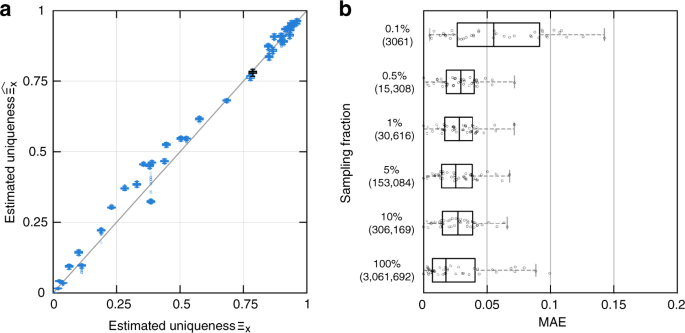
"Estimating the success of #reidentification in incomplete datasets":

"We find that 99.98% of Americans would be correctly re-identified in any dataset using 15 demographic attributes. Our results suggest that even heavily sampled anonymized #datasets are unlikely to satisfy the modern standards for #anonymization set forth by #GDPR and seriously challenge the technical and legal adequacy of the de-identification release-and-forget model."

https://www.nature.com/articles/s41467-019-10933-3/ @dataGovernance #dataPrivacy

Estimating the success of re-identifications in incomplete datasets using generative models - Nature Communications

Anonymization has been the main means of addressing privacy concerns in sharing medical and socio-demographic data. Here, the authors estimate the likelihood that a specific person can be re-identified in heavily incomplete datasets, casting doubt on the adequacy of current anonymization practices.

Nature
"Avec des moyens, il est parfois possible de réidentifier des personnes à partir de leurs données personnelles, même quand elles ont été anonymisées" : https://theconversation.com/comment-anonymiser-des-donnees-personnelles-199922 par Nesrine #Kaaniche et #MarylineLaurent de Télécom SudParis avec des financements de la Fondation Mines-Télécom.

#RGPD #dataMining #individualisation #anonymat #donnéesPersonnelles #confidentialité #viePrivée #réidentification #pseudonymat #individualisation #inférence #corrélation
Comment anonymiser des données personnelles ?

Anonymiser les données que l’on collecte sur ses clients, patients ou citoyens est une obligation, mais comment la met-on en œuvre et surtout, quelles en sont les limites ?

The Conversation
Tentative conclusion: I’m not going to get the minimum number of photos I need to reidentify a #mantaray below about a half-dozen. Once I have that few k-shot I get good results but I’m just not getting a “general model of how to tell one manta from another.” #MetricLearning #ArcFace #SubcenterArcface #Reidentification #LowKShot

Does #deidentification of #data from #wearable devices give us a false sense of #security? A #SystematicReview

#OpenAccess

"This systematic review seeks to investigate whether deidentifying data from wearable devices is sufficient to protect the privacy of individuals in datasets. Correct identification rates were typically 86–100%, indicating a high risk of #reidentification. As little as 1–300 s of recording were required to enable reidentification."

https://www.thelancet.com/journals/landig/article/PIIS2589-7500(22)00234-5/fulltext

Does deidentification of data from wearable devices give us a false sense of security? A systematic review

Wearable devices have made it easier to generate and share data collected on individuals. This systematic review seeks to investigate whether deidentifying data from wearable devices is sufficient to protect the privacy of individuals in datasets. We searched Web of Science, IEEE Xplore Digital Library, PubMed, Scopus, and the ACM Digital Library on Dec 6, 2021 (PROSPERO registration number CRD42022312922). We also performed manual searches in journals of interest until April 12, 2022. Although our search strategy had no language restrictions, all retrieved studies were in English.

The Lancet Digital Health