@trib
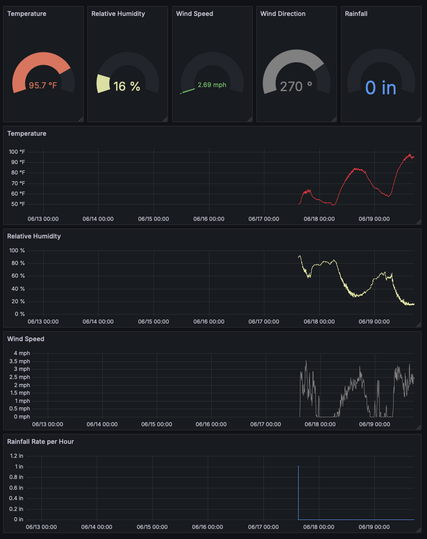
Since I was already running Mosquitto as #MQTT broker, I flashed #OpenMqttGateway on an #ESP32 module with a 433MHz receiver and got myself a non-smart weather station.
Alternately you could use #RTL433 and an #RTLSDR dongle to receive the data (or data from your neighbors weather stations).

My station is from LaCrosse, but there are other supported brands.

me: *pipes rtl_433 output as JSON into a Python script*

Python script: *crashes and exits after an hour due to a network error*

rtl_433: *continues on as if nothing has happened*

Sure, ignoring SIGPIPE is definitely the right course of action here. 🙄

#rtl433 #rtl_433

TIL, a lot of devices send out automatic signals at 433MHz, which can be picked up and decoded.

I was hoping to get some temperature sensors from the neighbors, but the only thing around here seems to be a tire pressure monitor in some car.

#rtl433

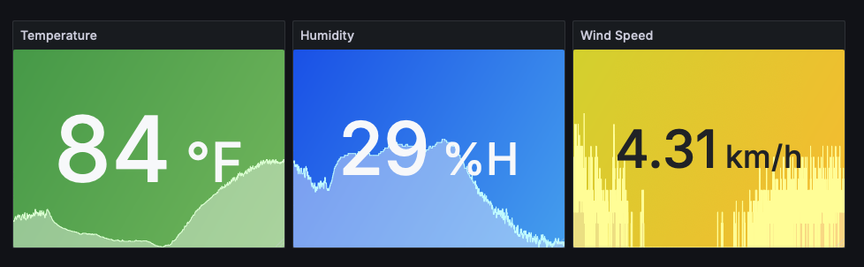
Grafana is so awesome. It's abilities coupled with those of the Flux language make things so easy. I am just starting to scratch the surface of what I can display.

#RTL433
#InfluxDB
#Grafana

It turns out I am just an idiot.

It was DNS.

Definitely need a shirt that says that by @geerlingguy

#RTLSDR
#RTL433
#InfluxDB

This seems to be an issue with rtl_433 while using -F "influx://", not an issue with the firewall or InfluxDB docker container.

I can run a test python script from the same machine that is running the rtl_433 tool and write successfully to the remote InfluxDB instance. Also tried the same and different API Tokens as well as the same and different buckets just to check.

Unclear why rtl_433 can only write to a local InfluxDB instance.

#RTLSDR
#RTL433
#InfluxDB

Well adding a remote InfluxDB source to Grafana is easy-peasy. Now I just need to figure out why I cannot seem to write data to a remote InfluxDB instance.

#RTLSDR
#RTL433
#InfluxDB
#Grafana

I've been learning a lot about the rtl-433 library used with an RTLSDR v4 dongle and trying to capture data from my AcuRite 5 in 1 weather station.

Debian 12 currently has the following versions available through the package manager:

librtlsdr-dev (0.6.0-4)
rtl-sdr (0.6.0-4)
rtl-433 (22.11-1)

However, it seems like the driver for the v4 dongle is too old to properly support it. I kept getting the error:

bitbuffer_add_bit: Warning: row count limit (50 rows) reached

#RTLSDR
#RTL433
#InfluxDB

Über einen zweckentfremdeten DVB-T-Empfänger landen die Messwerte diverser Funkthermometer in unserer Home-Assistant-Instanz. Dafür wird in der Konfigurationsdatei /etc/rtl_433.conf eine MQTT-Ausgabe definiert:
output mqtt://[…],events=rtl_433[/model][/id]

Die ID der Thermometer ändert sich aber mit jedem Batteriewechsel. Weshalb die Thermometer, gemäß einem Tipp aus dem Netz, manuell in der YAML-Konfiguration von Home Assistant angelegt sind. Dadurch lässt sich dort die ID anpassen, ohne dass sich die HA-interne Entität ändert (was sonst z. B. für kontinuierliche Messreihen in der Oberfläche problematisch wäre).

Da allerdings unsere von HA unabhängigen Empfangsdisplays die Thermometer nach jedem Batterietausch problemlos wiederfinden, kam der Gedanke, dass dann doch auch fßr HA die Erkennung nach sich nicht änderndem Kanal anstatt wechselnder ID gangbar sein mßsste. Also /etc/rtl_433.conf abgeändert
output mqtt://[…],events=rtl_433[/model]/C[channel]
und auch in der HA-Konfiguration die Topic-Parameter entsprechend angepasst:

state_topic: rtl_433/Ambientweather-F007TH/C1 json_attributes_topic: rtl_433/Ambientweather-F007TH/C1

Funktioniert bisher wunderbar.

#HomeAssistant #rtl433 #rtl-sdr #MQTT

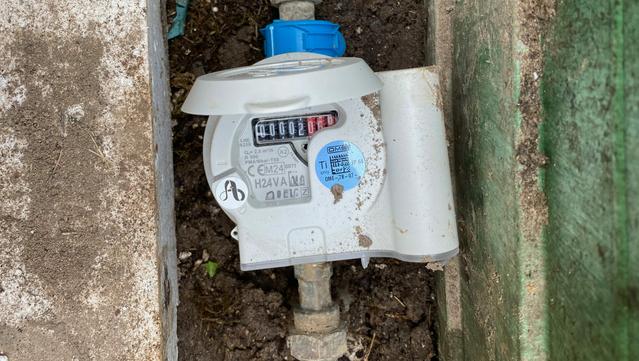
I'm trying to receive a weather station at 868.3 MHz as well as some heat cost allocators and water meters at 868.95 MHz, both via #rtl_433.

Up until now, I did this using

rtl_433 -f 868.3M -f 868.95 -H 15 -s 250k -Y autolevel -Y magest -M noise -M level

i.e. frequency hopping. But shouldn't I be able to capture both frequencies simultaneously with a higher sample rate? But with "-f 868.3M -s 2M" nothing shows up anymore at all.

Edit: Solved! https://chaos.social/@scy/113068997126643230

#SDR #rtl433

scy (@[email protected])

@quanten Okay, with a sample rate of 1 M (-s 1M) and manually specifying "-Y filter=20" as suggested in the GitHub issue, it appears to be working now! Thanks a lot for pointing me into the right direction <3

chaos.social