Weekly Update from the Open Journal of Astrophysics – 13/09/2025

It’s Saturday again, so it’s time for another summary of the week’s new papers at the Open Journal of Astrophysics. Since the last update we have published seven new papers, which brings the number in Volume 8 (2025) up to 134, and the total so far published by OJAp up to 369. We seem to be emerging for the slight late-summer hiatus we have experienced over the last few weeks.

Anyway, the first paper to report this week is “Observing the Sun with the Atacama Large Aperture Submillimeter Telescope (AtLAST): Forecasting Full-disk Observations” by Mats Kirkaune & Sven Wedemeyer (U. Oslo, Norway), Joshiwa van Marrewijk (Leiden U., Netherlands), Tony Mroczkowski (ESO, Garching, Germany) and Thomas W. Morris (Yale, USA). This paper discusses possible strategies and parameters for full-disk observations of the Sun using the proposed Atacama Large Aperture Submillimeter Telescope (AtLAST). It was published on Tuesday 9th September 2025 in the folder Solar and Stellar Astrophysics.

The overlay is here:


You can make this larger by clicking on it.  The officially accepted version of this paper can be found on the arXiv here.

The second paper this week, published on Wednesday 10th September in the folder Cosmology and NonGalactic Astrophysics, is “The exact non-Gaussian weak lensing likelihood: A framework to calculate analytic likelihoods for correlation functions on masked Gaussian random fields” by Veronika Oehl and Tilman Tröster (ETH Zurich, Switzerland).  This paper shows how to calculate likelihoods for the correlation functions of spin-2 Gaussian random fields defined on the sphere in the presence of a mask with applications to weak gravitational lensing.

The overlay is here:

and you can find the final accepted version on arXiv here.

Next one up, the third paper this week, is  “Subspace Approximation to the Focused Transport Equation. II. The Modified Form” by B. Klippenstein and Andreas Shalchi (U. Manitoba, Canada). This was also published on 10th September 2025 in the folder Solar and Stellar Astrophysics. It is about solving the focused transport equation analytically and numerically using the subspace method in two or more dimensions.

You can find the final accepted version on arXiv here.

The fourth paper of this week was also published on Wednesday 10th September. It is “Mass models of galaxy clusters from a non-parametric weak-lensing reconstruction” by Tobias Mistele (Case Western Reserve U., USA), Federico Lelli (INAF, Firenze, Italy), Stacy McGaugh (Case Western), James Schombert (U. Oregon, USA) and Benoit Famaey (Université de Strasbourg, France).  Published in the folder Cosmology and NonGalactic Astrophysics, it presents new, non-parametric deprojection method for weak gravitational lensing applied to a sample of galaxy clusters. The overlay is here:

You can find the officially accepted version on arXiv here.

The fifth paper of the week is “A Swift Fix II: Physical Parameters of Type I Superluminous Supernovae” by Jason T. Hinkle & Benjamin J. Shappee (U. Hawaii, USA) and Michael A. Tucke (Ohio State, USA). This one was published on Thursday 11th September 2025 in the folder High-Energy Astrophysical Phenomena. The paper uses recalibrated Swift photometry to recompute peak luminosities and other properties of a sample of superluminous Type I supernovae. The overlay is here:

You can find the official accepted version on arXiv here.

Paper No. 6 for this week is “Detailed Microwave Continuum Spectra from Bright Protoplanetary Disks in Taurus” by Caleb Painter (Harvard, USA) and 11 others, too numerous to mention by name, based in the USA, Germany, Mexico and Taiwan.  This one was published in the folder marked Solar and Stellar Astrophysics on September 11th 2025. It presents new observations sampling the microwave (4-360 GHz) continuum spectra from eight young stellar systems in the Taurus region. The overlay is here:


The final version can be found on arXiv here.

The last paper for this update is “On Soft Clustering For Correlation Estimators” by Edward Berman (Northeastern University, USA) and 13 others based in the USA, France, Denmark and Finland and Cosmos-Web:The JWST Cosmic Origins Survey. This was published on Friday 12th September 2025 in the folder Instrumentation and Methods for Astrophysics. It presents an algorithm for estimating correlations that clusters objects in a probabilistic fashion, enabling the uncertainty caused by clustering to be quantified simply through model inference. The overlay is here:

You can find the final version on arXiv here.

And that’s all the papers for this week. I’ve noticed a significant recent increase in the number of papers in Solar and Stellar Astrophysics, which means we’re broadening our impact across the community. Which is nice.

P.S. I found out last week that, according to NASA/ADS, papers in OJAp have now accumulated over 5000 citations.

#arXiv230903270v3 #arXiv240708718v2 #arXiv250406174v3 #arXiv250513145v2 #arXiv250613716v2 #arXiv250711801v2 #arXiv250721268v2 #AtacamaLargeApertureSubmillimeterTelescope #AtLAST #CorrelationFunctions #CosmologyAndNonGalacticAstrophysics #DiamondOpenAccess #FocusedTransportEquation #galaxyClusters #InstrumentationAndMethodsForAstrophysics #MicrowaveSpectroscopy #OpenJournalOfAstrophysics #ProtoplanetaryDisk #protoplanetaryDisks #SolarAndStellarAstrophysics #solarObservations #Spin2Fields #StatisticalMethods #strongGravitationalLensing #SuperluminousSupernovae #SWIFT #TheOpenJournalOfAstrophysics #weakGravitationalLensing

Weekly Update from the Open Journal of Astrophysics – 02/08/2025

It’s Saturday morning again, and it’s the start of a new month, so it’s time for an update of papers published at the Open Journal of Astrophysics. Since the last update we have published five new papers, which brings the number in Volume 8 (2025) up to 110, and the total so far published by OJAp up to 345. I expect we’ll the total number we published last year (120) sometime this month. I predict that by the end of this year we will have published around 180 papers in Volume 8 and around 400 altogether.

The papers published this week, with their overlays, are as follows. You can click on the images of the overlays to make them larger should you wish to do so.

The first paper to report is “The matter with(in) CPL” by Leonardo Giani (U. Queensland, Australia), Rodrigo Von Marttens (Universidade Federal da Bahia, Brazil) and Oliver Fabio Piattella (Universita degli Studi dell’Insubria, Italy). This was published on Monday 29th July 2025 in the folder Cosmology and Nongalactic Astrophysics. This article presents a new parameterization of the standard model and its implications for the interpretation of cosmological observations.

The overlay is here:


The officially-accepted version can be found on arXiv here.

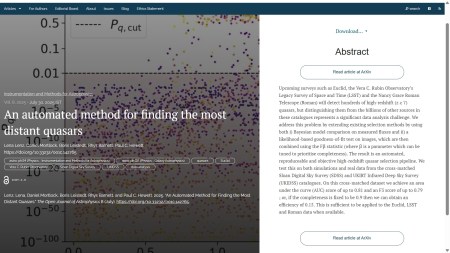
The second paper of the week, published on Tuesday 30th July in the folder Instrumentation and Methods for Astrophysics, is “An automated method for finding the most distant quasars” by Lena Lenz, Daniel Mortlock, Boris Leistedt & Rhys Barnett (Imperial College London, UK) and Paul C. Hewett (U. Cambridge, UK)”.  This paper presents an automated, reproduceable and objective high-redshift quasar selection pipeline, tested on simulations and real data from the Sloan Digital Sky Survey (SDSS) and UKIRT Infrared Deep Sky Survey (UKIDSS). The overlay is here:


You can find the officially accepted version of the paper on arXiv here.

The third paper of the week is “Early Post Asymptotic Giant Branch Instability: Does it Affect White Dwarf Hydrogen Envelope Mass?” by James MacDonald (University of Delaware, USA). This one was published on Friday 1st Auguest (i.e. yesterday) in the folder Solar and Stellar Astrophysics. It is an investigation into whether Early Post AGB Instability (EPAGBI) can affect determinations of the total abundance of hydrogen in white dwarf stars.

The overlay is here:

The final version is on arXiv here.


The fourth paper of the week, also published on Friday 1st August, is “Light Echoes of Time-resolved Flares and Application to Kepler Data” by Austin King and Benjamin C. Bromley (University of Utah, USA).  This describes a new model for circumstellar disks that incorporates echoes produced by extended, time-resolved flares. It is published in the folder Solar and Stellar Astrophysics. Here is the overlay:

You can find the officially-accepted version on arXiv here.


The fifth and final article published this week, also published on Friday 1st August,  is “Wide Binaries from Gaia DR3 : testing GR vs MOND with realistic triple modelling” by Charalambos Pittordis, Will Sutherland and Paul Shepherd (Queen Mary, University of London, UK). This presents a test for modified gravity from a sample of wide-binary stars from Gaia DR3, finding that (unmodified) Newtonian gravity provides a better fit to the data. It is in the folder Astrophysics of Galaxies.

The overlay is here:


You can find the officially-accepted version on arXiv here.

And that’s all the papers for this week. I’ll do another update next Saturday.

#AGBStars #arXiv240812770v2 #arXiv250407569v2 #arXiv250508467v3 #arXiv250508921v2 #arXiv250513313v2 #AstrophysicsOfGalaxies #AsymptoticGiantBranch #binaryStars #circumstellarDisks #Cosmology #CosmologyAndNonGalacticAstrophysics #DarkEnergy #DiamondOpenAccess #expansionOfTheUniverse #GaiaD3 #InstrumentationAndMethodsForAstrophysics #Kepler #ModifiedNewtonianDynamics #MOND #OpenAccessPublishing #OpenJournalOfAstrophysics #PostMainSequenceEvolution #protoplanetaryDisks #quasars #stellarFlares #TheOpenJournalOfAstrophysics #WideBinaries #YoungStellarSystems

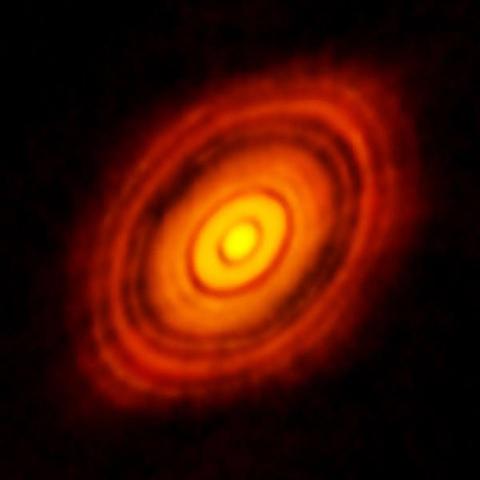
Of course all of this builds on the initial success from the original ALMA long-baseline campaing that looked at HL Tau and found its protoplanetary disk in all its glory…

https://www.almaobservatory.org/en/press-releases/revolutionary-alma-image-reveals-planetary-genesis/

#ALMA #AtacamaLargeMillimeterSubmillimeterArray #AtacamaLargeMillimeterArray #ProtoplanetaryDisks #PlanetFormation #YoungStars #YoungSolarSystems #HLTau

Revolutionary ALMA Image Reveals Planetary Genesis | ALMA Observatory

A new image from ALMA, the Atacama Large Millimeter/submillimeter Array, reveals extraordinarily fine detail that has never been seen before in the planet-forming disc around a young star. ALMA’s new high-resolution capabilities were achieved by spacing the antennas up to 15 kilometers apart[1. Since September 2014 ALMA has been observing the Universe using its longest...

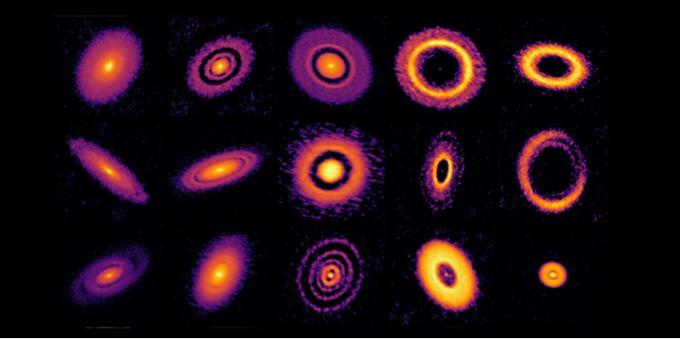
Using data from ALMA and advanced simulations, a research team led by Santiago Orcajo from the Instituto de Astrofísica de La Plata in Argentina (CONICET and Universidad Nacional de La Plata) has presented a new model that traces the evolution of protoplanetary disks through five distinct stages. The results strongly support a planet-driven origin of these substructures and offer new insights into how planets interact with the disks in which they form.

Stage I: Very young disks with shallow or no obvious substructures, corresponding to an epoch in which protoplanets are not massive enough to carve noticeable gaps in the disks.

Stage II: Disks with relatively narrow, but clear gaps and rings, indicating the growth of protoplanets

Stage III: A rapid widening of the gaps due to the sudden growth in the mass of some planets when they acquire their gaseous envelopes. This stage includes the rapid accumulation of dust at the outer edges of the gaps (the inner rims of the outer disks) due to the strong “pressure bumps” caused by the giant planets that recently formed, which stops the inward drift of dust.

Stage IV: Dust filtration at the edges of the cavities, resulting in dust-depleted inner disks. The millimeter dust from the outer disks efficiently drifts in and accumulates at the edges of the gaps.

Stage V: Eventually, the dusty inner disks drain completely onto the stars, and the outer disks become narrow rings (or collections of narrow rings).

More info: https://www.almaobservatory.org/en/press-releases/alma-inspires-new-models-for-the-evolution-of-planet-forming-disks/

#ALMA #AtacamaLargeMillimeterSubmillimeterArray #AtacamaLargeMillimeterArray #ProtoplanetaryDisks #PlanetFormation #YoungStars #YoungSolarSystems

ALMA Inspires New Models for the Evolution of Planet-Forming Disks | ALMA Observatory

By combining ALMA observations and simulations, the ODISEA team traces how planets may form and reshape their disks Ever since ALMA captured the striking image of HL Tau in 2014, revealing intricate rings and gaps in a disk around a newborn star, astronomers have sought to understand how such complex structures could emerge so early. The...

🔍🚫 In today's riveting episode of "Science Mysteries," experts are flabbergasted to learn that protoplanetary disks are smaller than expected! 🌌🔬 But don't worry, you can't read the details because the article is locked—403 Forbidden! 🎉 Thanks, #nginx, for always keeping us on the edge of #ignorance. 📚❌
https://www.centauri-dreams.org/2025/04/04/protoplanetary-disks-are-smaller-than-expected/ #ScienceMysteries #ProtoplanetaryDisks #403Forbidden #SpaceExploration #HackerNews #ngated
Protoplanetary Disks Are Smaller Than Expected | Centauri Dreams

Protoplanetary Disks Are Smaller Than Expected | Centauri Dreams

The JWST Reveals New Things About How Planetary Systems Form

Every second in the Universe, more than 3,000 new stars form as clouds of dust and gas undergo gravitational collapse. Afterward, the remaining dust and gas settle into a swirling disk that feeds the star’s growth and eventually accretes to form planets – otherwise known as a protoplanetary disk. While this model, known as the … Continue reading "The JWST Reveals New Things About How Planetary Systems Form"

Universe Today

This goes well beyond what was expected from ALMA: for the first time, astronomers have been able to observe a disc around a young star in the Large Magellanic Cloud, a neighboring galaxy. It’s the first time such a disc has ever been found outside our galaxy, and is identical to those forming planets in our Milky Way.

https://www.almaobservatory.org/en/press-releases/astronomers-discover-disc-around-star-in-another-galaxy-for-the-first-time/

#ALMA #ALMAObservatory #RadioAstronomy #ExtragalacticAstronomy #ProtoplanetaryDisks #LMC #LargeMagellanicCloud

Astronomers discover disc around star in another galaxy for the first time | ALMA

In a remarkable discovery, astronomers have used the Atacama Large Millimeter/submillimeter Array (ALMA) to observe a disc around a young star in the Large Magellanic Cloud, a galaxy neighboring ours. It’s the first time such a disc, identical to those forming planets in our Milky Way, has ever been found outside our galaxy. The new...

This was published early in October, but it is quite remarkable: DG Taurus has a very smooth proto-planetary disk, without any grooves, which means it is in an state prior to planet formation…

However, polarized observations showed some structure in the outer regions, which might be the beginning of planet formation!

#ALMA #PlanetFormation #ProtoplanetaryDisks #Polarization