 Dr. Juande Santander-Vela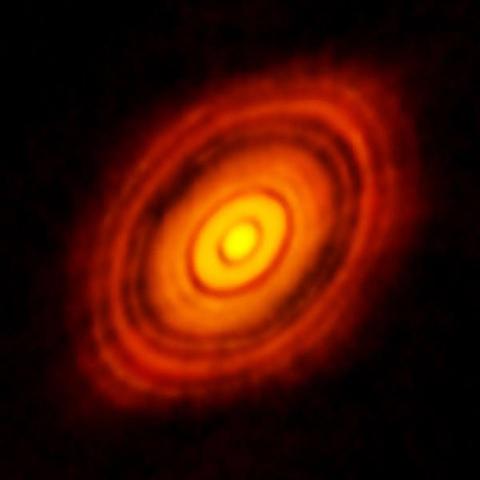

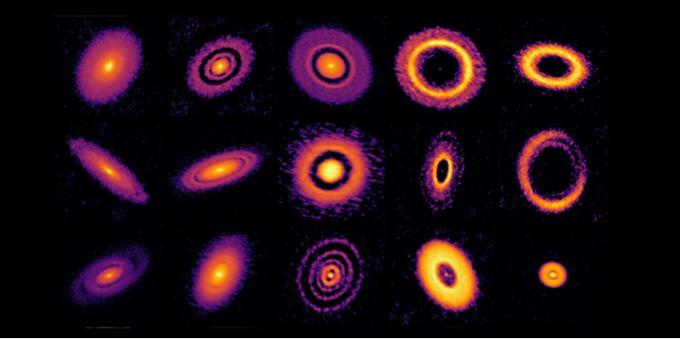
Using data from ALMA and advanced simulations, a research team led by Santiago Orcajo from the Instituto de Astrofísica de La Plata in Argentina (CONICET and Universidad Nacional de La Plata) has presented a new model that traces the evolution of protoplanetary disks through five distinct stages. The results strongly support a planet-driven origin of these substructures and offer new insights into how planets interact with the disks in which they form.
Stage I: Very young disks with shallow or no obvious substructures, corresponding to an epoch in which protoplanets are not massive enough to carve noticeable gaps in the disks.
Stage II: Disks with relatively narrow, but clear gaps and rings, indicating the growth of protoplanets
Stage III: A rapid widening of the gaps due to the sudden growth in the mass of some planets when they acquire their gaseous envelopes. This stage includes the rapid accumulation of dust at the outer edges of the gaps (the inner rims of the outer disks) due to the strong “pressure bumps” caused by the giant planets that recently formed, which stops the inward drift of dust.
Stage IV: Dust filtration at the edges of the cavities, resulting in dust-depleted inner disks. The millimeter dust from the outer disks efficiently drifts in and accumulates at the edges of the gaps.
Stage V: Eventually, the dusty inner disks drain completely onto the stars, and the outer disks become narrow rings (or collections of narrow rings).
#ALMA #AtacamaLargeMillimeterSubmillimeterArray #AtacamaLargeMillimeterArray #ProtoplanetaryDisks #PlanetFormation #YoungStars #YoungSolarSystems

ALMA Inspires New Models for the Evolution of Planet-Forming Disks | ALMA Observatory
By combining ALMA observations and simulations, the ODISEA team traces how planets may form and reshape their disks Ever since ALMA captured the striking image of HL Tau in 2014, revealing intricate rings and gaps in a disk around a newborn star, astronomers have sought to understand how such complex structures could emerge so early. The...