๐—ฃ๐—ฟ๐—ถ๐˜ƒ๐—ฎ๐—ฐ๐˜†๐—น๐—ฎ๐—ฏ๐—ฒ๐—น๐˜€ ๐—ถ๐—ป ๐—ถ๐—ข๐—ฆ: ๐˜‡๐—ผ ๐˜‡๐—ถ๐—ฒ ๐—ท๐—ฒ ๐˜„๐—ฎ๐˜ ๐—ฎ๐—ฝ๐—ฝ๐˜€ ๐˜ƒ๐—ฎ๐—ป ๐—ท๐—ฒ ๐˜„๐—ฒ๐˜๐—ฒ๐—ป

Apple maakt zich al langer hard voor de privacy van diens gebruikers. Met de privacylabels in de App Store weet je als gebruiker precies welke informatie een app over je verzamelt en hoe dit wordt gebruikt.

https://www.iculture.nl/tips/privacylabels-in-ios-zo-zie-je-wat-apps-van-je-weten/

#Privacylabels #iOS #apps

Building user trust is super important in todayโ€™s app ecosystem, and Appleโ€™s App Privacy Labels play a central role in this process. I explore best practices to make sure transparency, comply with privacy guidelines, and build confidence among users.

https://www.bytescove.com/build-user-trust-with-apple-app-privacy-labels-best-practices/

#iOSDeveloper #Privacy #PrivacyLabels #AppPrivacy #UserTrust #DataTransparency #AppDevelopment #ApplePrivacy #PrivacyMatters #UserExperience #MobileApps #DeveloperTips

Build user trust with Apple App Privacy labels: Best practices

Youโ€™ve probably noticed that privacy isnโ€™t just a technical box to tick anymore. Itโ€™s a massive factor in how people choose apps these days.

Bytes Cove - Mobile Solutions & Expertise | Principal Mobile Engineer

@swearyanthony +1

We as #consumers need to give such #Enshittiied #Appliance the #juicero treatment and collectively #RefuseToBuy that shite and urge lawmakers to ban "unnecessarily connected devices" if not for #privacy and #cost then at least due to their wasteful #EnergyConsumption!!!

I want @EUCommission & @bsi to mandate "#PrivacyLabels" like the #EUenergyLabel and mandate everything to be functional without #App, #Account, #Subscription or #Internet / #Network access at all!!!

Worst Juicer Ever Created

YouTube

D. Balash et al., "Longitudinal Analysis of Privacy Labels in the Apple App Store"ยน

In December of 2020, Apple started to require app developers to self-report privacy label annotations on their apps indicating what data is collected and how it is this http URL understand the adoption and shifts in privacy labels in the App Store, we collected nearly weekly snapshots of over 1.6 million apps for over a year (July 15, 2021 -- October 25, 2022) to understand the dynamics of privacy label ecosystem. Nearly two years after privacy labels launched, only 70.1% of apps have privacy labels, but we observed an increase of 28% during the measurement period. Privacy label adoption rates are mostly driven by new apps rather than older apps coming into compliance. Of apps with labels, 18.1% collect data used to track users, 38.1% collect data that is linked to a user identity, and 42.0% collect data that is not linked. A surprisingly large share (41.8%) of apps with labels indicate that they do not collect any data, and while we do not perform direct analysis of the apps to verify this claim, we observe that it is likely that many of these apps are choosing a Does Not Collect label due to being forced to select a label, rather than this being the true behavior of the app. Moreover, for apps that have assigned labels during the measurement period nearly all do not change their labels, and when they do, the new labels indicate more data collection than less. This suggests that privacy labels may be a ``set once'' mechanism for developers that may not actually provide users with the clarity needed to make informed privacy decisions.

#arXiv #ResearchPapers #Apple #AppStore #Privacy #PrivacyLabels

__
ยน https://arxiv.org/abs/2206.02658

Longitudinal Analysis of Privacy Labels in the Apple App Store

In December of 2020, Apple started to require app developers to self-report privacy label annotations on their apps indicating what data is collected and how it is used.To understand the adoption and shifts in privacy labels in the App Store, we collected nearly weekly snapshots of over 1.6 million apps for over a year (July 15, 2021 -- October 25, 2022) to understand the dynamics of privacy label ecosystem. Nearly two years after privacy labels launched, only 70.1% of apps have privacy labels, but we observed an increase of 28% during the measurement period. Privacy label adoption rates are mostly driven by new apps rather than older apps coming into compliance. Of apps with labels, 18.1% collect data used to track users, 38.1% collect data that is linked to a user identity, and 42.0% collect data that is not linked. A surprisingly large share (41.8%) of apps with labels indicate that they do not collect any data, and while we do not perform direct analysis of the apps to verify this claim, we observe that it is likely that many of these apps are choosing a Does Not Collect label due to being forced to select a label, rather than this being the true behavior of the app. Moreover, for apps that have assigned labels during the measurement period nearly all do not change their labels, and when they do, the new labels indicate more data collection than less. This suggests that privacy labels may be a ``set once'' mechanism for developers that may not actually provide users with the clarity needed to make informed privacy decisions.

arXiv.org

#Mozilla says "most top apps" on #Android have misleading #PrivacyLabels

App #privacy policies openly contradict the far more visible "nutrition labels."

https://arstechnica.com/gadgets/2023/02/mozilla-says-most-top-apps-on-android-have-misleading-privacy-labels/

Mozilla says โ€œmost top appsโ€ on Android have misleading privacy labels

App privacy policies openly contradict the far more visible "nutrition labels."

Ars Technica

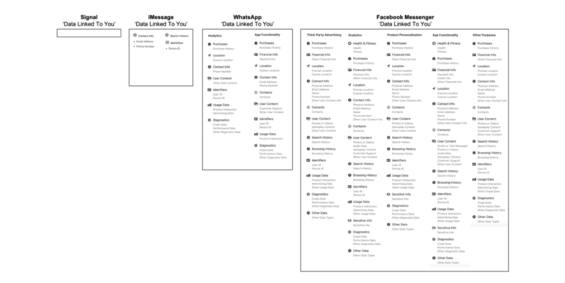
pCloud did an analysis of the Apple app privacy labels and shows the most 'Invasive' apps collecting your data

No, Facebook is actually in second place, but second to one of its other family members, Instagram. And yes Microsoft's LinkedIn is right up there in number 3 place. A better privacy respecting alternative to Instagram is Pixelfed.
Apps that collect data for third-party use do so for targeting purposes, sharing the info across different apps and websites. Apps also collect data to market their own products, with Facebook and Instagram again collecting the most data in this category.
One could argue though with this list that if a particular privacy category shown, has a higher weighting, then that would of course skew the scoring and the order somewhat differently.
See App Privacy Study Looks at Most 'Invasive' Apps Collecting User Data

https://www.macrumors.com/2021/03/16/app-privacy-study-most-invasive-apps/ https://squeet.me/objects/962c3e108d63304cf9c4f92672fed3d3da67ffc5

App Privacy Study Looks at Most 'Invasive' Apps Collecting User Data

With App Privacy labels now available for many of the top apps in the App Store, pCloud earlier this month took a look at the most "invasive"...

Apple to Deliver โ€˜Privacy Labelsโ€™ for Apps, Revealing Data-Sharing Details - Developers will have to reveal how data is shared with any โ€œthird-party partners,โ€ which include a... https://threatpost.com/apple-privacy-labels-apps-data-sharing/161081/ #privacypolicies #mobilesecurity #privacylabels #thirdparties #datasharing #developers #mobileapps #appstore #privacy #apple #dec.8 #macos #apps #ios
Apple to Deliver 'Privacy Labels' for Apps, Revealing Data-Sharing Details

Developers will have to reveal how data is shared with any โ€œthird-party partners,โ€ which include analytics tools, advertising networks, third-party SDKs or other external vendors.

Threatpost - English - Global - threatpost.com