MK-UNet: Multi-kernel Lightweight CNN for Medical Image Segmentation

Md Mostafijur Rahman, Radu Marculescu
https://arxiv.org/abs/2509.18493 https://arxiv.org/pdf/2509.18493 https://arxiv.org/html/2509.18493

arXiv:2509.18493v1 Announce Type: new
Abstract: In this paper, we introduce MK-UNet, a paradigm shift towards ultra-lightweight, multi-kernel U-shaped CNNs tailored for medical image segmentation. Central to MK-UNet is the multi-kernel depth-wise convolution block (MKDC) we design to adeptly process images through multiple kernels, while capturing complex multi-resolution spatial relationships. MK-UNet also emphasizes the images salient features through sophisticated attention mechanisms, including channel, spatial, and grouped gated attention. Our MK-UNet network, with a modest computational footprint of only 0.316M parameters and 0.314G FLOPs, represents not only a remarkably lightweight, but also significantly improved segmentation solution that provides higher accuracy over state-of-the-art (SOTA) methods across six binary medical imaging benchmarks. Specifically, MK-UNet outperforms TransUNet in DICE score with nearly 333$\times$ and 123$\times$ fewer parameters and FLOPs, respectively. Similarly, when compared against UNeXt, MK-UNet exhibits superior segmentation performance, improving the DICE score up to 6.7% margins while operating with 4.7$\times$ fewer #Params. Our MK-UNet also outperforms other recent lightweight networks, such as MedT, CMUNeXt, EGE-UNet, and Rolling-UNet, with much lower computational resources. This leap in performance, coupled with drastic computational gains, positions MK-UNet as an unparalleled solution for real-time, high-fidelity medical diagnostics in resource-limited settings, such as point-of-care devices. Our implementation is available at https://github.com/SLDGroup/MK-UNet.

toXiv_bot_toot

MK-UNet: Multi-kernel Lightweight CNN for Medical Image Segmentation

In this paper, we introduce MK-UNet, a paradigm shift towards ultra-lightweight, multi-kernel U-shaped CNNs tailored for medical image segmentation. Central to MK-UNet is the multi-kernel depth-wise convolution block (MKDC) we design to adeptly process images through multiple kernels, while capturing complex multi-resolution spatial relationships. MK-UNet also emphasizes the images salient features through sophisticated attention mechanisms, including channel, spatial, and grouped gated attention. Our MK-UNet network, with a modest computational footprint of only 0.316M parameters and 0.314G FLOPs, represents not only a remarkably lightweight, but also significantly improved segmentation solution that provides higher accuracy over state-of-the-art (SOTA) methods across six binary medical imaging benchmarks. Specifically, MK-UNet outperforms TransUNet in DICE score with nearly 333$\times$ and 123$\times$ fewer parameters and FLOPs, respectively. Similarly, when compared against UNeXt, MK-UNet exhibits superior segmentation performance, improving the DICE score up to 6.7% margins while operating with 4.7$\times$ fewer #Params. Our MK-UNet also outperforms other recent lightweight networks, such as MedT, CMUNeXt, EGE-UNet, and Rolling-UNet, with much lower computational resources. This leap in performance, coupled with drastic computational gains, positions MK-UNet as an unparalleled solution for real-time, high-fidelity medical diagnostics in resource-limited settings, such as point-of-care devices. Our implementation is available at https://github.com/SLDGroup/MK-UNet.

arXiv.org
tredition SHOP

Im tredition SHOP findest du Mainstream- und Special-Interest-Bücher. Sie kommen von unseren Autoren, die sie selbst bei uns veröffentlicht haben.

Knowledge-aware Evolutionary Graph Neural Architecture Search

Chao Wang, Jiaxuan Zhao, Lingling Li, Licheng Jiao, Fang Liu, Xu Liu, Shuyuan Yang
https://arxiv.org/abs/2411.17339 https://arxiv.org/pdf/2411.17339 https://arxiv.org/html/2411.17339

arXiv:2411.17339v1 Announce Type: new
Abstract: Graph neural architecture search (GNAS) can customize high-performance graph neural network architectures for specific graph tasks or datasets. However, existing GNAS methods begin searching for architectures from a zero-knowledge state, ignoring the prior knowledge that may improve the search efficiency. The available knowledge base (e.g. NAS-Bench-Graph) contains many rich architectures and their multiple performance metrics, such as the accuracy (#Acc) and number of parameters (#Params). This study proposes exploiting such prior knowledge to accelerate the multi-objective evolutionary search on a new graph dataset, named knowledge-aware evolutionary GNAS (KEGNAS). KEGNAS employs the knowledge base to train a knowledge model and a deep multi-output Gaussian process (DMOGP) in one go, which generates and evaluates transfer architectures in only a few GPU seconds. The knowledge model first establishes a dataset-to-architecture mapping, which can quickly generate candidate transfer architectures for a new dataset. Subsequently, the DMOGP with architecture and dataset encodings is designed to predict multiple performance metrics for candidate transfer architectures on the new dataset. According to the predicted metrics, non-dominated candidate transfer architectures are selected to warm-start the multi-objective evolutionary algorithm for optimizing the #Acc and #Params on a new dataset. Empirical studies on NAS-Bench-Graph and five real-world datasets show that KEGNAS swiftly generates top-performance architectures, achieving 4.27% higher accuracy than advanced evolutionary baselines and 11.54% higher accuracy than advanced differentiable baselines. In addition, ablation studies demonstrate that the use of prior knowledge significantly improves the search performance.

Knowledge-aware Evolutionary Graph Neural Architecture Search

Graph neural architecture search (GNAS) can customize high-performance graph neural network architectures for specific graph tasks or datasets. However, existing GNAS methods begin searching for architectures from a zero-knowledge state, ignoring the prior knowledge that may improve the search efficiency. The available knowledge base (e.g. NAS-Bench-Graph) contains many rich architectures and their multiple performance metrics, such as the accuracy (#Acc) and number of parameters (#Params). This study proposes exploiting such prior knowledge to accelerate the multi-objective evolutionary search on a new graph dataset, named knowledge-aware evolutionary GNAS (KEGNAS). KEGNAS employs the knowledge base to train a knowledge model and a deep multi-output Gaussian process (DMOGP) in one go, which generates and evaluates transfer architectures in only a few GPU seconds. The knowledge model first establishes a dataset-to-architecture mapping, which can quickly generate candidate transfer architectures for a new dataset. Subsequently, the DMOGP with architecture and dataset encodings is designed to predict multiple performance metrics for candidate transfer architectures on the new dataset. According to the predicted metrics, non-dominated candidate transfer architectures are selected to warm-start the multi-objective evolutionary algorithm for optimizing the #Acc and #Params on a new dataset. Empirical studies on NAS-Bench-Graph and five real-world datasets show that KEGNAS swiftly generates top-performance architectures, achieving 4.27% higher accuracy than advanced evolutionary baselines and 11.54% higher accuracy than advanced differentiable baselines. In addition, ablation studies demonstrate that the use of prior knowledge significantly improves the search performance.

arXiv.org

Welcome to the book “Angular Routing”.
In this book, I explain everything you need to know about Angular routing.
Routing helps you to change what the user sees in a single-page app.
By the end of this book, you will be confident working with routing in your Angular application and be able to handle all kinds of scenarios.
Let us get started.

#angularrouting #guards #resolvers #canActivate #pathmatch #params #queryparams #nestedroutes #scrollpositionrestration #routerevents #routertracing

Multi-objective Neural Architecture Search by Learning Search Space Partitions

Yiyang Zhao, Linnan Wang, Tian Guo
https://arxiv.org/abs/2406.00291 https://arxiv.org/pdf/2406.00291

arXiv:2406.00291v1 Announce Type: new
Abstract: Deploying deep learning models requires taking into consideration neural network metrics such as model size, inference latency, and #FLOPs, aside from inference accuracy. This results in deep learning model designers leveraging multi-objective optimization to design effective deep neural networks in multiple criteria. However, applying multi-objective optimizations to neural architecture search (NAS) is nontrivial because NAS tasks usually have a huge search space, along with a non-negligible searching cost. This requires effective multi-objective search algorithms to alleviate the GPU costs. In this work, we implement a novel multi-objectives optimizer based on a recently proposed meta-algorithm called LaMOO on NAS tasks. In a nutshell, LaMOO speedups the search process by learning a model from observed samples to partition the search space and then focusing on promising regions likely to contain a subset of the Pareto frontier. Using LaMOO, we observe an improvement of more than 200% sample efficiency compared to Bayesian optimization and evolutionary-based multi-objective optimizers on different NAS datasets. For example, when combined with LaMOO, qEHVI achieves a 225% improvement in sample efficiency compared to using qEHVI alone in NasBench201. For real-world tasks, LaMOO achieves 97.36% accuracy with only 1.62M #Params on CIFAR10 in only 600 search samples. On ImageNet, our large model reaches 80.4% top-1 accuracy with only 522M #FLOPs.

Multi-Objective Neural Architecture Search by Learning Search Space Partitions

Deploying deep learning models requires taking into consideration neural network metrics such as model size, inference latency, and #FLOPs, aside from inference accuracy. This results in deep learning model designers leveraging multi-objective optimization to design effective deep neural networks in multiple criteria. However, applying multi-objective optimizations to neural architecture search (NAS) is nontrivial because NAS tasks usually have a huge search space, along with a non-negligible searching cost. This requires effective multi-objective search algorithms to alleviate the GPU costs. In this work, we implement a novel multi-objectives optimizer based on a recently proposed meta-algorithm called LaMOO on NAS tasks. In a nutshell, LaMOO speedups the search process by learning a model from observed samples to partition the search space and then focusing on promising regions likely to contain a subset of the Pareto frontier. Using LaMOO, we observe an improvement of more than 200% sample efficiency compared to Bayesian optimization and evolutionary-based multi-objective optimizers on different NAS datasets. For example, when combined with LaMOO, qEHVI achieves a 225% improvement in sample efficiency compared to using qEHVI alone in NasBench201. For real-world tasks, LaMOO achieves 97.36% accuracy with only 1.62M #Params on CIFAR10 in only 600 search samples. On ImageNet, our large model reaches 80.4% top-1 accuracy with only 522M #FLOPs.

arXiv.org

Mounds No. 4 is the latest variation of my Mounds series. This is 100% code, using #p5js and fx(lens). I have fun doing projects like this, coming up with different fills.

18/100 minted, 2.5 tez per ticket.

https://www.fxhash.xyz/generative/27292
#fxhash #params #patterns #mounds

Mounds No. 4 — fxhash

This project is an exploration of patterns, fills, and masks. Each mint takes a simple pallet, usually five colors, and various fills and patterns to create the scene. Params -----------------------

TODAY (March 31) at 9:00 PM CET my generative token "nd-genuary32nd-plants-chatgpt3-001" will be released on #fxhash.

The foundation was built by using #ChatGPT and this is the result of me transforming that code into a NFT.

https://www.fxhash.xyz/generative/slug/nd-genuary32nd-plants-chatgpt3-001

#generativeart #genart #nd #chatgpt3 #plants #flower #sun #midnight #nerddisco #agpl #opensource #aiinfluenced #canvas2d #params #javascript #generative #nft #crypto #tezos #blockchain #genart #art #mastoart

nd-genuary32nd-plants-chatgpt3-001 — fxhash

## Disclaimer This artwork is partially generated by AI, and I seek to be as transparent as possible about the human and machine contributions. ## From idea to foundation For GENUARY32nd I wanted t

The NFT itself will be released on March 31 at 9:00 PM CET on
#fxhash and it’s limited to 32 editions because of #genuary32nd. It's also using #params, so make sure to check it out 🙏

https://www.fxhash.xyz/generative/slug/nd-genuary32nd-plants-chatgpt3-001

25% will go to #TezQuakeAid

nd-genuary32nd-plants-chatgpt3-001 — fxhash

## Disclaimer This artwork is partially generated by AI, and I seek to be as transparent as possible about the human and machine contributions. ## From idea to foundation For GENUARY32nd I wanted t

I'm also curious how people are using dry-validation/dry-schema/dry-struct to handle sinatra params from forms or sidekiq job arguments. Do people use the dry-* libraries directly, or do they use one of the other plugin libraries such as sinatra-validation, sinatra-dry_params, or sidekiq-dry?
https://github.com/IzumiSy/sinatra-validation
https://github.com/tiev/sinatra-dry_param
https://github.com/zorbash/sidekiq-dry
#dryrb #sinatra #sidekiq #params
GitHub - IzumiSy/sinatra-validation: Validation helper for Sinatra powered with dry-validation

Validation helper for Sinatra powered with dry-validation - GitHub - IzumiSy/sinatra-validation: Validation helper for Sinatra powered with dry-validation

GitHub

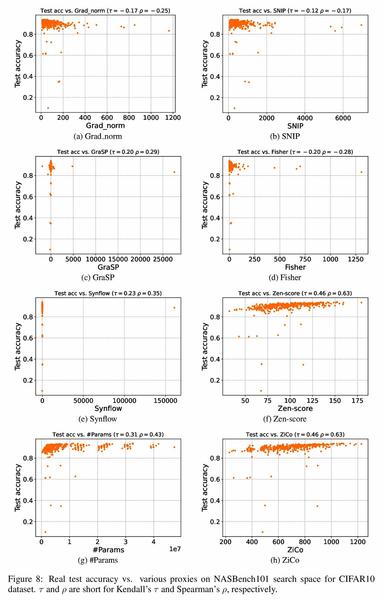
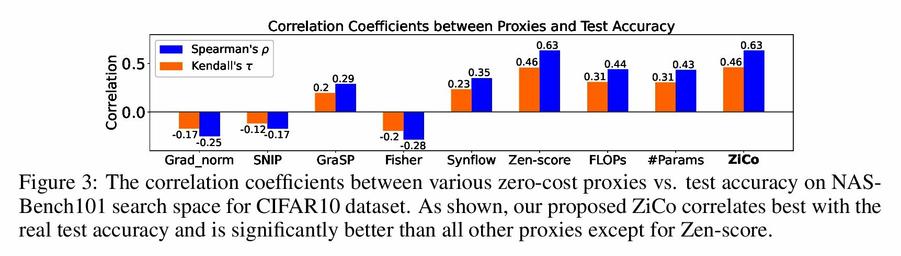
📝 ZiCo: Zero-Shot NAS via Inverse Coefficient of Variation on Gradients 🧠

"ZiCo is the first training-free proxy that works consistently better than the number of network parameters (#Params), the previous SOTA training-free proxy." [gal30b+] 🤖 #LG

🔗 https://arxiv.org/abs/2301.11300v1 #arxiv

ZiCo: Zero-shot NAS via Inverse Coefficient of Variation on Gradients

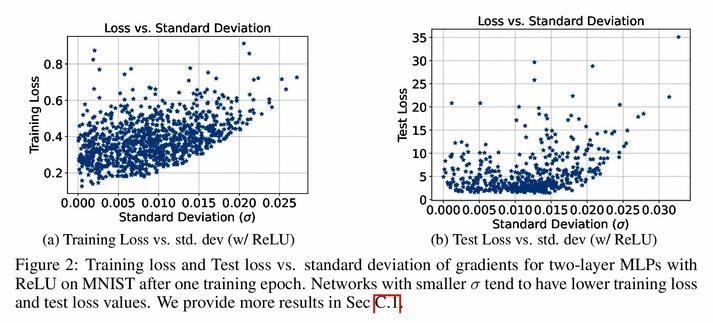
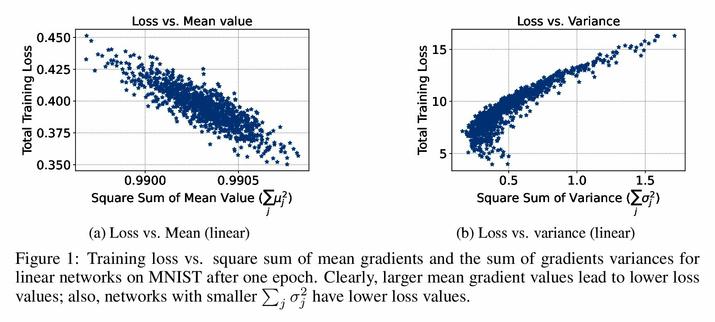
Neural Architecture Search (NAS) is widely used to automatically obtain the neural network with the best performance among a large number of candidate architectures. To reduce the search time, zero-shot NAS aims at designing training-free proxies that can predict the test performance of a given architecture. However, as shown recently, none of the zero-shot proxies proposed to date can actually work consistently better than a naive proxy, namely, the number of network parameters (#Params). To improve this state of affairs, as the main theoretical contribution, we first reveal how some specific gradient properties across different samples impact the convergence rate and generalization capacity of neural networks. Based on this theoretical analysis, we propose a new zero-shot proxy, ZiCo, the first proxy that works consistently better than #Params. We demonstrate that ZiCo works better than State-Of-The-Art (SOTA) proxies on several popular NAS-Benchmarks (NASBench101, NATSBench-SSS/TSS, TransNASBench-101) for multiple applications (e.g., image classification/reconstruction and pixel-level prediction). Finally, we demonstrate that the optimal architectures found via ZiCo are as competitive as the ones found by one-shot and multi-shot NAS methods, but with much less search time. For example, ZiCo-based NAS can find optimal architectures with 78.1%, 79.4%, and 80.4% test accuracy under inference budgets of 450M, 600M, and 1000M FLOPs, respectively, on ImageNet within 0.4 GPU days. Our code is available at https://github.com/SLDGroup/ZiCo.

arXiv.org