Nice new paper of the Quest for Orthologs consortium, addressing 5 timely challenges:
• Ortholog Search Across Tens of Thousands of Genomes
• Tracking Functional Changes of Orthologs
• Orthology Inference off the Beaten Track
• Integrating Orthology With Protein Structure
• Making Orthology Inferences FAIR
with @dessimoz and many others #ortholog #orthology #bioinformatics
https://academic.oup.com/gbe/article/16/10/evae224/7822254
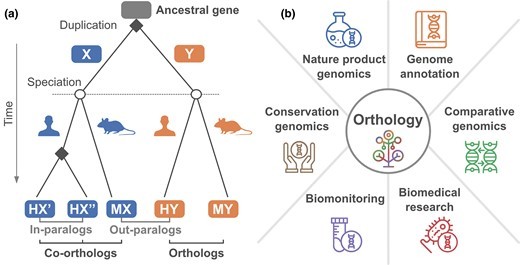
Quest for Orthologs in the Era of Biodiversity Genomics

Abstract. The era of biodiversity genomics is characterized by large-scale genome sequencing efforts that aim to represent each living taxon with an assemb

OUP Academic
Thanks to the keen eyes of the reviewers we were able to fix a colour palette issue in the local synteny view https://f1000research.com/articles/12-936 DrosOMA: the #Drosophila Orthologous Matrix browser #genome #genomics #orthology #evolution https://drosoma.unil.ch/oma/home/
F1000Research Article: DrosOMA: the <i>Drosophila</i> Orthologous Matrix browser.

Read the latest article version by Antonin Thiébaut, Adrian M. Altenhoff, Giulia Campli, Natasha Glover, Christophe Dessimoz, Robert M. Waterhouse, at F1000Research.

💡 Why choose OMA? Unique in its comprehensive orthology analysis, OMA offers unparalleled depth in prokaryotic & eukaryotic coverage, ancestral genome insights, and a suite of specialized tools. A one-stop solution for comparative genomics! #Orthology #OMAdvantage #OMAUpdate2024

Another phylogenetic controversy: are Arachnida actually monophyletic?

I am puzzled by this Ballesteros et al 2022 article:
https://academic.oup.com/mbe/article/39/2/msac021/6522129

Traditionally, horseshoe crabs (Xiphosura) are viewed as the closest parent of arachnids, but here they find that they are nested within, when coping for artefacts (saturation, taxon occupancy)...

I'm not expert of arachnids, but this does not seem in line with the fossil record, so what's wrong, #orthology again?

#phylogenetics #phylogenomics

Comprehensive Species Sampling and Sophisticated Algorithmic Approaches Refute the Monophyly of Arachnida

Abstract. Deciphering the evolutionary relationships of Chelicerata (arachnids, horseshoe crabs, and allied taxa) has proven notoriously difficult, due to their

OUP Academic
What is the best way to visualize the results of gene Gain/Loss in #evolution and #genomics research nowadays? I do have a phylogenetic tree from complete genomes and an #orthology analysis but I don't see a nice way to make a figure...
#phylogenetics #phylogenomics and #Evolution researchers...
A great group of enthusiastic students getting to grips with concepts and applications with #orthology for comparative #genomics at the Český Krumlov Workshop on Genomics 2023 https://evomics.org/2023-workshop-on-genomics-cesky-krumlov/
2023 Workshop on Genomics, Cesky Krumlov - Evolution and Genomics

The 2023 Workshop on Genomics is being held from the 14th to the 27th of May, 2023 in Český Krumlov, Czech Republic. This is the 12th time the Workshop of Genomics will be held in the Czech Republic, and the second time it will be organized in spring time.

Evolution and Genomics
A great deal of work and working with some really tiny critters so hard to get good #DNA but some great first insights into these dangerous invisibles https://journals.plos.org/plosntds/article?id=10.1371/journal.pntd.0010862 #insect #genome #vector
Working on this #phylogeny was particularly interesting given the uncertainties and how things jumped around so much depending on which #genes were used. #Bioinformatics #orthology
Genomic analysis of two phlebotomine sand fly vectors of leishmania from the new and old World

Author summary The leishmaniases are a group of neglected tropical diseases caused by protist parasites from the Genus Leishmania. Different Leishmania species present a wide clinical profile, ranging from mild, often self-resolving cutaneous lesions that can lead to protective immunity, to severe metastatic mucosal disease, to visceral disease that is ultimately fatal. Leishmania parasites are transmitted by the bites of sand flies, and as no approved human vaccine exists, available drugs are toxic and/or expensive and parasite resistance to them is emerging, new dual control strategies to combat these diseases must be developed, combining interventions on human infections and integrated sand fly population management. Effective vector control requires a comprehensive understanding of the biology of sand flies. To this end, we sequenced and annotated the genomes of two sand fly species that are important leishmaniasis vectors from the Old and New Worlds. These genomes allow us to better understand, at the genetic level, processes important in the vector biology of these species, such as finding hosts, blood-feeding, immunity, and detoxification. These genomic resources highlight the driving forces of evolution of two major Leishmania vectors and provide foundations for future research on how to better prevent leishmaniasis by control of the sand fly vectors.

Multifaceted quality assessment of #gene repertoire annotation with OMArk https://biorxiv.org/cgi/content/short/2022.11.25.517970v1 #biorxiv #orthology #genomics
I am NO super-expert on #orthology inference and #sequencehomology, nor #DGEanalysis, but... if I am to believe my eyes with this paper I'm reading... I am pretty scared of what is being published out there!