Leftist and rightists both updated their beliefs on political and non-political issues in the face of counter-evidence to the same degree.
Individual differences in threat sensitivity also did not play a role.
https://onlinelibrary.wiley.com/doi/full/10.1002/ejsp.2965
@socialpsych @politicalscience #research #ideology #psych #newpsychresearch #socpsych #politics
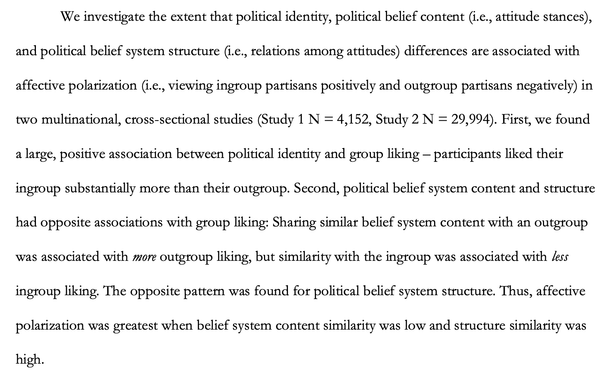
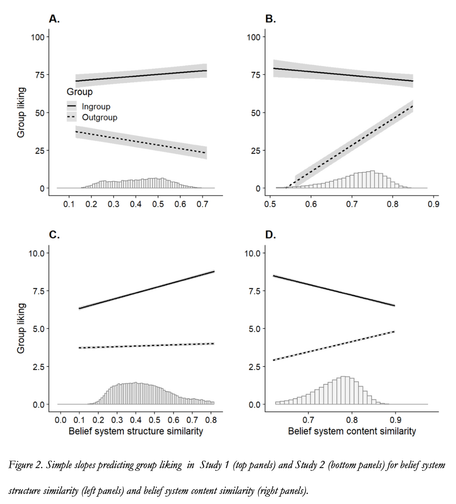
People like political ingroups more than outgroups around the world
This gap is widened when people share belief system *structure* and narrowed when they share belief system *content*
Felicity Turner-Zwinkels, Jochem van Noord, Rebekka Kesberg and many more!
https://osf.io/he2ay
#newresearch #politics #polarization #polisci #sociology #socPsych #newpsychresearch @socialpsych @politicalscience @orgbehavior
The salience of infectious disease (COVID) was not associated with increased xenophobia in the Netherlands
https://psyarxiv.com/wm4qy/
#socpsych #polpsych #covid #covid19 #prejudice #Netherlands #research #newpsychresearch
Loneliness is more painful when we are with other people than when they are alone.
Social contact does not necessarily help people cope with loneliness.
https://link.springer.com/article/10.1007/s10902-023-00661-3
#newpsychresearch #psychology #loneliness #newresearch #socpsych #wellbeing #happiness

Alone in a Crowd: Is Social Contact Associated with Less Psychological Pain of Loneliness in Everyday Life? - Journal of Happiness Studies
People are often advised to engage in social contact to cope with the experience of loneliness and improve well-being. But are the moments of loneliness actually more bearable when spent in other people’s company? In this research, we proposed and tested two conflicting theoretical accounts regarding the role of social contact: social contact is associated with a stronger (the amplifying account) or with a weaker (the buffering account) negative effect of loneliness on psychological well-being. Analyses of three datasets collected using ecological momentary assessments (Nindividuals = 3,035) revealed that the negative association between loneliness and well-being was stronger when participants were with others than alone, consistent with the amplifying account. Further, when participants experienced high levels of loneliness, being with others was associated with the same or with even a lower level of well-being than being alone. These findings suggest that simply spending time with others (vs. alone) is not associated with a reduced burden of loneliness and may even backfire.
Liberals and conservative use similar moral words, but they attach different meanings to those words
Maybe seems obvious, but suggests that moral politics is a competition over *meaning* and not promoting specific values
It also has implications for how we think about and use (or don't use) dictionary methods for understanding morality in text and speech.
https://www.cambridge.org/core/journals/british-journal-of-political-science/article/abs/lexical-ambiguity-in-political-rhetoric-why-morality-doesnt-fit-in-a-bag-of-words/BF369893D8B6B6FDF8292366157D84C1
#polisci #newresearch #newpaper #morality #socpsych #newpsychresearch @socialpsych @politicalscience #textasdata

Lexical Ambiguity in Political Rhetoric: Why Morality Doesn't Fit in a Bag of Words | British Journal of Political Science | Cambridge Core
Lexical Ambiguity in Political Rhetoric: Why Morality Doesn't Fit in a Bag of Words
It's ok if you're different from your partner
Similarity in personality does not predict life or relationship satisfaction of partners.
https://www.sciencedirect.com/science/article/pii/S0092656623000405
#newpaper #personality #romance #newpsychresearch #relationships #happiness

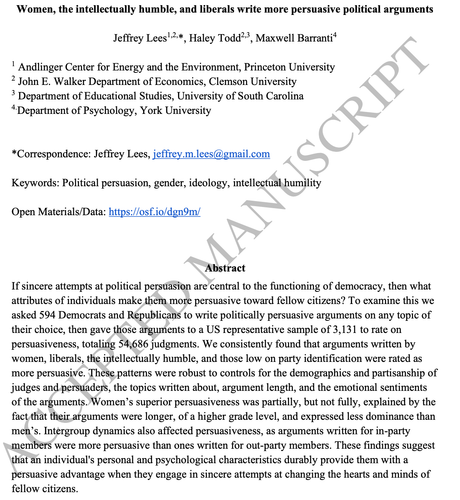
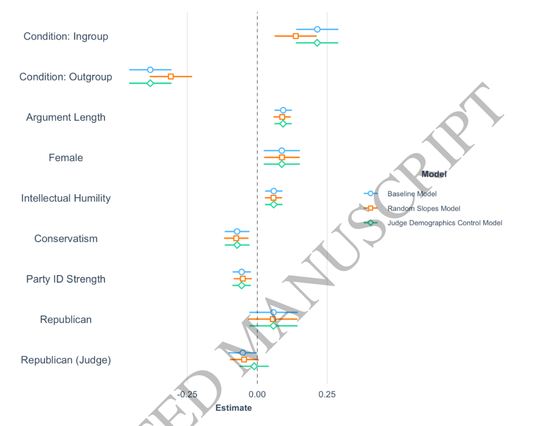
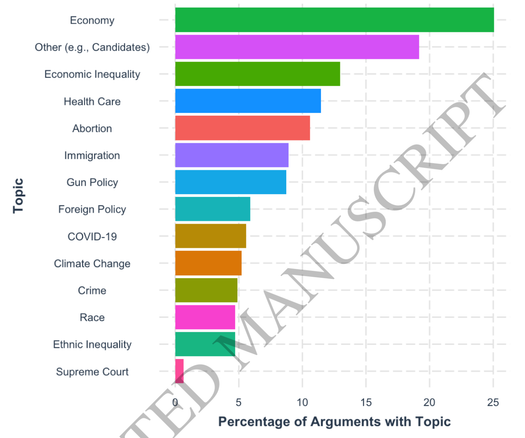
Women, the intellectually humble, and liberals write more persuasive political arguments
Abstract. If sincere attempts at political persuasion are central to the functioning of democracy, then what attributes of individuals make them more persuasive
 mark
mark