Has anyone messed with synced lyrics before for music?  I started playing with Chronograph and swiftly started falling into an LRC file rabbit hole (I haven't played with their new bespoke file format yet).

One thing I can't figure out is how you're meant to denote stanzas. I figured you'd just leave a blank line between stanzas, but I don't see anyone else on LRCLib doing that and Jellyfin ignores empty lines entirely. I figured out you could just put a timecode followed by an empty line and Jellyfin renders it correctly, but I'm not sure if that's the proper way to do it and I don't wanna upload bad LRC files to LRCLib.

Any thoughts on stanzas for LRC files? Should Jellyfin be showing the line breaks, is a timecode followed by an empty line the proper way to do it, or should LRC files just not have a way to denote stanzas? This is super niche so I'm not expecting a reply, but it'd be super appreciated if I got one. 

#Lyrics #LRC #LRCLib #MusicTagging #Metadata #Jellyfin #Chronograph #FOSS

Install Chronograph on Linux | Flathub

Sync lyrics of your loved songs

#3GoodThings @3goodthings
Three good things this day.

1. My replacement #CPAP mask arrived! I am looking forward to better sleep tonight. (Old mask is semi-functional, I think something snapped somewhere.)
2. I have managed to add a "Mood" field to my #MusicTagging script (#ID3 tags version 2.4) and to my music files. One more thing crossed off my to-do list.
3. That, despite the Industrial Revolution, many cottage #crafts have not died out; whether due to sustained traditions or to rediscovery, it is good.

"Finally, brothers, whatever is true, whatever is honourable, whatever is just, whatever is pure, whatever is lovely, whatever is of good repute, if there is any excellence, if there is anything worthy of praise, let your mind dwell on these things." - Philippians 4:8

For users of Yate, the single greatest music-tagging app ever made (sadly Mac only):

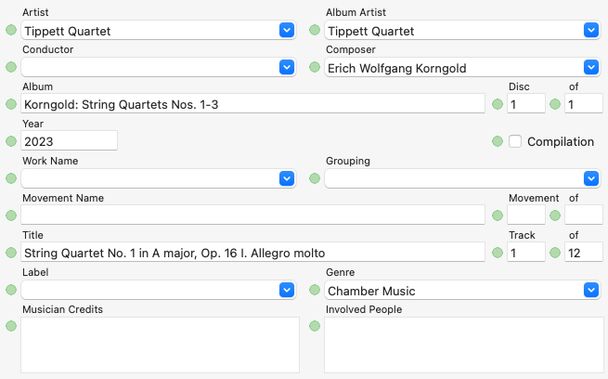
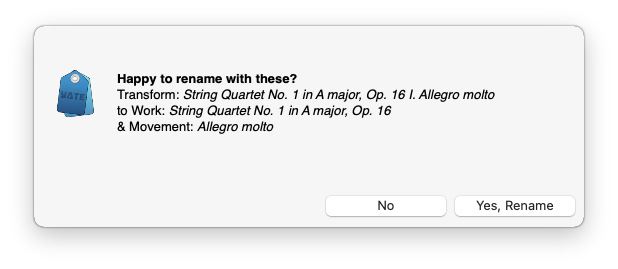
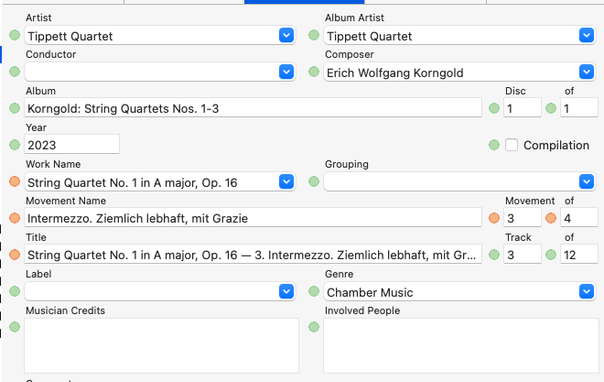
I have made an action set which will automagically parse Work and Movement related tags from reasonably-formatted titles, as are usually provided from external sources. This allows players which support it to display a much more classical-music-oriented interface which allows the grouping of tracks by Works, and numbering of Movements separately to tracks and discs. It uses the "common prefix" of the track titles to detect the work name.

Screenshots show a demo picked at random from my "to sort" folder.

It is capable of correctly handling titles containing:

  • punctuation separating work and movement names, including dashes, commas, colons, or even only a space
  • decimal and roman numeral movement numbers, with variety of punctuation, between work and movement
  • no movement numbering, including words that start with valid roman numerals.
  • work and movement names containing all manner of punctuation marks.#MusicTagging #Yate

Poor schemas, poor cataloguing: why music tagging sucks

One common issue that many music enthusiasts face with their local music library is the tedious process of tagging. While tools like beets or MusicBrainz Picard can help streamline the process, there are still fundamental issues with the design of tags for music and the way they are applied. This not only makes exploring music more difficult, but it also limits the potential of our music collections and leaves many opportunities untapped.

The current state of music tagging leaves much to be desired. Tagging schemas are often incomplete, inconsistent, and incorrect, making it difficult to navigate music libraries and discover new music. This hinders the ability to find what you're looking for and prevents full exploration of the potential of music libraries.

https://sporks.space/2023/02/18/poor-schemas-poor-cataloguing-why-music-tagging-sucks/

#musiclibrary #musiccollection #musicmetadata #musicorganization #musicdiscovery #musicenthusiast #beets #musicbrainzpicard #musictechnology #musictagging #musictags #musicproblems #musicfrustrations #musicstreaming #musicstorage #localmusiclibrary #musicsearching #musicexploration

Poor schemas, poor cataloguing: why music tagging sucks - the sporks space

One of the things that frustrates me with having a local music library is the tedium of tagging. While there are tools (like beets or MusicBrainz Picard) to make it easier, I feel there are fundamental issues with the design… Continue reading →

the sporks space