An Awful Endurance: the thread about the seizure of “SS Alster” and the sinking of “Empire Endurance”
Sometimes I go looking for interesting rabbit holes to go down in the hopes of finding a story. Sometimes people send me the strand that will lead me to a thread of the story. And sometimes unique and unusual inspiration just drops itself straight into my inbox, begging to be looked into.
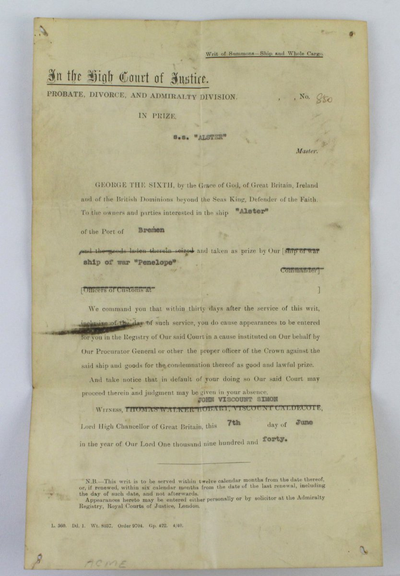
You see way back whenever, I set up email alerts for online auction houses with the words “Edinburgh” or “Leith“, to keep a watchful eye on whatever interesting objets may be coming up for sale with those words in the listing. Mainly it’s sets of Edinburgh Crystal, kitsch Duke of Edinburgh memorabilia or job lots of Prue Leith cookbooks: but sometimes it will be something unusual. Very occasionally it’s something very unusual indeed, something you never knew you were looking for until it arrived in your email at 3:30AM one morning. And today’s Auction House Artefact is one such, because it is the original “Writ of Summons” from the WW2 seizure of the German merchant ship SS Alster in Leith in June 1940: the prize rules dictating that the officer who served this writ had to board the vessel and nail this very paper to its mast!
Writ of Summons for the seizure of SS Alster, Leith, June 13th 1940.
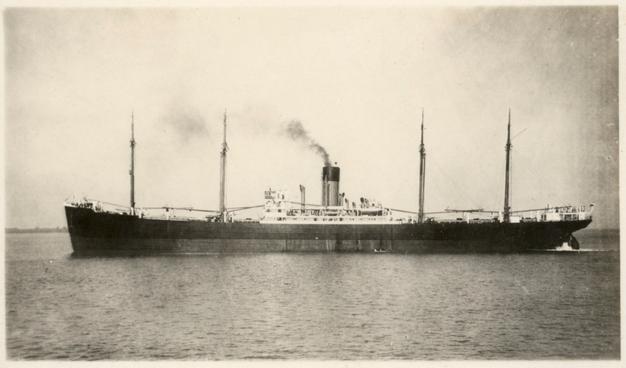
The Alster was a 12,000 deadweight tonnage cargo ship of the German Norddeutscher Lloyd line (NDL). Built in Hamburg in 1927, she was intended to sail the routes between Bremen, Australia and the far east. Her name is taken from a tributary river of the Elbe which flows through the city and port of Hamburg.
SS Alster in 1929, postcard in the Ernest G. Best collection, Mitchell Library, State Library of New South Wales PXE 722/120
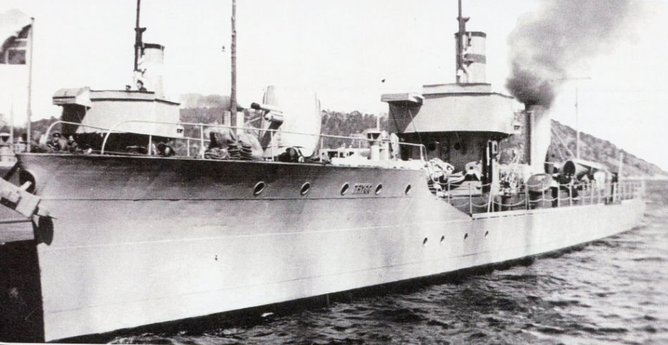
The ship was requisitioned by the Kriegsmarine (German Navy) in 1940 in advance of the German invasion of Norway. She surreptitiously departed for that country on April 3rd, destination Narvik, loaded up with military supplies. On board were guns, ammunition, 80 lorries, thousands of tons of coke fuel, food, hundreds of tons of hay for horses and even toys to distribute to children in a hearts and minds effort. She arrived in Norwegian waters under cover of being a regular merchant ship four days before the invasion proper began in order that she would be in position and ready to supply the landing. The old Norwegian torpedo boat Trygg was deceived and cleared her to pass and escorted her towards land.
Norwegian Navy torpedo boat Trygg
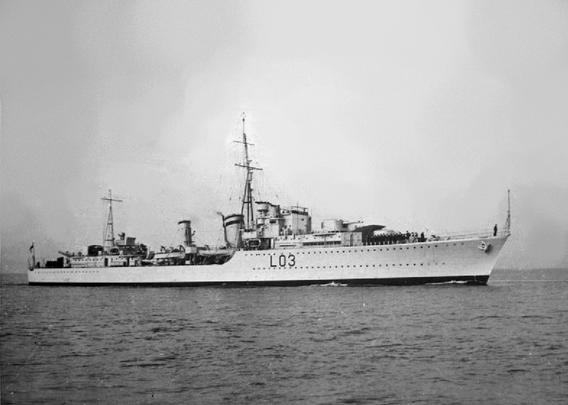
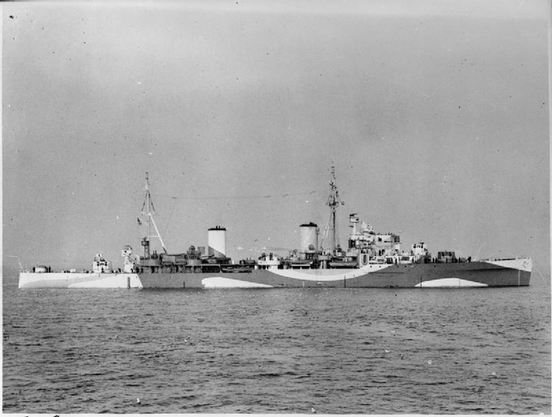
On the 8th April Alster reached Vestfjorden and was warned off of a British minefield by a Norwegian patrol boat Syrian. This latter vessel, a converted trawler inspected the Alster and– deciding there was nothing odd about this heavily laden German merchant ship – let her pass on her way to Bodø. When war officially broke out two days later the Syrian caught up with Alster once again but, worried that the much larger ship was probably armed and carrying German troops, decided that discretion was the better part of valour and stood off. Instead, as the Alster plodded off at her leisurely top speed of 14 knots, Syrian passed the details to the Royal Navy instead. Realising the value of the thousands of tons of supplies in the merchantman, a force was quickly dispatched to capture her, consisting of the cruiser HMS Penelope and four destroyers led by HMS Icarus.
HMS Penelope in 1942. Photograph FL4822 from the collection of the Imperial War Museums (collection no. 8308-29)
On paper it was a hugely one-sided fight stacked in the favour of the Royal Navy, but things very quickly started to go wrong. The Penelope ran into a few navigational difficulties which caused her to run into the island of Fleinvær on April 11th. The big destroyer HMS Eskimo managed to pull the damaged ship free and, with the assistance of Norwegian tugs, on to Skjelfjorden where temporary repairs could be made. She would limp back to the UK and be out of the war for 14 months, requiring an extensive rebuild below the water line.
The crippled HMS Penelope being shepherded by Norwegian tugs in Skjelfjorden.
The next day it was Eskimo, erstwhile saviour of Penelope, that needed help when the German destroyer Georg Thiele hit her with a torpedo in the Second Battle of Narvik, causing a significant rearrangement and truncation of her bows. Amazingly, despite the damage, Eskimo survived, was patched up at Skjelfjorden and sent back to the Tyne to get a new front end. She was back in action within 5 months, going on to survive the war.
Eskimo after losing her bow during the Second Battle of Narvik. Photograph the War Office’s official photographer, N233 from the collections of the Imperial War Museums.
It was thus left to HMS Icarus to round up the Alster The crew of the German ship tried and failed to set of a scuttling charge and quickly found themselves British captives. The Royal Navy was surprised to find that the German captain was none other than Oskar Scharf, the Norddeutscher Lloyd line’s most senior officer and something of a celebrity in maritime circles.
HMS Icarus in 1942. © IWM FL 14022
Scharf was – or had been – the captain of the NDL transatlantic liner Europa, the pride of the fleet. He found himself on the Alster as a demotion after it proved impossible for him to work under the political supervision of the Nazi party and Robert Ley. Ley was a fanatic, close to Hitler and in charge of the German Labour Front (Deutsche Arbeitsfront, DAF).
NDL liner Europa prior to her maiden voyage. Bundesarchiv, Bild 102-09251 / CC-BY-SA 3.0
Scharf was adamant to the end of his days that he was no Nazi . Although he admitted he had joined the party for a year from 1934-35, this he said was purely in order to keep his job. His later actions would lend some credence to that position and as an old fashioned captain, he was not used to taking orders on his own ship, particularly political orders, and he was not about to change. But Scharf was also a German officer and therefore wasn’t about to hand over his ship to the Royal Navy without a struggle: six of his men would die resisting the boarding parties.
Oskar Scharf on board the NDL liner Europa before the war
The captive Alster and her crew were moved to the British advanced naval base at Skjelfjord and all the supplies and materiel aboard were turned over to the Norwegians who were more than happy to turn them against their former owners. The Royal Navy used the ship as a temporary base for repairing ships; ironically one of the first ships she would assist would be the truncated Eskimo. Scharf and his crew, still aboard, managed to make one more attempt to scuttle their ship by opening seawater valves to try and flood the ship. They failed again and the officers found themselves taken off for their trouble and locked up on other Royal Navy ships for onward transport to Scotland.
The Navy now needed a prize crew to man the Alster and as many of the men of the cruiser Penelope now found themselves without a ship to sail they were put on-board and given the task. The Germans now made multiple attempts to sink her by aerial bombing, but somehow she survived them all.
Alster under attack by German bombs, London Daily News, 11 July 1940
On April 27th, Alster arrived in Tromsø to unload the last of her supplies for the Norwegian forces defending that port. To satisfy Navy regulations the British consul observed the unloading and gave the Norwegians an official receipt. After almost a month, she was then sent on to the port of Kirkenes in the far north of the country to load 10,000 tons of iron ore to be taken to the UK. On her way south again catastrophe was narrowly averted after she was sighted and attacked by the British submarine HMS Truant. This was despite her having been made aware of the submarine’s patrol area and being given orders to avoid it, and despite messages being sent to Truant to make her aware the vessel was friendly. Fortuitously the two torpedoes fired at Alster missed and exploded harmlessly on the shore.
HMS Truant. Official Royal Navy photograph, FL22602 from the collections of the Imperial War Museums (collection no. 8308-29)
Four days after this narrow escape, she finally departed Norwegian waters for the last time and sailed across the North Sea. As well as her cargo she evacuated 209 British and 46 Norwegian military personnel, 72 German prisoners of war (her crew, minus the officers who made their way separately) and the surviving forward gun turret from HMS Eskimo, which currently had little use for it in her new configuration. British newspapers reported the capture of the Alster with great enthusiasm as there wasn’t much other good news to tell at the time, plus Captain Scharf was a high-status prisoner of war and his old ship the Europa was a household name.
A rather dejected looking Oskar Scharf arriving in Scotland as a prisoner. Daily Record, April 1940.
Alster unloaded her passengers at Scapa Flow on 31st May and arrived at the naval base of Rosyth on the Firth of Forth on June 4th. Shortly thereafter, she was sent across the Firth to Leith to unload and conclude the legal formalities of making her a prize. And so it was that Robert Robertson, a man from Morningside and a Customs & Excise Officer at the Leith Custom House, went aboard the ship on the 13th of the month and nailed the official writ to the mast. At a stroke, she officially became the property of the British Admiralty.
Detail of the Writ served by Robert Robertson on the Alster in LeithDetail of the Writ served by Robert Robertson on the Alster in Leith
The ship was now passed to the Ministry of War Transport who made her an Empire Ship, a ship owned by the Government and allocated to a British merchant shipping company to make good wartime losses. Her new managers were Alfred Booth & Co. of Liverpool. After being refitted to bring her to a British standard and being renamed SS Empire Endurance she left Southend in Convoy FN255 and started her new career in the middle of the Battle of the Atlantic, plying the dangerous waters between British ports and Canada. This she did for six months after which she was ordered to Egypt via Cape Town with a mixed load of cargo and passengers. She departed on this new journey from the Welsh port of Milford Haven on the 19th April 1941.
Early the next morning, at 3:32AM German time she was hit by a torpedo from the German submarine U73. She was far out into the Atlantic, some 425 miles southwest of Rockall, and 460 miles west of the nearest dry land on the west coast of Ireland. A second torpedo 25 minutes later broke her in two and sent her to the bottom, with the ultimate loss of 66 souls from the 95 passengers and crew on board. The Canadian warship HMCS Trillium found and picked up twenty-four survivors (sixteen merchant seamen and eight servicemen who were on board to man the guns) the next day, landing them at Greenock four days later.
Officers on the bridge of Canadian corvette HMCS Trillium. Credit National Defence – Canadian Navy Heritage website. Image Negative Number JT-159
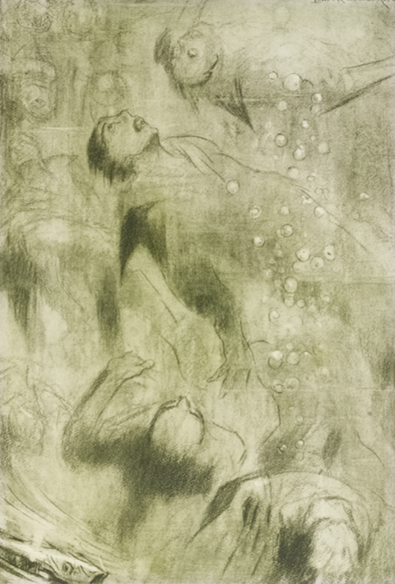
Another lifeboat had been filled with survivors but was destroyed when the second torpedo hit the ship and only one of the occupants survived. He was blown overboard but made it into a further lifeboat. Also sent into the water at this time was the Captain, William Willis R. D. Torkington, who was was also picked up. David Selwyn Davies, the Chief Officer, took charge of the survivors in this boat and was credited with pulling his injured captain aboard. For these few survivors, the name Endurance would be cruelly ironic, as they would spend the next nineteen days adrift in an open lifeboat in the North Atlantic Ocean.
“The lifeboat amongst the wreckage”, watercolour and drawing by John Kingsley Cook depicting the sinking of the
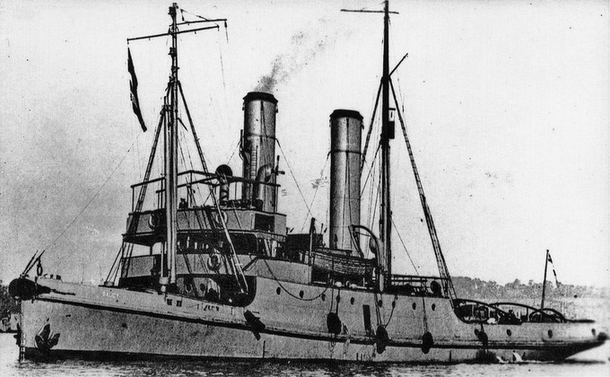
Empire Guillemot in 1941. Royal Museums Greenwich ZBA5373
As the senior ranking man in the boat, Davies took charge as best as he could. His board was not found – by the Royal Mail Line liner Highland Brigade – until the 9th of May. During this time twenty of those onboard had died and only eight remained alive, the last two on the day of rescue. Of the slim remainder who made it aboard the Highland Brigade, three more died aboard her including the Captain and Second Engineer. A fourth would die in hospital in Liverpool, leaving only four survivors from the boat. Including the first boat, only twenty souls survived from the eighty-five who had been onboard Empire Endurance. (Thank you to Kirby Grant for providing me with additional details and corrected numbers for the losses and survivors from the ship.)
MV
Highland Brigade post-war in 1946, photo taken from an aircraft. She was bound for Singapore with Indian Troops when she hit a mine and had to be brought in with the assistance of the tugs. She made it safely in to Singapore with no loss of life. IWM SE 6360
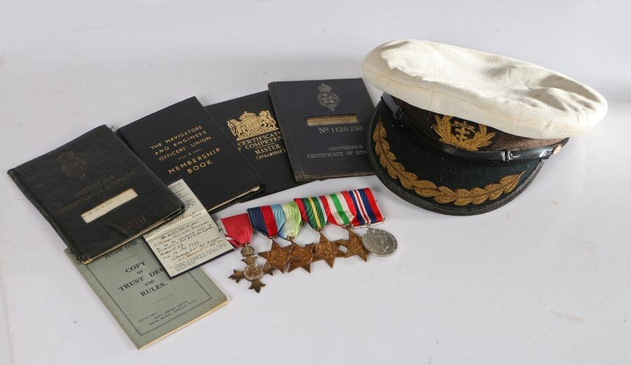
For these efforts he would receive the MBE and the Lloyd’s Medal. “No one would have lived to be rescued but for the skill, seamanship and courage of the chief officer” reported the London Gazette.
19 Days in an Open Board. Press & Journal, October 8th 1941
Oskar Scharf found himself sent to Canada for internment. Because of his seniority and because he was neither a military or political man, he was put in charge of the internees in Camp R in the pleasant lakeside township of Red Rock, Ontario. This institution had around 1,100 inmates, mainly merchant and naval seamen. Some were ardent Nazis, others were Communists, many were politically apathetic and amongst their number there were 78 Jews, interned in Britain as “enemy aliens“, including 11 of school age. Scharf is credited in a number of sources as going out of his way to protect the Jews in his charge from the Nazis within his ranks. This he did for about 6 months before the authorities came to their senses and released the Jewish inmates back to Britain in January 1941.
Scharf had an awkward balancing act to maintain between those he was in charge of and his Canadian captors – with whom he was no collaborator. He found that the Nazis in the camp went out of their way to make life difficult for him, they heckled and humiliated him for refusing to give a “Sieg Heil” after official announcements. The Canadian authorities eventually decided that Scharf posed no threat and somewhat surprisingly released him in April 1944, allowing him the option to return to Germany as a civilian. This he did, departing for home on a Swedish ship in New York and taking a dangerous and convoluted journey via Algiers, Barcelona and Marseilles. He was reunited with his family after a 4 year absence but would be interrogated by the Gestapo on-and-off until the end of the war. Nevertheless, he was given back his job and rank with NDL and put back in charge of the liner Europa which was laid up in Bremerhaven as a barracks ship.
An American photo of the camouflaged Europa in Bremerhaven in May 1945
He was still in charge of her in May 1945 when first the British and then the Americans entered Bremerhaven, capturing the port and the ship. The Americans claimed her as a war prize, Scharf symbolically handing over his pistol to an American sailor. He thus found himself in the unusual position of having not one but two of his ships boarded and taken off his hands by the Allies in the war. However the Americans had need of the Europa, commissioning her into their navy as USS Europa, for use as a transport ship repatriating servicemen from Europe back home across the Atlantic. As they didn’t know how to operate her Scharf and some of his officers were allowed to remain on board to ensure the operation of the ship. They departed for Southampton, picked up the first 4,500 men for repatriation, arriving in New York on September 24th 1945 under Scharf’s command.
USS Europa returns to New York in September 1945. Life Magazine Photo
Europa made 3 further transatlantic repatriation trips, before being laid up in her home port of Bremerhaven in May 1946 and decommissioned by the US Navy. Later that year she was allocated to France as a war reparation, and given to the Compagnie Générale Transatlantique (CGT) line, who renamed her Liberté and refitted her for post-war service as their flagship, to replace the SS Normandie which had been lost in a wartime accident.
SS Liberté in the 1950s. CC-by-SA 3.0 Frederic Logghe
Scharf resigned from the NDL after the war and took up the job of port captain of Bremerhaven, helping oversee the restoration of the docks. The post-war de-Nazification process classified him as Level II (Follower), which was the 2nd lowest level and which incurred a fine – nearly worthless as it was denominated in Reichsmarks – of 18,000 Marks. He died in 1953, aged 67.
Oskar Scharf in 1953, the year of his death. Photo by Wolfgang Scharf.
Chief Officer Selwyn Davies MBE returned home to Moreton in Cheshire, to his neat suburban house, his wife Helen and his daughter Sadie. He died at home in 1952, aged 64.
Note to readers: unfortunately in April 2026, a third-party plug-in more than exceeded its authority and broke many of the image links on this site. No images were lost but I will have to restore them page-by-page, which may take some time. In the meantime please bear with me while I go about rectifying this issue.
If you have found this site useful, informative or amusing then you can help contribute towards its running costs by supporting me on ko-fi. This includes my commitment to keeping it 100% advert and AI free for all time coming, and in helping to find further unusual stories to bring you by acquiring books and paying for research.
Or please do just share this post on social media or amongst friends and like-minded people, sites like this thrive on being shared.
Explore Threadinburgh by map:
Travelers' Map is loading...
If you see this after your page is loaded completely, leafletJS files are missing.
These threads © 2017-2026, Andy Arthur.
NO AI TRAINING: Any use of the contents of this website to “train” generative artificial intelligence (AI) technologies to generate text is expressly prohibited. The author reserves all rights to license uses of this work for generative AI training and development of machine learning language models.
#Lochend #Logan #Restalrig #StMargaret Arun Himt
 Goudomrand
 Andy Arthur - Threadinburgh
 Chris Koester
 odnewsin