 Dagmar Fraser
The first flight simulator I played was PSION Flight Simulation on the ZX spectrum in 1982.
#MATLAB #MATLABambassador 1/6
#MATLAB #MATLABambassador 1/6
Terry Pratchett gave us octarine - the magical 8th colour of the spectrum, visible only to wizards and of course cats 🐱. UC Berkeley researchers have discovered "olo" - a real colour 🎨 that exists outside standard human vision… so far visible to only 5 people in the world! ✨
#MATLAB #MATLABambassador
James Fong and colleagues used Psychtoolbox (the MATLAB toolbox that I owe my job too!) to control their RGB projector during the colour matching experiments.

Making all the right noises... MATLAB has wgn for White (Gaussian) Noise and pinknoise for Pink.. The power spectral density (PSD) of Pink is 1/f and so drops off as f increases (-10dB/dec as pictured). #MATLAB #MATLABAmbassador 1/10
https://twitter.com/dagmarfraser/status/1879294713477435423 /We did a thread/g about MATLAB becoming a 'moon' 🌙 of Jupyter earlier this year
Way back in October 2024 we had a chat about Making Noise! 🔊 #MATLAB #MATLABambassador
Making all the right noises... MATLAB has wgn for White (Gaussian) Noise and pinknoise for Pink.. The power spectral density (PSD) of Pink is 1/f and so drops off as f increases (-10dB/dec as pictured). #MATLAB #MATLABAmbassador 1/10
🧠 At the https://twitter.com/TheCHBH neuroimaging centre we use the FieldTrip toolbox for MEG/EEG analysis. Here's why this open-source powerhouse is essential for modern neuroscience... #MATLAB #MATLABAmbassador
💻 FieldTrip empowers researchers with command-line scripting for maximum flexibility. No fancy GUI to learn only to abandon when things get serious and scriptable. 1/4
🧪 For vision researchers and psychologists -- having precise control of audio & visual production is vital. You can't measure a reaction time if you don't know when a beep or flash begins! #MATLAB #MATLABAmbassador #psychtoolbox
💻 The humble PC can flash and beep, but can it be a research-grade? Maybe.. whilst high-level languages like #MATLAB are delightfully easy to use, they abstract away hardware control. Low-level languages like C give full and perilous! 1/6
📊 Delightful new preprint reveals a meta *power law* in physics! The mathematical symbols & operators we use to describe nature's laws... follow their own mathematical pattern! #MATLAB #MATLABAmbassador
(image from New Scientist)
Constantin et al. (2024) analysed equations from physics textbooks, Wikipedia's named equations, and cosmology papers. Rather than random symbol frequencies, they discovered an exponential pattern! 🤓 https://arxiv.org/abs/2408.11065 1/5
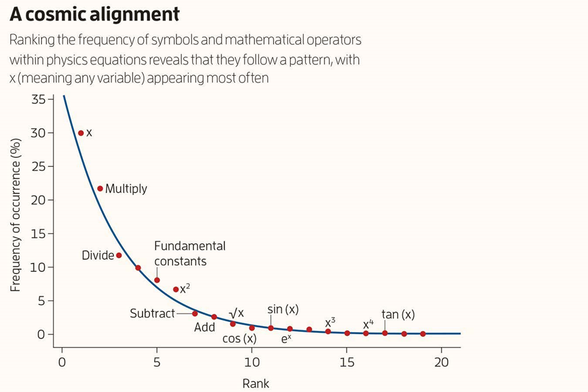

Physics, as a fundamental science, aims to understand the laws of Nature and describe them in mathematical equations. While the physical reality manifests itself in a wide range of phenomena with varying levels of complexity, the equations that describe them display certain statistical regularities and patterns, which we begin to explore here. By drawing inspiration from linguistics, where Zipf's law states that the frequency of any word in a large corpus of text is roughly inversely proportional to its rank in the frequency table, we investigate whether similar patterns for the distribution of operators emerge in the equations of physics. We analyse three corpora of formulae and find, using sophisticated implicit-likelihood methods, that the frequency of operators as a function of their rank in the frequency table is best described by an exponential law with a stable exponent, in contrast with Zipf's inverse power-law. Understanding the underlying reasons behind this statistical pattern may shed light on Nature's modus operandi or reveal recurrent patterns in physicists' attempts to formalise the laws of Nature. It may also provide crucial input for symbolic regression, potentially augmenting language models to generate symbolic models for physical phenomena. By pioneering the study of statistical regularities in the equations of physics, our results open the door for a meta-law of Nature, a (probabilistic) law that all physical laws obey.

