@rupdecat @mario_angst_sci

I've just caved and set up Google calendar and contacts access BUT I've done it through #davx5 and am using the default calendar and contacts apps which came with #lineage.

Long-term I think it would be fun to move away from having #Google manage that data for me (maybe using #radicale and #syncthing? https://forum.syncthing.net/t/how-to-sync-contacts-and-calendars-between-desktop-and-android-without-root/21326) but that can be an adventure for another day.

#lineages
#deGoogle #deGoogled #deGoogling

How to sync contacts and calendars between desktop and Android (without root)

This is a simple guide on how to synchronise contacts and calendars between a desktop operating system (Windows, macOS, Linux) and Android relying on a combination of Syncthing and Radicale. The main goal and idea is to have Radicale running on every system locally, so that you can connect with it even when there is no network connection available. This applies to both desktop operating systems and Android as well. Desktop: Install and run Radicale following instructions from https://radical...

Syncthing Community Forum
Local and introduced #lineages drive #MERS-CoV #recombination in Egyptian #camels

Genetic #reassortment and diversification of #host specificity have driven evolutionary trajectories of #lineages of #panzootic #H5N1 #influenza, https://etidiohnew.blogspot.com/2025/08/genetic-reassortment-and.html
Genetic #reassortment and diversification of #host specificity have driven evolutionary trajectories of #lineages of #panzootic #H5N1 #influenza

Co-Circulation of 2 #Oropouche Virus #Lineages during #Outbreak, #Amazon Region of #Peru, 2023–2024

Co-Circulation of 2 #Oropouche Virus #Lineages, #Amazon Basin, #Colombia, 2024

Source: Emerging Infectious Diseases Journal, AbstractIn early 2024, explosive outbreaks of Oropouche virus (OROV) linked to a novel lineage were documented in the Amazon Region of Brazil. We report the introduction of this lineage into Colombia and its co-circulation with another OROV lineage. Continued surveillance is needed to prevent further spread of OROV in the Americas. ____

https://etidioh.wordpress.com/2024/10/02/co-circulation-of-2-oropouche-virus-lineages-amazon-basin-colombia-2024/

Co-Circulation of 2 #Oropouche Virus #Lineages, #Amazon Basin, #Colombia, 2024

Source: Emerging Infectious Diseases Journal, AbstractIn early 2024, explosive outbreaks of Oropouche virus (OROV) linked to a novel lineage were documented in the Amazon Region of Brazil. We repor…

ETIDIoH

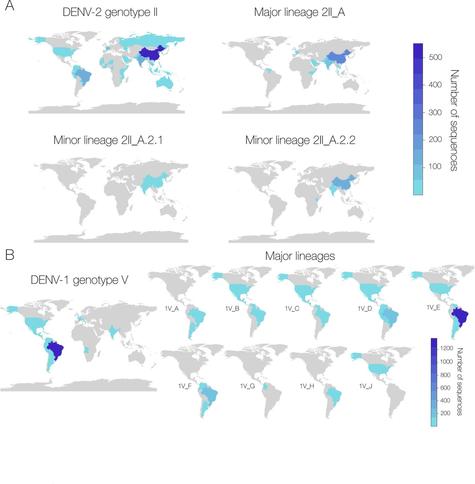
📣📣So excited to see this #Consensus View on a naming system for #Dengue #lineages!
With prevalence increasing globally and more #sequencing being done, this was really needed

It includes tools to #identify new lineages

International authorship have agreed on naming convention to aid #genomic #surveillance for
The authors have done an amazing job of reaching consensus here ⬇️⬇️

https://plos.io/47C0hR9

#PLOSBiology

A new lineage nomenclature to aid genomic surveillance of dengue virus

Dengue virus (DENV) is causing increasingly larger and more widespread epidemics, which makes it critical to track the virus using genomic surveillance, but there is currently no suitable system to classify circulating variants. This Consensus View proposes a new DENV nomenclature system and free online tools to identify and track lineages of potential epidemiological and/or clinical importance.

#Virulence and #transmission vary between #Usutu virus #lineages in #Culex pipiens https://journals.plos.org/plosntds/article?id=10.1371/journal.pntd.0012295

Therefore, we found evidence of lineage-specific differences in vectorial capacity and virulence to both the vector and vertebrate host which lead to balanced propagation of both viral lineages.

Virulence and transmission vary between Usutu virus lineages in Culex pipiens

Author summary Usutu virus is a zoonotic arbovirus that emerged in the last decade in Europe, impacting wild bird and human populations. Several co-circulating USUV lineages differ in their virulence to vertebrate hosts but their relative transmission and effects on their mosquito vectors is still not known. We compared the vector competence and survival of Culex pipiens mosquitoes experimentally infected with two distinct USUV lineages. We showed that their relative transmission efficiencies are similar but EU3 was more virulent to mosquitoes than EU2. In addition to published results, we revealed lineage-specific differences in vectorial capacity and virulence to both the vector and the vertebrate host suggesting that propagation of both viral lineages might be balanced. Our study provides new insights into the transmission of an emerging arbovirus and highlights the need to investigate the interactions between vectors, vertebrate hosts, and the diversity of arbovirus lineages to fully understand transmission dynamics.

Tracking #SARSCoV2 #Lineages - Globally

@rajlabn

KP3 is rising in BC and is much more immune evasive

Top lineages -#30DayTrends (#G30)

KP.2 (12.7%)
KP.3 (11.6%)👀
JN.1.7 (6.9%)
JN.1 (6.8%)
JN.1.16 (5%)
JN.1.4 (4.9%)
JN.1.16.1 (4.6%)
KP.1.1 (3.6%)
KS.1 (2.8%)
JN.1.32 (2.7%)
LB.1 (2.7%)

#KP3 #KP2 #KP1

https://threadreaderapp.com/thread/1791943765667795391.html

https://public.tableau.com/app/profile/raj.rajnarayanan/viz/ConvergentLineages-VariantSoup-World/G20

Thread by @RajlabN on Thread Reader App

@RajlabN: Tracking #SARSCoV2 #Lineages - Globally |05/18/24 Top lineages -#30DayTrends (#G30) KP.2 (12.7%) KP.3 (11.6%)👀 JN.1.7 (6.9%) JN.1 (6.8%) JN.1.16 (5%) JN.1.4 (4.9%) JN.1.16.1 (4.6%) KP.1.1 (3.6%) KS.1 (2.8%)...…

#H6N2 #reassortant avian #influenza virus isolate in wild #birds in #Jiangxi Province, #China, Virus Genes: https://link.springer.com/article/10.1007/s11262-024-02068-5

The H6N2 isolate possessed a complex #genome, indicating it is a multi-gene #recombinant virus with genetic material from both #Eurasian and North #American #lineages.

H6N2 reassortant avian influenza virus isolate in wild birds in Jiangxi Province, China - Virus Genes

H6 avian influenza virus is widely prevalent in wild birds and poultry and has caused human infection in 2013 in Taiwan, China. During our active influenza surveillance program in wild waterfowl at Poyang Lake, Jiangxi Province, an H6N2 AIV was isolated and named A/bean goose/JiangXi/452-4/2013(H6N2). The isolate was characterized as a typical low pathogenic avian influenza virus (LPAIV) due to the presence of the amino acid sequence PQIETR↓GLFGAI at the cleavage site of the hemagglutinin (HA) protein. The genetic evolution analysis revealed that the NA gene of the isolate originated from North America and exhibited the highest nucleotide identity (99.29%) with a virus recovered from wild bird samples in North America, specifically A/bufflehead/California/4935/2012(H11N2). Additionally, while the HA and PB1 genes belonged to the Eurasian lineage, they displayed frequent genetic interactions with the North American lineage. The remaining genes showed close genetic relationships with Eurasian viruses. The H6N2 isolate possessed a complex genome, indicating it is a multi-gene recombinant virus with genetic material from both Eurasian and North American lineages.

SpringerLink