#neuralnetworks of various kinds can generalise within a distribution of #data they are exposed to, but their generalisations tend to break down beyond that distribution.” www.theguardian.com/commentisfre... #AI #AGI #LLMs #LRMs

When billion-dollar AIs break ...
When billion-dollar AIs break down over puzzles a child can do, it’s time to rethink the hype

The tech world is reeling from a paper that shows the powers of a new generation of AI have been wildly oversold, says cognitive scientist Gary Marcus

The Guardian
Apple's paper on Large Reasoning Models (LRMs) is making waves like a toddler in a kiddie pool 🏊‍♂️. Enter #Claude #Opus, the coauthor whose appearance is as questionable as the paper's arguments 🤡. This #rebuttal is the intellectual equivalent of trying to fix a flat tire with a kazoo. 🎺🚗
https://victoramartinez.com/posts/why-claudes-comment-paper-is-a-poor-rebuttal/ #Apple #LRMs #tech #news #humor #HackerNews #ngated
Beyond Token Limits: Why the Apple LRM Rebuttal Misses the Point :: Victor's Blog

Recently Apple published a paper on LRMs (Large Reasoning Models) and how they found that “that LRMs have limitations in exact computation” and that “they fail to use explicit algorithms and reason inconsistently across puzzles.” I would consider this a death blow paper to the current push for using LLMs and LRMs as the basis for AGI. Subbaro Kambhampati and Yann LeCun seem to agree. You could say that the paper knocked out LLMs. More recently, a comment paper showed up on Arxiv and shared around X as a rebuttal to Apple’s paper. Putting aside the stunt of having Claude Opus as a co-author (yes, I’m not kidding), the paper in itself is a poor rebuttal for many reasons which we shall explore, but mainly for missing the entire point of the paper and prior research by AI researchers such as Professor Kambhampati.

"So, our argument is NOT "humans don't have any limits, but #LRMs do, and that's why they aren't intelligent". But based on what we observe from their thoughts, their process is not logical and intelligent."

https://garymarcus.substack.com/p/a-knockout-blow-for-llms?r=lw58&utm_medium=ios&triedRedirect=true

#LLM
#AI
#Apple
#theillusionofthinking
#Applestudy

A knockout blow for LLMs?

LLM “reasoning” is so cooked they turned my name into a verb

Marcus on AI

I know it feels like it is imminent that the #Singularity will happen. The more I use #LLMs and #LRMs, the more I’m convinced that it’s much farther away. Simulation of #AGI is in the near future, but it doesn’t mean it’s truly the singularity.

What happens the day after humanity creates AGI?

https://bigthink.com/the-future/what-happens-the-day-after-humans-create-agi/

#AI

What happens the day after humanity creates AGI?

"We are racing towards a new era in which we outsource cognitive abilities that are central to our identity as thinking beings."

Big Think

Apple’s LLM study draws important distinction on reasoning models

It systematically probes so-called Large Reasoning Models (#LRMs) like Claude 3.7 and DeepSeek-R1 using controlled puzzles (Tower of Hanoi, Blocks World, etc.), instead of standard math benchmarks that often suffer from data contamination.

https://9to5mac.com/2025/06/09/apples-llm-study-draws-an-important-distinction-about-reasoning-models/

#AI #LLMs

Apple’s LLM study draws important distinction on reasoning models - 9to5Mac

There’s a new Apple research paper making the rounds, and if you’ve seen the reactions, you’d think it just toppled the entire LLM industry.

9to5Mac

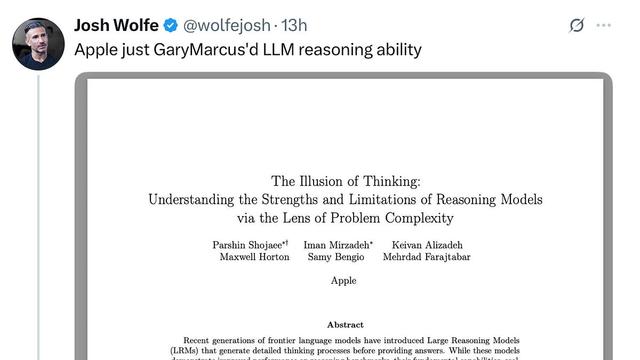
💻 **The Illusion of Thinking: Understanding the Strengths and Limitations of Reasoning Models via the Lens of Problem Complexity**

“_We found that LRMs have limitations in exact computation: they fail to use explicit algorithms and reason inconsistently across puzzles._”

🔗 https://machinelearning.apple.com/research/illusion-of-thinking

#AI #ArtificialIntelligence #LRMS #Technology #Tech #Thinking #Reasoning @ai

The Illusion of Thinking: Understanding the Strengths and Limitations of Reasoning Models via the Lens of Problem Complexity

Recent generations of frontier language models have introduced Large Reasoning Models (LRMs) that generate detailed thinking processes…

Apple Machine Learning Research

"In LRMs, the term “reasoning” seems to be equated with generating plausible-sounding natural-language steps to solving a problem, and the extent to which this provides general and interpretable problem-solving abilities is still an open question. The performance of these models on math, science, and coding benchmarks is undeniably impressive. However, the overall robustness of their performance remains largely untested, especially for reasoning tasks that, unlike those the models were tested on, don’t have clear answers or cleanly defined solution steps, which is the case for many, if not most, real-world problems, not to mention “ fixing the climate, establishing a space colony, and the discovery of all of physics,” which are achievements OpenAI’s Sam Altman expects from AI in the future. And although LRMs’ chains of thought are touted for their “human interpretability,” it remains to be determined how faithfully these generated natural-language “thoughts” represent what is actually going on inside the neural network in the process of solving a problem. Multiple studies (carried out before the advent of LRMs) have shown that when LLMs generate explanations for their reasoning, the explanations are not always faithful to what the model is actually doing.

Moreover, the anthropomorphic language used in these models may mislead users into trusting them too much. The problem-solving steps that LRMs generate are often referred to as “thoughts”; the models themselves tell us that they are “thinking” (...) According to an OpenAI spokesperson, “Users have told us that understanding how the model reasons through a response not only supports more informed decision-making but also helps build trust in its answers.” But the question is, are users building trust based mainly on these humanlike touches, when the underlying model is less than trustworthy?"

https://www.science.org/doi/10.1126/science.adw5211

#AI #GenerativeAI #LLMs #ChatBots #LRMs #Reasoning

🪧 Beyond Transformers: Efficient alternatives like State-Space Models and Liquid Neural Networks could power edge AI with reduced compute needs.

🪧 New Scaling Laws: As size and data scaling hit limits, inference-time scaling offers fresh potential for AI breakthroughs.

#AI #LLMs #LRMs #EdgeAI

📗 AI
🔴 Four Predictions for AI in 2025

🪧 Plummeting Costs: AI inference costs are dropping sharply, making advanced models more scalable for enterprises.

🪧 Large Reasoning Models (LRMs): Models like OpenAI’s o1 enable deep reasoning and generate synthetic training data, accelerating innovation. 🧵

#AI #LLMs #LRMs #EdgeAI