Concerns about facial recognition

The use of facial recognition technology advancing with few controls

February 2026

One of the features of the Chinese state is the massive use of facial recognition technology throughout China. It is a vast system with millions of cameras and is used to monitor every movement of its citizens. The system is used to control everyone and it means no one can move or meet someone without it being observed and logged by the state. It is the ultimate example of the panopticon in a modern setting.

Some are remarkably relaxed about its use in the UK believing claims made that it will be properly controlled and will be used to catch criminals, drug dealers and the like. So innocent people have nothing to fear. Read on …

Right to Privacy

The government’s Biometric Technology Consultation (to close on 12 February) aims to help develop a new legal framework for the use of facial recognition and similar technologies by law enforcement. Despite the landmark UK Court of Appeal ruling in 2020, that found the South Wales Police use of automated facial recognition (AFR) technology was unlawful, police forces in different parts of the country have increased their use of Live Facial Recognition (LFR).  As these systems contain the biometric data of huge numbers of people, some concerns from human rights groups, including Amnesty and Liberty, are briefly summarised here.

The first concern is to ensure that a new legal framework should apply to all use of ‘biometric technologies’ by all law enforcement and other organisations and should be transparent.  Complex mathematical processing is used to identify facial features and generate ‘similarity scores’ but the internal logic of how a match is calculated is hidden from both the police operators and the public.  The authorities cannot explain the specific basis for an intervention nor account for why or if the technology produces biased or inaccurate results.

Second, it is concerning that the use of Facial Recognition Technology (FRT) is becoming widespread and easily accessible, with retail outlets taking on a quasi law enforcement role, aided and supported by the police, and drawing on the same or similar databases.  It is becoming normalised in schools, in commercial and retail settings, with information flowing between sectors and under a patchwork of inconsistent laws which the public does not understand and find almost impossible to challenge.

This was demonstrated in a recent Guardian report (6th February) on the apprehension and removal from Sainsbury’s store in Elephant and Castle of a customer who had been wrongly matched by staff with a photo of a different customer flagged by their Facewatch camera.  In order to prove his innocence he had to apply to the agency using a QR code and submit a photo and a copy of his passport to them before they declared him not on their blacklist.

 The following is a list of factors of concern to human rights groups:

Transparency – to include how and when the technology is being used and the clarity of accessible information about rights.

– Whether biometric data is acquired overtly or covertly.

– Whether it is collected voluntarily or involuntarily. Pervasive monitoring is leading to the normalisation of suspicion less surveillance.

-The subject’s status – whether or not someone is the intended subject of a police investigation or an innocent bystander walking past a camera.

– Who has access to the data and the results.

– The space, context and location of deployment. Expectations of privacy vary significantly between a quiet park and a busy thoroughfare.

– Whether the system is used to make inferences about a person’s internal state, their emotion or intent.

– Whether the interference is demonstrably ‘necessary’ and ‘proportionate’ to a legitimate aim, such as the prevention of serious crime.

– Whether assessments consider the Public Sector Equality Duty (PSED) to ensure the technology does not have a discriminatory impact.

Algorithm bias: whether this performs differently based on race, gender, or age, which could lead to the over-policing of marginalised communities.

Watchlist bias: whether scrutiny of criteria can ensure groups are not disproportionately targeted based on protected characteristics.

Bias in interpretation of identification patterns claiming to provide predictive evidence.

Human Rights groups say that any new regulation should protect privacy and limit data-sharing between public authorities, law enforcement and private companies; and that as the state gains powerful new ways to monitor citizens, a strong and resilient oversight body with true independence is needed to protect human rights and dignity.

#facialRecognition #LFR #police

„Heiter weiter“, damit wir nicht erst in 134 Jahren Gleichberechtigung in Deutschland haben. Das ist die Prognose, wenn es wie bisher weitergeht. Knapp hundert geladene Gäste und ein Mann #männerquote feierten den 75. Geburtstag des #landesfrauenrat Schleswig-Holstein.

Zum 75. Geburtstag des #lfr ist die Bilanz nüchtern: die Durchschnittsfrau arbeitet heute 60 Stunde/Woche inkl. unbezahlter Care-Arbeit.

#keinegewaltanfrauen #frauenquote #petzekiel #landesfrauenratsh

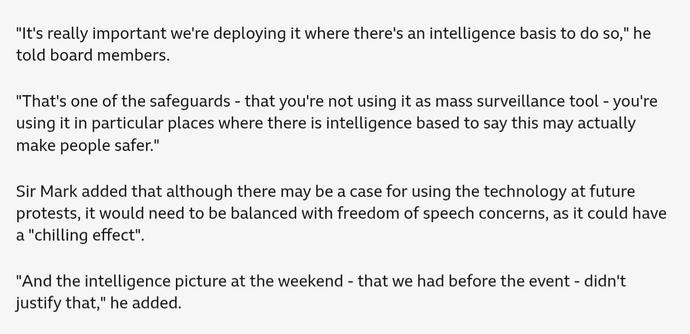
Live facial recognition (#LFR) was not used to police the #UniteTheKingdom rally in #London. No "intelligence basis" for it, #MetropolitanPolice Commissioner Sir Mark Rowley told #LondonPolicingBoard.
Rowley was challenged on the difference in approach at #NottingHillCarnival, when LFR was used.

Rowley reckoned that #Carnival was more dangerous than a #fascist #racist rally. 😡

Same, it seems, with the #DefendOurJuries protest. 😡

#MetPol needs new leaders. #Scary

https://www.bbc.co.uk/news/articles/c75q3e7xnr9o.amp

Human rights regulator criticises Met's use of #FacialRecognition cameras

The UK's equality regulator has criticised the Metropolitan Police's use of live facial recognition technology (#LFR), saying the way it is being deployed is breaching #HumanRights law.

https://www.bbc.com/news/articles/c1kzgx4v2pko

Regulator raises concerns over Met's facial recognition camera use

The Equality and Human Rights Commission says it believes the Met's use of the tech is unlawful.

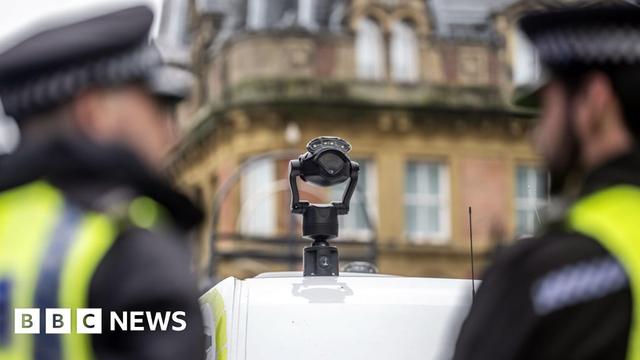
The UK government is moving forward with a wider rollout of live facial recognition (LFR) technology across seven police forces, prompting debate over privacy, legal safeguards, and ethical deployment.

https://www.computing.co.uk/news/2025/ai/uk-expands-live-facial-recognition

#technews #facialrecognition #ukpol #yvettecooper #lfr #police

UK expands live facial recognition

The UK government is moving forward with a wider rollout of live facial recognition (LFR) technology across seven police forces, prompting debate over privacy, legal ...

#UKGovernment expands #police use of #FacialRecognition vans

by Kate Whannel, August 13, 2025

"More live facial recognition (#LFR) vans will be rolled out across seven police forces in England to locate suspects for crimes including sexual offences, violent assaults and homicides, the Home Office has announced.

"The forces will get access to 10 new vans equipped with cameras, which scan the faces of people walking past and check them against a list of wanted people.

"The government says the technology has been used in London to make 580 arrests in 12 months, including 52 registered sex offenders who breached their conditions.

"However, campaign group #BigBrotherWatch said the 'significant expansion of the #SurveillanceState' was 'alarming'.

"Live facial recognition was first used in #England and #Wales in 2017 during the Uefa Champions League final football match in Cardiff.

"Since then its use has largely been confined to #SouthWales, #London and #Essex including at a Beyoncé concert to scan for paedophiles and terrorists [like elderly Palestine Action activists!]

"The government is now funding 10 vans equipped with LFR to be shared between seven forces, approximately doubling the number of vehicles.

"The seven forces are Greater #Manchester, #WestYorkshire, #Bedfordshire, #Surrey, #Sussex, #ThamesValley and #Hampshire.

"The technology identifies people by taking measurements of facial features including the distance between the eyes and the length of the jawline and then comparing the data to to an existing watchlist.

"Each van will be staffed with a trained officer who checks the matches identified by the technology.

"Simultaneously, the government is holding a consultation on what safeguards are needed to "ensure transparency and public confidence", ahead of drawing up a new legal framework.

"Big Brother Watch is bringing a legal challenge against the #MetPolice's use of the technology, alongside #ShaunThompson, who was wrongly identified by an LFR camera.

#Rebecca Vincent, interim director of Big Brother Watch, said: 'Police have interpreted the absence of any legislative basis authorising the use of this intrusive technology as carte blanche to continue to roll it out unfettered, despite the fact that a crucial judicial review on the matter is pending.

" ;The #HomeOffice must scrap its plans to roll out further live facial recognition capacity until robust legislative safeguards are established.'

"Labour peer Baroness Chakrabarti told the BBC the technology was 'incredibly intrusive' and 'some would say this is yet another move towards a total #surveillance society'."

Read more:
https://www.bbc.com/news/articles/cj4wy21dwkwo

Archived version:
https://archive.ph/I2g32

#Orwellian #UKPol #BigBrotherIsWatchingYou #ThoughtCrime #PalestineAction #Censorship #Authoritarianism

Government expands police use of live facial recognition vans

The Home Office says the technology helps locate suspects but civil liberties groups warn of heightened surveillance.

Empfehlungen des bundesweiten Bleiberechtsnetzwerkes der Flüchtlingsräte zum Übergang vom Chancen-Aufenthaltsrecht ins Bleiberecht – Hessischer Flüchtlingsrat

UK's first permanent facial recognition #cameras installed • The Register

The #MetropolitanPolice has confirmed its first permanent installation of live facial recognition ( #LFR ) cameras is coming this summer and the lucky location will be the South #London suburb of #Croydon
#facialrecognition #biometrics #privacy

https://www.theregister.com/2025/03/27/uk_facial_recognition/

UK's first permanent facial recognition cameras installed in South London

: As if living in Croydon wasn't bad enough

The Register
Tonight’s #LFR is live and… a little sexy.

Spotted at Oxford Circus #london yesterday evening. Naturally, the link to the #metropolitianpolice site on #facialrecognition doesn't work for me.

#lfr #livefacialrecognition