#livefacialrecognition
BBC News - Arrests made in Oxford as facial recognition vans introduced - BBC News
https://www.bbc.co.uk/news/articles/cqxqnp27ddno?app-referrer=search&app-referrer=deep-link
Swansea city centre live facial recognition cameras return on September 26
South Wales Police have confirmed that Live Facial Recognition (LFR) technology will be deployed across Swansea city centre on Friday, September 26. The force says the system will help officers identify wanted individuals and high‑risk missing people as part of ongoing public safety measures.
Marked vehicles and signage will highlight the areas where cameras are in use, and officers will be available to answer questions or provide demonstrations.
Before each deployment, police compile a watchlist of individuals who are either wanted by the courts, suspected of offences, or considered at risk of harm. Cameras then scan faces in real time and compare them against the watchlist. If a possible match is flagged, an officer makes a visual check before deciding whether to approach the person.
South Wales Police stressed that anyone not on the watchlist cannot be identified. Images of people who do not trigger an alert are deleted immediately, while alerts are wiped within 24 hours. CCTV footage used by the system is retained for 31 days.
How the technology works in Swansea
The LFR system uses cameras to scan faces in real time and compare them against a police watchlist. Officers then decide whether to engage with anyone flagged by the system.
Police say the technology is used to locate suspects, wanted people and vulnerable missing individuals. They emphasise that images of people not on the watchlist are never stored.
🖥️ What is facial recognition?
Live Facial Recognition (LFR)
Cameras scan faces in real time and check them against a watchlist of wanted or high‑risk individuals.
Retrospective Facial Recognition (RFR)
Still images from CCTV, body‑worn cameras or social media are checked against police databases after an incident.
Operator‑Initiated Facial Recognition (OIFR)
Officers can take a photo on a mobile device and check it instantly against police records.
Why police use it: To identify suspects, find missing people and protect the public.
Why campaigners are concerned: Could be used without enough legal safeguards, misidentify innocent people or expand surveillance in public spaces.
Why South Wales Police say it’s needed
South Wales Police have been one of the UK’s leading adopters of facial recognition technology, deploying it at major events and in busy town centres. Earlier this year, the force confirmed similar operations in Bridgend and during Operation Sceptre week in Swansea.
The technology is part of a wider rollout that includes a mobile facial recognition app for frontline officers in South Wales and Gwent. Known as Operator Initiated Facial Recognition (OIFR), the app has already led to arrests and the identification of missing people.
What campaigners are warning about
An audit by the Information Commissioner’s Office (ICO) earlier this year gave South Wales Police’s use of both live and retrospective facial recognition a “high” assurance rating, citing strong safeguards and oversight. The watchdog found no evidence of bias across age, gender or ethnicity.
However, campaigners remain sceptical. Groups such as Big Brother Watch argue that live facial recognition represents a “significant expansion of the surveillance state” and risks treating “every passer‑by as a walking barcode.” Critics also point out that there is still no dedicated law governing police use of the technology.
What happens next
The force has encouraged anyone with questions or concerns to speak directly to officers during Friday’s deployment. Information leaflets will also be available, and further details about how the technology works can be found on the South Wales Police website.
Related stories from Swansea Bay News
Watchdog gives high marks to South Wales Police over facial recognition use – but campaigners remain wary
Independent review praised safeguards but critics say concerns remain.
Your face, their tech: Police turn facial recognition back on in Bridgend
Deployment in town centre reignited debate over privacy and policing.
South Wales and Gwent Police roll out facial recognition app to frontline officers amid privacy concerns
New mobile app allows instant checks against police databases.
Police to use live facial recognition cameras in Swansea city centre
Previous deployment in Swansea highlighted public engagement efforts.
South Wales Police restarts facial recognition tech usage – although critics reiterate privacy concerns
Civil liberties groups continue to call for stronger legal safeguards.
#BigBrotherWatch #CCTV #FacialRecognition #ICO #InformationCommissionerSOffice #LiveFacialRecognition #PoliceWatchlist #privacy #SouthWalesPolice #Swansea #SwanseaCityCentre #Technology #watchlist

Watchdog gives high marks to South Wales Police over facial recognition use — but campaigners remain wary
The Information Commissioner’s Office (ICO) – which enforces data protection laws – carried out an audit looking at live facial recognition (real‑time camera scans against a police watchlist), retrospective facial recognition (checking images after an incident), and a new operator‑initiated system being trialled on police mobile devices.
What the ICO found
The audit gave both live and retrospective systems a “high” assurance rating, meaning the watchdog found good safeguards in place and only limited room for improvement.
The ICO said the forces:
Some recommendations were made, including tightening up how document changes are recorded and making sure data retention rules are always applied consistently.
🖥️ What is facial recognition?
Live Facial Recognition (LFR)
Cameras scan faces in real time and check them against a watchlist of wanted or high‑risk individuals.
Retrospective Facial Recognition (RFR)
Still images from CCTV, body‑worn cameras or social media are checked against police databases after an incident.
Operator‑Initiated Facial Recognition (OIFR)
A trial system allowing officers to take a photo on a mobile device and check it instantly against police records.
Why police use it: To identify suspects, find missing people and protect the public.
Why campaigners are concerned: Could be used without enough legal safeguards, misidentify innocent people or expand surveillance in public spaces.
Police response
Chief Superintendent Tim Morgan, from the joint South Wales and Gwent digital services department, said the findings show the forces are “in a stronger position than ever” to prove the technology is used fairly, legally and ethically.
He stressed there have been no wrongful arrests and no false alerts for several years, and that independent testing has shown the system does not discriminate by gender, age or race.
“Our priority is to keep the public safe and this technology continues to help us bring offenders to justice and protect the public,” he said.
Concerns from privacy campaigners
Not everyone is reassured. Civil liberties group Big Brother Watch has long argued that live facial recognition represents a “significant expansion of the surveillance state” and risks treating “every passer‑by as a walking barcode”.
Campaigners say there is still no dedicated law governing police use of the technology, and warn that even with safeguards, it can be inaccurate in real‑world conditions or misidentify people from minority backgrounds. They are calling for a pause on further roll‑outs until robust legal protections are in place.
Background
South Wales Police has been one of the UK’s early adopters of facial recognition, using it at major events and in targeted operations. The force says it only uses the technology when there is a clear policing need, and in line with national guidance brought in after a legal challenge in 2020.
The ICO’s audit is the first in a new series looking at police use of facial recognition across England and Wales. Further audits of other forces are planned.
#BigBrotherWatch #CivilLiberties #FacialRecognition #ICO #InformationCommissionerSOffice #LiveFacialRecognition #privacy #SouthWalesPolice
Why are ID cards and smoking bans such a big deal in Britain, while live facial recognition cameras are just quietly introduced without much backlash?
Live facial recognition cameras may become 'commonplace' as police use soars
#HackerNews #livefacialrecognition #policeuse #surveillance #technology #privacyconcerns #digitalrights
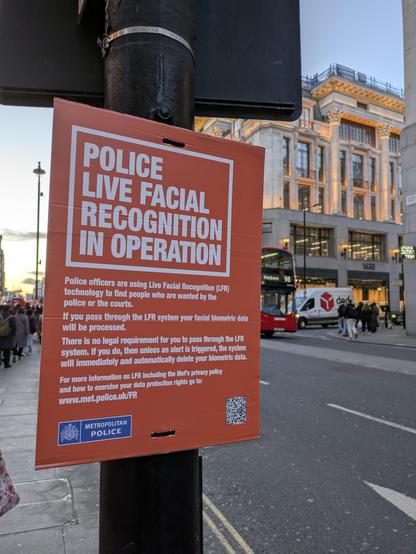
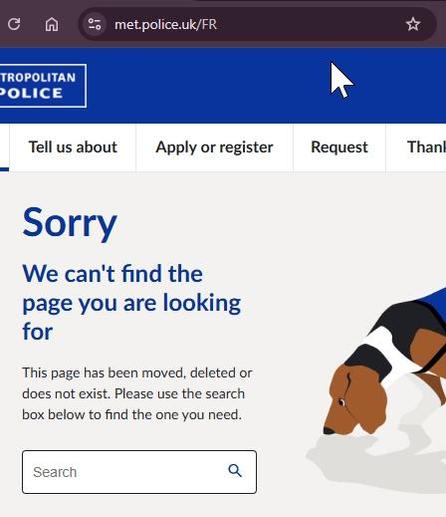
Spotted at Oxford Circus #london yesterday evening. Naturally, the link to the #metropolitianpolice site on #facialrecognition doesn't work for me.
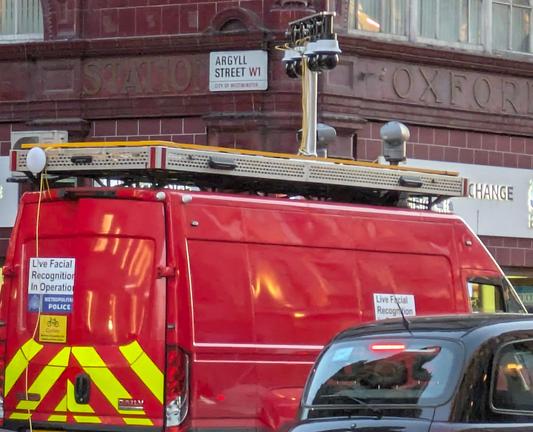
Live Facial Recognition active in town either side of a pedestrian crossing. Wonder how many taxis and SUV going through on red they'll bother with, or the speeding on my residential road, or the obviously way over the limit drivers late evenings, or Wankpanzers and sports cars parked on double yellow and pavements everywhere.
Still easy day sitting around isn't it copper and no danger of hassling some middle class cunt with resources to put up a legal fight.
Under cover of a shoplifting panic, the Tories are pushing through a shocking expansion of facial recognition | Akiko Hart | The Guardian
https://www.theguardian.com/commentisfree/2023/oct/12/shoplifting-facial-recognition-shops-police-surveillance-powers
#FacialRecognition
#Shoplifting
#Calpol
#FormulaMilk
#BabyMilk
#Poverty
#CCTV
#CamerasOnPoliceVans
#LiveFacialRecognition
#Surveillace
#SurveillaceTech
#Harrassment
#PoliceHarrassment
#Minorities
#MET
#PassportPhotos
#Passports
MPs and peers call for ‘immediate stop’ to #LiveFacialRecognition #surveillance
#UK #police forces and #PrivateFirms urged to drop #technology due to impact on #HumanRights
https://www.theguardian.com/technology/2023/oct/06/mps-and-peers-call-for-immediate-stop-to-live-facial-recognition-surveillance #DontScanMe