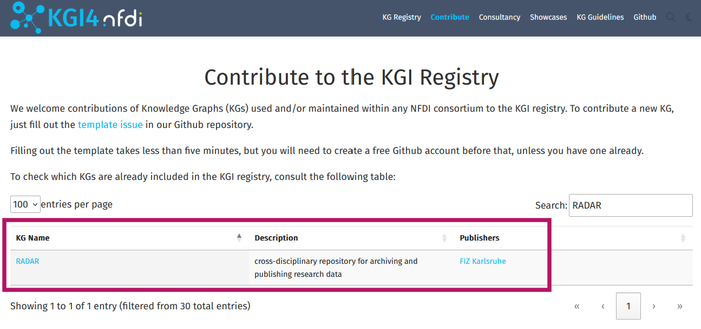
RADAR ist mit seinem Wissensgraphen seit Kurzem im Knowledge Graph Registry des NFDI-Basisdienstes #KGI4NFDI (Knowledge Graph Infrastructure for NFDI) vertreten.

Damit wird der RADAR-Wissensgraph in die gemeinsame semantische Infrastruktur der #NFDI eingebunden und in deren Kontext sichtbar gemacht.

Details unter https://radar.products.fiz-karlsruhe.de/de/nachricht/radar-und-kgi4nfdi-einbindung-des-radar-wissensgraph-den-nfdi-basisdienst

#Forschungsdaten #FAIRdata #Wissensgraph #KnowledgeGraph #FDM #openscience
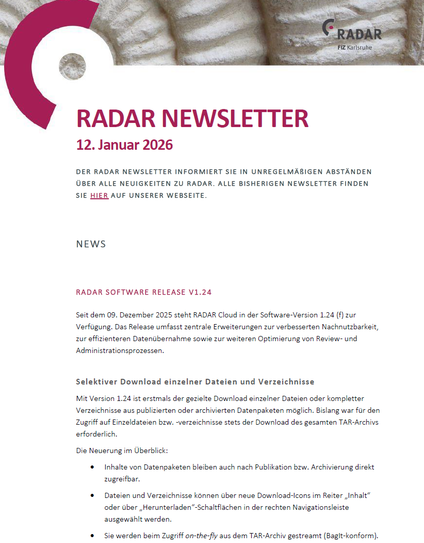
Der neue RADAR-Newsletter ist da 📯

✔️RADAR Software-Release: Selektiver Download von Dateien und Verzeichnissen, verbesserte Review-Option, GitLab-/GitHub- Import nun standardmäßig verfügbar uvm.
✔️NFDI-Basisdienst #KGI4NFDI: Einbindung des RADAR Wissensgraph
✔️OstData der BSB München nutzt RADAR Local
✔️ Rückblick & Ausblick auf Veranstaltungen

Alle Newsletter sowie die Anmeldemöglichkeit finden Sie unter: https://radar.products.fiz-karlsruhe.de/de/radarsupport/support#newsletter

Bleiben Sie informiert – wir freuen uns über Ihr Interesse!

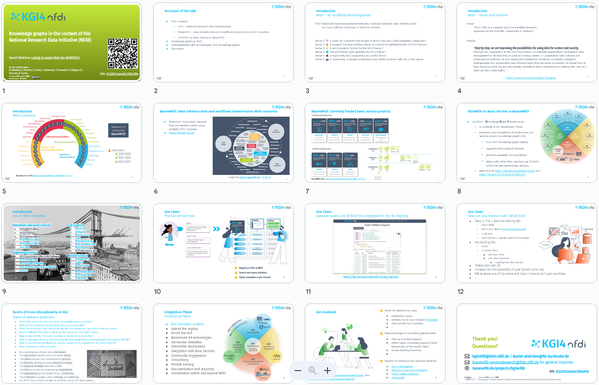
The slides for my #lswt2025 talk "Knowledge graphs in the context of the National Research Data Initiative (NFDI)"
are up at
https://doi.org/10.5281/zenodo.15644994 .

#knowledgegraphs #kgi4nfdi #openscience

And just last week, we presented at the Workshop on New Media Art Archiving, which took place at ZKM | Center for Art and Media Karlsruhe. #WNMAA2025

A blog post up on the @tibhannover blog, outlines the key topics discussed at the workshop and how current developments in #RDM on national and international level can deliver the goal of the workshop to interconnect media art archives globally. Specifically services such as #KGI4NFDI and #TS4NFDI from #Base4NFDI, in addition to tools such as #Qlever and #ORKGask provide relevant points of reference for the further development of a decentralised media art archive infrastructure.

🔗🔖 https://blog.tib.eu/2025/02/10/connecting-media-art-archives/

Connecting media art archives – closer to reality through advances in research data infrastructures - TIB-Blog

The 2025 Workshop on New Media Art Archiving took place at ZKM | Center for Art and Media Karlsruhe from 5 to 8 February 2025. The special topic of the workshop – Globally Connecting New Media Art Archives – set the stage for the organisation of thematic sessions and expert working groups with over 60 attendees representing a wide variety of research and cultural organisations from across Europe, North and South America, Asia and Australia. 

TIB-Blog
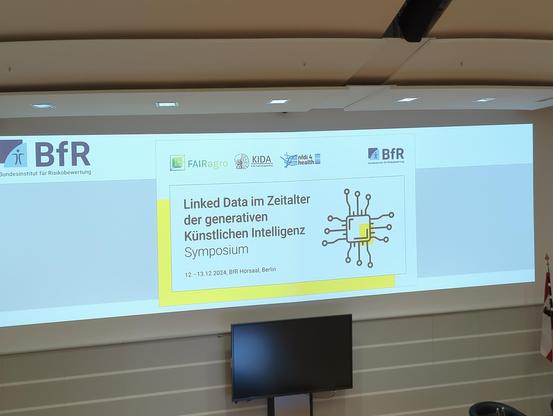
Gerade ist das zweitägige Symposiums „Linked Data im Zeitalter der generativen Künstlichen Intelligenz – Neue Perspektiven oder überholte Vision?“ - organisiert von @bfr, @nfdi4health und @FAIRagro - gestartet. Wir werden morgen #KGI4NFDI vorstellen. Ich freue mich auf eine kompakte Sammlung spannender Vorträge und anregende Diskussionen im Spannungsfeld von Knowledge Graphs und KI. https://www.bfr-akademie.de/deutsch/veranstaltungen/linkeddata.html #FAIR #KnowledgeGraph #LinkedOpenData #LinkedData #AI
Linked Data im Zeitalter der generativen Künstlichen Intelligenz – Neue Perspektiven oder überholte Vision? - Alle Veranstaltungen

<p><!--[if gte mso 9]><xml> <o:OfficeDocumentSettings> <o:RelyOnVML/> <o:AllowPNG/> </o:OfficeDocumentSettings> </xml><![endif]--><!--[if gte mso 9]><xml> <w:WordDocument> <w:View>Normal</w:View> <w:Zoom>0</w:Zoom> <w:TrackMoves/>

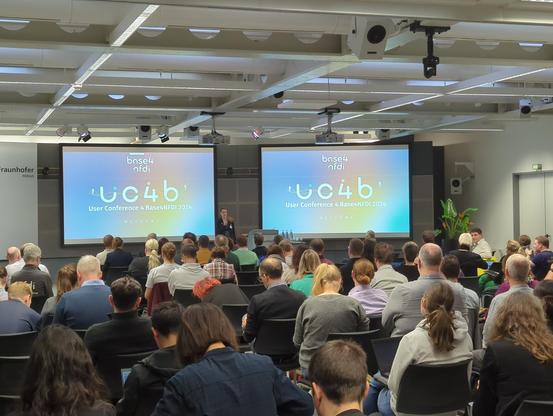
The 1st #BASE4NFDI User Conference has started today and is meanwhile in full swing. We are happy to present our base services: #KGI4NFDI (#KnowledgeGraph Infrastructure) and #RDMTraining4NFDI. Stay tuned for the link to our presentation slides - coming soon!

#UC4B2024 #NFDIRocks #NFDI #RDM #FAIR #OpenScience #DataLiteracy

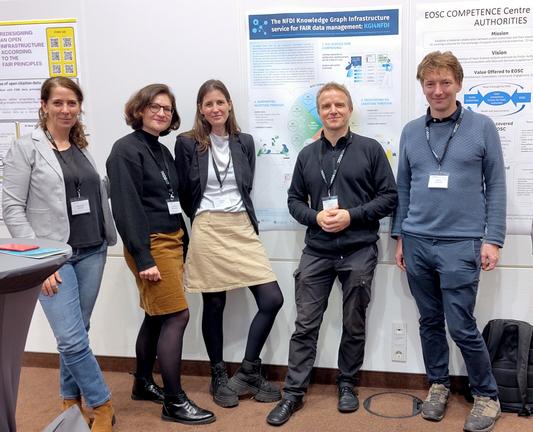
➡️ Earlier this week #NFDI colleagues attended the #EOSCsymposium2024 in Berlin. We had a chance to learn more about the EU-level open science infrastructure and services and discuss the common challenges faced on international & domain-specific level.

👥 We were also there with colleagues from #Base4NFDI and the #KGI4NFDI service which includes #NFDI4Culture participation via @tibosl @lozross

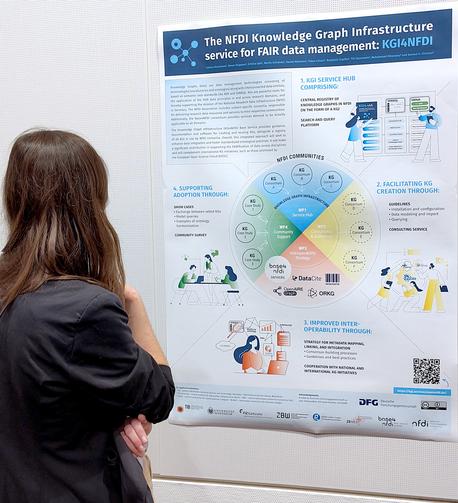
🔗 Learn more about the KGI service via the poster publication on Zenodo:
https://zenodo.org/records/13712824

^gp

The NFDI Knowledge Graph Infrastructure service for FAIR data management

Knowledge Graphs (KGs) are data management technologies consisting of terminologies (vocabularies and ontologies) along with interconnected data entities, based on semantic web standards like RDF and SPARQL. KGs are powerful tools for the application of the FAIR data principles in and across research domains, and thereby supporting the mission of the National Research Data Infrastructure (NFDI) in Germany. Developing KG solutions as part of the data management strategies is seen as an important step towards FAIR(er) data by a range of consortia. The NFDI Association includes subject-specific consortia, responsible for delivering research data resources and services to their respective communities, with cross-cutting sections forming Working Groups to tackle cross-domain issues. Additionally, the Base4NFDI consortium provides services deemed to be broadly applicable to all domains.  Besides the development of technical solutions, achieving interoperability requires a high degree of social coordination that can bridge disciplinary silos. The Working Group "Knowledge Graphs" provides such coordination by including members representing consortia across the spectrum of the natural and life sciences, engineering, humanities and social science domains. The WG also led the development of the Knowledge Graph Infrastructure (KGI4NFDI) Base service proposal. This new service will provide guidance, documentation, and software for creating and reusing KGs, alongside a registry of all KGs in use by NFDI consortia. Moreover, the service will develop an interoperability strategy, conduct surveys, and demonstrate the application of KGs across various research fields and scenarios using diverse methods. All solutions generated will be available under open-source and open-content licenses for broader benefit. This presentation will outline concrete goals, methods and intended outcomes of KGI4NFDI during its initiation phase in 2024-2025. We would like to use this opportunity to gather  feedback and explore the potential for collaboration and integration of the KGI service framework within the EOSC community.   

Zenodo

Busy start of the week with the #EOSCsymposium2024 in Berlin and participation from various #NFDI colleagues. Learning more about the EU-level open science infrastructure and services planning was insightful and revealing in terms of how common challenges are faced on international / domain-specific level. Paths towards meaningful federation are becoming tangible.

@tibosl & @tibhannover were also represented with our involvement in #Base4NFDI and the #KGI4NFDI service.

🔗 Poster is available on Zenodo: https://zenodo.org/records/13712824

#EOSC #EOSC2024 #OpenScience

The NFDI Knowledge Graph Infrastructure service for FAIR data management

Knowledge Graphs (KGs) are data management technologies consisting of terminologies (vocabularies and ontologies) along with interconnected data entities, based on semantic web standards like RDF and SPARQL. KGs are powerful tools for the application of the FAIR data principles in and across research domains, and thereby supporting the mission of the National Research Data Infrastructure (NFDI) in Germany. Developing KG solutions as part of the data management strategies is seen as an important step towards FAIR(er) data by a range of consortia. The NFDI Association includes subject-specific consortia, responsible for delivering research data resources and services to their respective communities, with cross-cutting sections forming Working Groups to tackle cross-domain issues. Additionally, the Base4NFDI consortium provides services deemed to be broadly applicable to all domains.  Besides the development of technical solutions, achieving interoperability requires a high degree of social coordination that can bridge disciplinary silos. The Working Group "Knowledge Graphs" provides such coordination by including members representing consortia across the spectrum of the natural and life sciences, engineering, humanities and social science domains. The WG also led the development of the Knowledge Graph Infrastructure (KGI4NFDI) Base service proposal. This new service will provide guidance, documentation, and software for creating and reusing KGs, alongside a registry of all KGs in use by NFDI consortia. Moreover, the service will develop an interoperability strategy, conduct surveys, and demonstrate the application of KGs across various research fields and scenarios using diverse methods. All solutions generated will be available under open-source and open-content licenses for broader benefit. This presentation will outline concrete goals, methods and intended outcomes of KGI4NFDI during its initiation phase in 2024-2025. We would like to use this opportunity to gather  feedback and explore the potential for collaboration and integration of the KGI service framework within the EOSC community.   

Zenodo

I currently passed Hanover on my way to berlin.

The next days I have at least some distraction from proposal writing for the integration phase of #ts4nfdi I'm on my to the Kick-Off meeting of #kgi4nfdi in #Berlin. I'm looking forward to see @lozross and @kuf @schubotz in person. At least @renat_shigapov could join us via remote.

#base4nfdi #nfdirocks #knowledgegraph