Egalement partagé lors de #PatNum,

L'arrivée d'un nouveau Triplestore #RDF Open Source qui change complètement la donne : QLever

https://docs.qlever.dev

Les performances impressionnantes de cet outil lève les (dernières) contraintes à travailler en RDF-natif.

La Fondation SAPA l'utilise déjà pour l'accès SPARQL à ses données publiques. Nous avons d'ailleurs fait dernièrement une mise à jour vers la dernière version!

https://qlever-ui.performing-arts.ch

#QLever

QLever Documentation

Documentation for the QLever graph database

#qlever wikidata endpoint now appears to sync with #wikidata in real-time. Updates are available basically immediately.👌

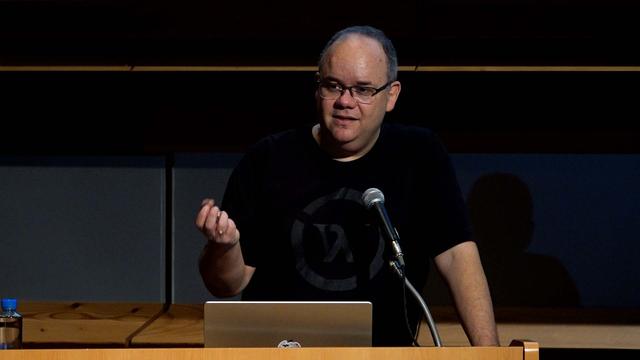
Just learned from @vrandecic 's presentation (https://videolectures.net/videos/iswc2025_nara_vrandecic_wikipedia_future) that there is a #wikidata #qlever interface mimicking the #WDQS gui. So here you've got native support for visualisations etc. -> https://wikidata-query-gui.scholia.wiki/

The interface has the drop-down-autocompletion function but no implicit PREFIXes, so you must add these on your own. Not a perfect replacement for WDQS but close.

Wikipedia and the Semantic Web: Celebrating 20 Years of Co-Development and the Future

In 2005, the very first papers proposed integrating Semantic Web technologies in the nascent Wikipedia ecosystem. This wasn’t just a convergence; it ignited two decades of mutual inspiration and benefit. From this crucible, the work in semantic wikis drew inspiration. Semantic MediaWiki, particularly, which found global adoption at Google, Microsoft, NASA, and beyond. Wikipedia became the bedrock for pioneering knowledge graphs, including DBpedia, Freebase, and Yago. These pivotal experiences directly fueled the development of Knowledge Graph, a term that has since found ubiquitous adoption, and, critically, Wikidata, a project that has become an indispensable, living component of Wikipedia itself. With over half a million global contributors, Wikidata stands as the world’s most-edited wiki, powering one of, if not the, most widely-used public SPARQL endpoint. Its software, Wikibase, has spawned a federation of knowledge graphs, serving diverse domains from museums to language preservation. Furthermore, Wikidata’s evolution into lexicographic data (inspired by ontologies such as OntoLex and Lemon) laid the groundwork for projects such as Wikifunctions and Abstract Wikipedia, a vision first unveiled right here at ISWC 2018 and now an official Wikimedia Foundation project. This takes us to the present and future: Abstract Wikipedia collaboratively confronts the inherent expressivity gap in knowledge graphs, while foundational role in training and the current use of language models can not be overstated. This creates a tantalising confluence of large language models and knowledge graphs, hinting at profound opportunities - and critical challenges -for Wikipedia, the Web, and beyond. As this rich history promises many more years of co-development and mutual inspiration, we will conclude with a forward-looking sketch of open research questions and exciting upcoming opportunities.
#SWAT4HCLS nice to see #qlever with a 1 trillion triple dataset. Or four UniProts ;)

Hier die Daten, dies schon nach #qlever geschafft haben: https://qlever.dev/wikidata/ZVyIxB

Kann das Procedere gerne in einem Blog-Beiträg schildern, wenn Dein Call noch offen ist, @JensB

The QLever SPARQL engine: fast, scalable, with autocompletion and text search

new blog: "Rescuing Scholia #3: We did it!" https://chem-bla-ics.linkedchemistry.info/2026/02/28/rescuing-scholia-3-we-did-it.html https://doi.org/10.59350/kd793-2fe02

"For now, however, please use qlever.scholia.wiki." https://qlever.scholia.wiki/

Replies show up in the blog.

#wikidata #scholia #qlever #sparql

Rescuing Scholia #3: We did it!

It was not a set up, when I openly wondered if we would be able to rescue Scholia in time. I honestly did not know. Three weeks and some serious hacking by an international team later I was more optimistic. Actually, just before christmas, we started writing a SWAT4HCLS 2026 demonstration abstract. This was accepted and you can read the Scholia 2026: Compliance with SPARQL 1.1 preprint here and here. This paper describes the work that had to be done, and I am deeply grateful to everyone who contributed with smaller or bigger contributions (Daniel, Peter, Konrad, Johannes, Lars, Wolfgang, Hannah). I am merely first author for the demo, and just another contributor to the long series of patches, in a branch started by Prof. Hannah Bast.

chem-bla-ics

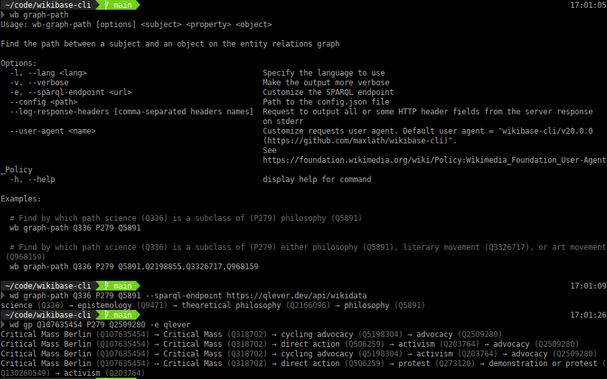
Released wikibase-cli v20.0.0 ✨

It includes a new command – `wb graph-path` – to find the path between a subject and an object via a given property, on the entities relations graph.

Package: https://www.npmjs.com/package/wikibase-cli
Changelog: https://github.com/maxlath/wikibase-cli/blob/main/CHANGELOG.md#2000---2026-02-11

#wikibase #wikidata #sparql #qlever #taxonomy

That's a list I've been looking for for some time: https://www.mediawiki.org/wiki/Wikibase/Indexing/RDF_Dump_Format#WDQS_data_differences

It shows the differences between the RDF source of a Wikidata item and the way it's stored in the RDF actually used in #Wikidata Query Service #WDQS (and in #qlever as well, apparently).

I'd stumbled over the fact that "?item a wikibase:Item" doesn't return any results. The link above explains why.

Wikibase/Indexing/RDF Dump Format - MediaWiki

MediaWiki

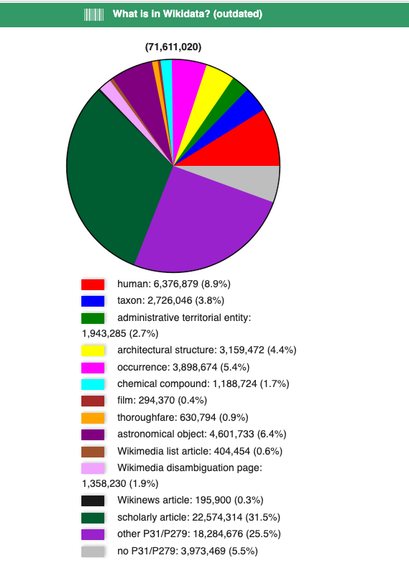
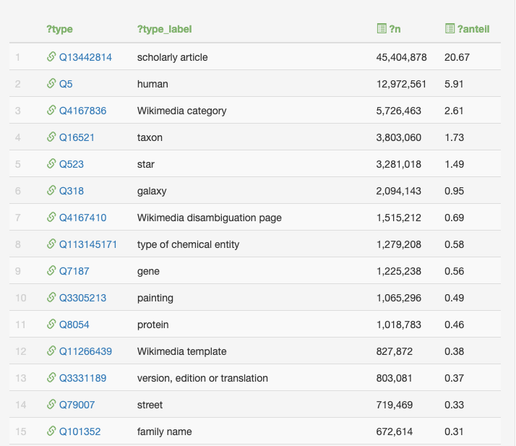
What is in #wikidata? The answer to this question on the Wikidata:Statistics page (https://www.wikidata.org/wiki/Wikidata:Statistics) hasn't been updated for a while. This #sparql query run in #qlever provides a snapshot of the current situation (it's not entirely identical as P31/P279* times out even in qlever but it conveys the idea): https://qlever.dev/wikidata/k9TJoh

Articles have the lion's share, paintings and manifestations of wirtten works are well represented, though.

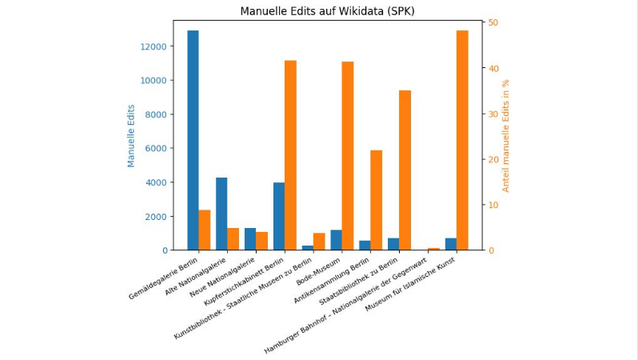
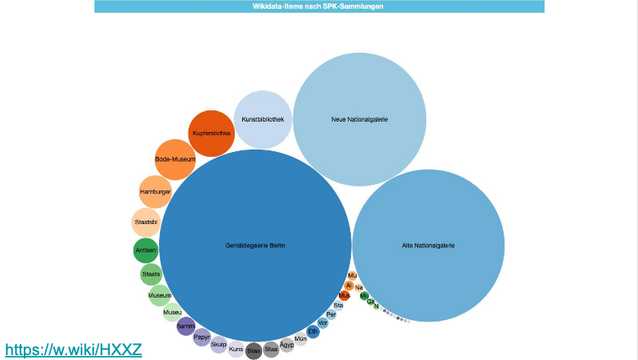
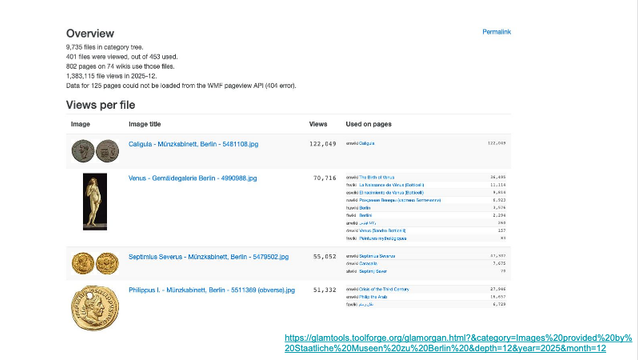
Für einen kurzen Impuls habe ich mir die Präsenz der Stiftung Preußischer Kulturbesitz im #Wikiversum angesehen und ein paar Daten dazu zusammengetragen. Neben #qlever, #petscan und #glamorgan habe ich inbesondere versucht, die Revisionshistorie der Items auszuwerten. Da ließe sich sicher noch mehr herausholen. Wenn also jemand Ideen hat, gerne! Präsentation, Daten und Code zum Nachbasteln gibt es unter https://doi.org/10.5281/zenodo.18380310

#wikidata #wikimediacommons #openglam #openglamdata