 Science Fiction and Other Suspect Ruminations
What pre-1985 science fiction are you reading? + Update No. XXVIII
First update post of 2026! What pre-1985 science fiction adventures have you started this year? Any great reads? Disappointing ones? Intriguing discoveries? Here’s the November 2025 installment of this column.
- A selection of read volumes from my shelf
Exciting news! Rachel S. Cordasco, who occasionally joins me to review older SF short stories in translation, will soon launch Small Planet: The SF in Translation Magazine. As the announcement on File 770 states, “the magazine will come out 4 times per year (February, May, August, and November) and include columns on such topics as: interesting upcoming books and notable reviews, interviews with authors, translators, editors, translators talking about books they’d like to see in English, essays on Anglophone awards, databases, and publishers that should recognize translators/SFT, essays on Anglophone awards, databases, and publishers that should recognize translators/SFT, pieces on interesting translation conundrums, notes on what’s happening in other countries in SF. It will be available for free on Cordasco’s Speculative Fiction in Translation website.”
Missing from the list will be my reviews of vintage SF in translation! The plan is to have one review in each issue for at least the next year or for as long as I can keep up a schedule (schedules and I do not mesh). I’ve already tracked down some lesser known gems from German, Norway, and Italy.
The Photograph (with links to reviews and brief thoughts)
What am I writing about?
While I have not had the most productive 2026, here are few notable reviews I’ve written recently in case you missed them: two interesting 50s short stories on race in America, Alan E. Nourse’s “Marley’s Chain” (1952) and Edward W. Ludwig’s “The Rocket Man” (1951); Fritz Leiber, Jr.’s Gather, Darkness! (1943, novelized 1950) and Gillian Freeman’s The Leader (1965); William Tenn’s collection Time in Advance (1958); and another installment on my survey of all pre-1985 generation ship stories available in English, Mari Wolf’s “The First Day of Spring” (1954) and Francis G. Rayer’s “Continuity Man” (1959).
As I mentioned earlier, I am writing reviews for Rachel’s online magazine on SF in translation. When they go live I’ll double-post them on the site and link the other goodies that are sure to grace the pages.
What am I reading?
I recently finished Matthew I. Thompson’s fascinating monograph On Life Support: Eco-Dystopian Cinema in the Long 1970s (2026). He explores the intersection of popular science works by Rachel Carson and Paul R. Ehrlich and dystopia SF film with ecological themes. If you missed my interview with Thompson, I highly recommend you check it out. The interview surveys the main theoretical premises of the work and the main films he covers. I should rewatch Soylent Green (1972), David Cronenberg’s Shivers (1975), and Douglas Trumbull’s Silent Running (1972).
- Matthew I. Thompson’s On Life Support: Eco-Dystopian Cinema in the Long 1970s (2026). Photographed by me on a hike in Pembroke, VA.
A Curated List of SF Birthdays from the Last Two Weeks [names link to The Internet Speculative Fiction Database for bibliographical info]
March 22nd: Raymond Z. Gallun (1911-1994).
- Johnny Bruck’s canvas for Perry Rhodan, #270: Ultimatum an Unbekannt (1966)
March 22nd: German cover artist Johnny Bruck (1921-1995). He’s easily one of the most prolific German cover artists.
March 22nd: Rudy Rucker (1946-).
March 23nd: H. Beam Piper (1904-1964). I recently (sort of) covered my first Piper story on the site: H. Beam Piper and John J. McGuire’s “Hunter Patrol” (1959). I have another one planned this year.
March 23nd: Sheila MacLeod (1939-).
March 23nd: Elizabeth Ann Scarborough (1947-). I enjoyed her Acorna sequence books (written with Anne McCaffrey) was a child. Most of her published solo work is outside my area of focus. I placed her novel The Healer’s War (1988-) on my Vietnam War-inspired SFF list.
March 23rd: Kim Stanley Robinson (1952-). I recently reviewed Icehenge (1984). I really enjoyed it. Perhaps more than his Mars Trilogy, albeit, they are very different books…
- David K. Stone’s cover for the 1978 edition of The Stainless Steel Rat Wants You (1978)
March 24th: Cover artist David K. Stone (1922-2001).
March 24th: Peter George (1924-1966).
March 25th: Jacqueline Lichtenberg (1942-)
March 26th: Edward Bellamy (1850-1898). Author of Looking Backward: 2000–1887 (1888), the highly influential utopian SF novel that inspired countless sequels and prequels and rebuttals by other authors.
March 26th: David J. Lake (1929-2016)
March 26th: K. W. Jeter (1950-)
March 27th: Artist Stanley Meltzoff (1917-2006)
- Still from René Laloux’s Fantastic Planet (1973)
March 27th: Stefan Wul (1922-2003). A French SF author best known for writing Oms en série (1957), the source material for Fantastic Planet (1973).
March 27th: Helmut Wenske (1940-).
March 28th: A. Bertram Chandler (1912-1984)
March 28th: Cover artist George Ziel (1914-1982)
March 29th: Lino Aldani (1926-2009). I adored Aldani’s “Good Night, Sophie” (1963, trans. 1973). He represents one of the many reasons why Rachel’s magazine to promote SF in translation is such a great idea. Despite his ability to craft a masterpiece, only ONE additional short story exists in English translation.
- Walt Miller’s cover for the July 1953 issue of Astounding Science Fiction
March 29th: Artist Walt Miller (1928-2015).
March 29th: Artist Johann Peter Reuter (1949-).
March 29th: Mary Gentle (1956-).
March 30th: Artist Curt Caesar (1906-1974).
March 30th: Alice Eleanor Jones (1916-1981). While she only published five science fiction short stories, “Created He Them” (1955) is a 50s masterpiece.
- Art Sussman’s cover for the 1957 edition of Murray Leinster’s The Planet Explorer (variant title: Colonial Survey) (1956)
March 30th: Artist Art Sussman (1927-2008). Another underrated SF artist with a beguiling surrealist streat– I put together a post on his work in 2017.
March 30th: Chad Oliver (1928-1993). Most recently I covered his two generation ship stories: “Stardust” (1952) and “The Wind Blows Free” (1957).
March 31st: Marge Piercy (1936-). Dance the Eagle To Sleep (1970) is not to be missed!
April 1st: Anne McCaffrey (1926-2011). I adored her work as a kid. I read everything I could get my hands on–even from the lowest points in her career i.e. the Acorna Universe sequence and co-written Dragonriders of Pern novels with her son.
April 1st: Samuel R. Delany (1942-).
April 2nd: Artist Mitchell Hooks (1923-2013). One of the underrated SF artists of the 50s-70s in my view. For a lovely example, check out my recent review of William Tenn’s Time in Advance (1958).
- Murray Tinkelman’s cover for the 1978 edition of John Brunner’s The Squares of the City (1965)
April 2nd: Artist Murray Tinkelman (1933-2016). Another underrated SF artist… How can your forget his iconic cover for Brunner’s The Sheep Look Up?
April 2nd: Joan D. Vinge (1948-)
April 3nd: Noel Loomis (1905-1969).
April 3rd: Colin Kapp (1928-2007). As I’ve said before, “want to push my buttons? Recommend stories for me to read like Kapp’s “Hunger Over Sweet Waters” (1965). You’ll have to read my review (an exercise in snark) to find out why.”
- Jack Faragasso’s cover for the 1972 edition of The Thinking Seat (1969)
April 3rd: Peter Tate (1940-). One of those British New Wave authors I should read more of… Tate’s The Thinking Seat (1969) is on the burner for later this year.
April 4th: Stanley G. Weinbaum (1902-1935). Best known for his early classic “A Martian Odyssey” (1934).
April 4th: Artist Tim White (1952-2020).
For book reviews consult the INDEX
For cover art posts consult the INDEX
For TV and film reviews consult the INDEX
#1950s #1970s #avantGarde #bookReviews #JGBallard #JudithMerril #paperbacks #RobertSheckley #RobertSilverberg #sciFi #scienceFiction #spaceships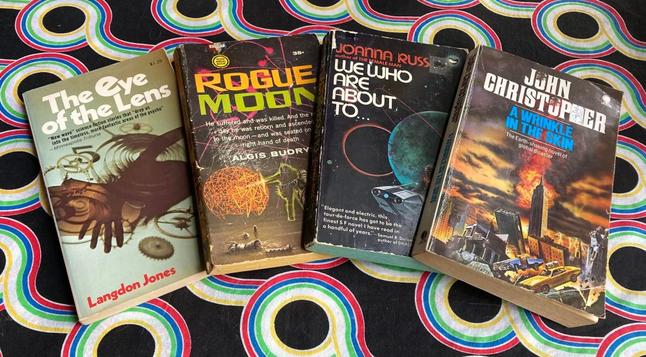
 Walt
Walt
 Aurélie
 lokatzi
 Seattle Worldcon 2025
 Seattle Worldcon 2025
 dance along the edge 💬
 Cory Doctorow
 dave
dave
 Paul Levinson