 Bevan Thomas
 Michael88
 דער קערפער פֿון השם
"In addition to my own #scholarship and #teaching on #Jewish #folklore, I also proudly serve as the co-chair of the #American Folklore Society’s #JewishFolklore and #Ethnology Section and as an associate editor of the #academic journal Jewish Folklore and Ethnology. My work, like that of my colleagues, depends on engagement with communities, with #archives, and with #scholars across borders.
It is precisely that kind of engagement that is now under threat.
Within #folkloristics, #ethnomusicology examines music as a form of cultural knowledge and expression, a way of understanding identity, history, and society. Recently, the group Music Scholars for #Palestine has pushed for the Society of Ethnomusicology (SEM) to adopt a resolution aligned with the #Palestinian Campaign for the #Academic and #Cultural #Boycott of #Israel (#BDS)."
https://blogs.timesofisrael.com/when-academic-boycotts-target-jewish-culture/
 UTAustin Dept Germanic Studies
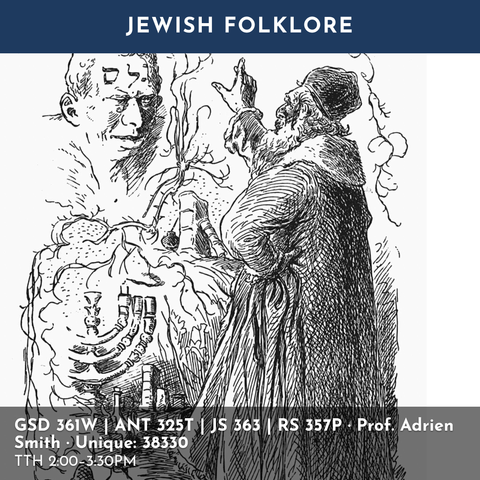
This spring at UT Austin, Germanic Studies:
Prof. Adrien Smith - GSD 361W | ANT 325T | JS 363 | RS 357P Jewish Folklore
TTH 2:00–3:30PM
Unique: 38330
#utgermanic #germanstudies #digitalhumanities #usgermanstudies #utaustin #jewishfolklore
This spring at UT Austin, Germanic Studies:
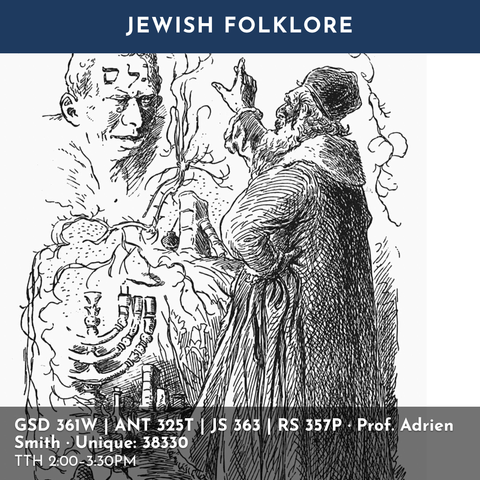
Prof. Adrien Smith - GSD 361W | ANT 325T | JS 363 | RS 357P Jewish Folklore
TTH 2:00–3:30PM
Unique: 38330
#utgermanic #germanstudies #digitalhumanities #usgermanstudies #utaustin #jewishfolklore
 Spirituality & Religious Studies
Golem
This entity is an animated anthropomorphic being in Jewish folklore that’s created entirely from inanimate matter, usually clay or mud. In modern popular culture, the word has become generalized. Any crude automaton devised by a sorcerer can be called a “golem.”
In modern Hebrew, golem is used to mean: dumb, helpless, or pupa. It’s often used today as a metaphor for a stupid man or other entity that serves a man under controlled conditions. but is hostile to him in other circumstances. Golem passed into Yiddish as goylem, meaning someone who’s lethargic or in a stupor.
The oldest stories of golems go to early Judaism. In the Talmud, Adam is initially created as a golem when his dust is “kneaded into a shapeless husk.” Like Adam, all golems are created from mud from those close to divinity. But no anthropogenic golem is fully human. Early on, the main disability of the golem was its inability to speak.
During the Middle East, passages from the Sefer Yetzirah were studied as a means to create & animate a golem. Although little in the writings of Jewish mysticism supports this belief. The earliest known written account of how to create a golem can be found in the Sode Raza, a commentary on Merkabah mysticism by Eleazer of Worms, who lived in the 12th & early 13th centuries.
It was believed that golems could be activated by an ecstatic experience induced by the ritual use of various letters of the Hebrew alphabet forming 1 of the names of God. This was written on a piece of paper & inserted into the mouth of forehead of the golem.
The oldest description of the creation of a golem by a historical figure is included in a tradition connected to the Baal Shem (folk healer) named Elijah of Chelm (1550-1583).
The most famous golem narrative involves Judah Loew ben Bezalel, the late 16th century rabbi of Prague. Also known as the Maharal, who reportedly “created a golem out of clay” from the banks of the Vltava River & brought it to life through rituals & Hebrew incantations to defend the Prague ghetto from antisemitic attacks & “pogroms.”
One-Time Monthly YearlyMake a one-time donation
Make a monthly donation
Make a yearly donation
Choose an amount.
$1.00 $5.00 $10.00 $1.00 $5.00 $10.00 $5.00 $10.00 $15.00Or enter a custom amount.
$Your contribution is appreciated.
Your contribution is appreciated.
Your contribution is appreciated.
DonateDonate monthlyDonate yearly
#1550 #1583 #16thCentury #Adam #BaalShem #EleazarOfWorms #ElijahOfChelm #Ghetto #Golem #Goylem #Hebrew #JewishFolklore #JewishMysticism #JudahLoewBenBezalel #Judaism #MiddleEast #Pogroms #Prague #SeferYetzirah #SodeRaza #Talmud #VltavaRiver #Yiddish

Dybbuk
Also spelled dibbuk, meaning “to cling,” “to cling,” or “adhere.” This entity is a malicious, restless spirit of a dead person/spirit that “clings” to or possesses the body of a living person or is the dislocated soul of a dead person.
This isn’t a good-natured ancestral ghost. But an earthbound soul that’s been denied peace & seeks refuge (or revenge) within a human host. It supposedly leaves the host body once it has accomplished its goal. Sometimes after being exorcised.
The idea of the dybbuk has roots in Jewish mystical traditions. Specifically the Kabbalah, which gained prominence in the 16th to 18th centuries in Central & Eastern Europe. Earlier accounts of possession, like those given by Josephus, were of demonic possession rather than that of ghosts.
Traditionally, dybbuks tended to be male spirits. Because women couldn’t become dybbuk, they didn’t participate in gilgul. In Hebrew, gilgul means “cycle” or “wheel.” In Kabbalistic esoteric system, gilgul is a concept of reincarnation or transmigration of souls.
Sometimes these spirits were said to possess women on the eve of their weddings. Typically, in a sexual fashion by entering the women through their vaginas. Men & boys could be possessed as well.
In traditional Jewish communities, the idea of the dybbuk served as a socially accepted way of expressing unacceptable urges. Including sexual ones.
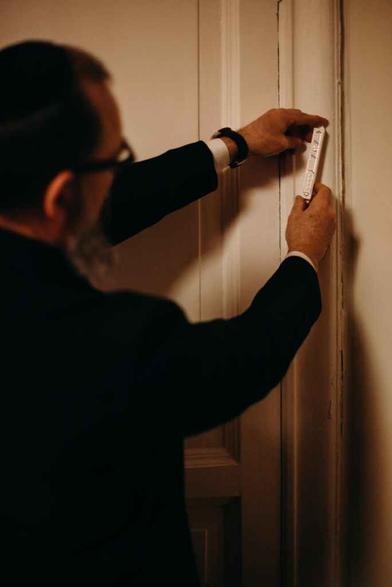
Within Jewish mysticism & folklore (particularly in Kabbalistic traditions) protective practices were also used to ward off malevolent spirits. One such practice involves attaching a mezuzah to the doorposts of a home. A mezuzah is a piece of parchment/paper written with a specific Torah verse.
Photo by cottonbro studio on Pexels.com. This is a mezuzah being hung on a doorpost.While the mezuzah mainly serves as a reminder of faith & adherence to God’s commandments. It’s also viewed as a protective amulet against harmful spirits, including the dybbuks.
The Zohar, a foundational Kabbalah text, suggests that a properly affixed mezuzah can prevent such entities from entering a home. Also, Jewish folklore includes accounts where neglected or improperly maintained mezuzah were believed to make homes open to dybbuk possession.
In Lurianic Kabbalistic view (a major school of Jewish mysticism), it’s believed that every soul undergoes a process called gilgul (reincarnation) until it has made good all its spiritual flaws & completed its divine mission (tikkun).
A dybbuk is usually the soul of a great sinner. Someone who failed so utterly in life that their soul is deemed unfit for reincarnation or even for the stillness of the afterlife.
Because the soul can’t find rest or transition into a new body, it’s condemned to wander the world, a spiritual refugee. this limbo state between death & full divine judgment is sometimes referred to as the Barzakh in certain mystical texts. The dybbuk, being trapped & tormented, lashes out by invading a living host.
The possession is an act of desperation or malice. Once a dybbuk possesses a person (usually a woman, but not always), the host’s voice may change, becoming that for a dead person. Sometimes they speak in an unfamiliar language (it’s unfamiliar to the speaker/possessed person), or they recite profound, sacred texts they’ve known or seen.
The dybbuk speaks through the host. Often they reveal the sins that condemned it to wander or it accuses the host’s family of a concealed transgression. The host often suffers intense physical & mental anguish.
Because the dybbuk is a spiritual entity with a soul, its removal is an intensely religious act, an exorcism, that requires the intervention of a learned & righteous rabbi. Usually a rabbi is versed in Kabbalistic practices. The ceremony is solemn & ritualistic.
The rabbi, with a quorum of 10 men (minyan) & often holding a shofar (a ram’s horn), tries to reason with the dybbuk, at first, urging the distressed soul to leave in peace to leave in peace & accept its divine judgment.
If the dybbuk resists, the rabbi must use the power of sacred names & oaths. The rabbi may threaten the spirit with complete banishment from the Jewish people (a harsher spiritual punishment than eternal wandering).
The essential moment is when the rabbi calls upon the Divine Name to compel the dybbuk to exit the body. Often through the host’s small toe or finger so as to not cause the host any permanent harm.
As the dybbuk leaves, the shofar is usually sounded to break the spirit’s hold & symbolizes the final severance. The exit is then sealed with a prayer.
The Possession (2012) is a supernatural horror centered around the idea of a dybbuk. The story follows a young girl who becomes possessed by an evil spirit after finding an old box at a yard sale. Jeffrey Dean Morgan & Kyra Sedgwick star in this movie.
One-Time Monthly YearlyMake a one-time donation
Make a monthly donation
Make a yearly donation
Choose an amount
$1.00 $5.00 $10.00 $1.00 $5.00 $10.00 $5.00 $10.00 $15.00Or enter a custom amount
$Your contribution is appreciated.
Your contribution is appreciated.
Your contribution is appreciated.
DonateDonate monthlyDonate yearly
#16thCentury #18thCentury #Afterlife #Barzakh #CentralEurope #Commandments #Dibbuk #Dybbuk #EasternEurope #Exorcism #Ghosts #Gilgul #Hebrew #JeffreyDeanMorgan #Jewish #JewishFolklore #JewishMysticalTraditions #Josephus #Kabbalah #KyraSedgwick #LurianicKabbalah #Mezuzah #Quorum #Rabbi #Reincarnation #Shofar #Sinner #Soul #Spirit #Tikkun #Torah #Weddings #Zohar
 Serge from Babka
 🐦🔥nemo™🐦⬛ 🇺🇦🍉
🎥 Rediscover "The Golem: How He Came into the World" (1920) - a silent German Expressionist masterpiece! 🇩🇪 A rabbi creates a golem to protect his community, but it becomes a force of destruction. 💀 Directed by Boese and Wegener, this influential horror classic features groundbreaking effects and a brooding atmosphere. 🎬 Experience the power of silent cinema! 🎥
https://www.youtube.com/watch?v=jTtZ6mdrfB0
#TheGolem #SilentFilm #GermanExpressionism #Horror #JewishFolklore #ClassicMovie
