https://www.moezine.com/1133166/ 【料理】関根さんのお手伝い【豚汁】 【料理】関根さんのお手伝い【豚汁】 わそうですですすごい始まりだな大人気 企画関根さんのお手伝いをしようの コーナーでございます本当人気ある本当に 人気ですよお雑煮がね本当思った以上に 反響があって良かったよかったで今回は こちら美味しそうだね生き生きしてる… #actress #baseball #FuminoKimura #HealthyJapaneseFoodRecipes #japan #japanese #JapaneseCultureAndTraditions #JapaneseFoodCooking #JapaneseRestaurantCooking #JapaneseRestaurants #JapaneseStreetFoodCooking #TraditionalJapaneseDinner #TraditionalJapaneseFood #とん汁 #和楽惣 #和食 #女優 #差し入れ #日本食 #木村文乃 #豚汁 #野球
【料理】関根さんのお手伝い【豚汁】

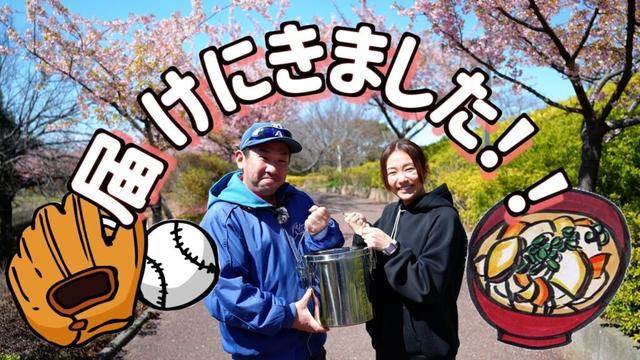
【料理】関根さんのお手伝い【豚汁】 わそうですですすごい始まりだな大人気 企画関根さんのお手伝いをしようの コーナーでございます本当人気ある本当に 人気ですよお雑煮がね本当思った以上に 反響があって良かったよかったで今回は こちら美味しそうだね生き生きしてるんね 全ての食材がねまこないの雑煮の応用だね 出汁をそんなに使わずに素材の出汁で 美味しく持ってくそれで豚の旨味を入れて こじるわあとんじる昆布またあれでしょ ちょっとしか使わないんじゃないそうそう 今回でも量が多いんで1本行っちゃうかな うんそう今回はささんの野球チームに豚汁 の差し入れをしようということで今この 作ってる裏側で子供たち今試合してるんで そんなみんなにねちょっとあったまって もらうべく豚汁を作りたいと思います ニンジンに昆布にと大根にネギこの ごぼうねこれなんか熊本のちょっと 柔らかいごぼうあ本当だあ柔らかい味噌は 2種類はい何と何合わせと白合わせと白 もう合わせちゃってんじゃんこれ2つだ から合わせるん だろ赤と白あはいこれ九州の麦味噌これ 新州味噌うんの新みそ麦味噌って白い イメージだったよあそううん豚汁には やっぱり麦味噌豚汁かには合うと思います 出身東京やんね千葉ですあそう千葉です あれ初めましてでしたっけ じゃも作っていきましょうかはいよろしく お願いしはいよろしくお願いし ますじゃあはい皮剥いてこうかはい人数 いるからな何いるの今日何いんだ2020 人だか30人だかなのでこのでかいズド1 杯作りますえいはいいっぱい作るの楽しい ねそうねやっぱいっぱい作った方が味が いいからねうんうんうんあやっぱそれは 実際にあるんだねあるあるニンジンのねば ちゃんを向いていきたいと思いますねはい 包丁で向くピーラーで向くピーラーだよ これにじゃあ向いてこううん オッケーなんかピーラーがさすごいあの いい刃物の切れ味の音がするそううんもう それ20年使ってるピーラだけどはい こちら20年ものピーラーだそうですお酒 じゃないんだからすごい歯きれだってピー ラーってさ歯の手入れのしよってなくない ですかないよね俺もさっきすくと思ったん だよこれってどうやって研ぐんだろうと 思って研げないよねねえだから20年もう このまんまで元気ってことそうそうすごい なまいたじゃあ大根も行きましょうはい いいよヒラでほいでもさ大根ってさ厚めに 皮剥くのがいいみたいな感じそうね似たり する時このこのねちょうどここにうん節が あるの分かるうん分かるここまで向くのが いいだよね煮れしないよだかなり厚めに 向くよねそうでも大丈夫薄くて両手で出す ものじゃないから今日はうんうんお店で 出すものだったらすっかり向くけどねうん うんうんこれ家でやる時皮剥かないもん 大根もニンジンもそのまかるけどそうなん だなんかあや歯触りあれじゃないのだ 大丈夫だそれがいいんだよ大丈夫だ大丈夫 だよできたほいはい抜きまして抜きました はいじゃあ切りますか おい下手落としてうんどどうやって胃腸 する胃腸え普通に半分に切ってじゃない うん下手落として下手落としておしっぽも 落としてうん片半分うん手気をつけてよ気 をつけてよ気をつけ てででえこれでま一応にしてく胃腸って どういう形 こうハートだろそれそれハートだよ三角形 三角形っぽい感じですこうだよねうんうん うんてことは塩水うんこのまま行くとえ ここでさ半分にしたらさこれでさ三角形 できるうんおおそうそうそう合ってる合っ てるよ合ってるけどうんじゃやって半分に してこ これ半分にしてうんじゃあこれ切っていき ますうんこれ とこれって一緒うん違いますはいはいこれ とこれ一緒かな全然違いますねだったら うんここまでねしとなるほど途中から半月 にしてけば細いとこと太いとこのバランス が良くなるじゃんおお正値ポインツうん そうだなちょっと今日朝早いですからああ 眠いすっごい 眠いなるほどじゃあそうやってやっていけ ばいいんだねおお確かに半分だけ切るって なかなか切っちゃったよこれだから大丈夫 大丈夫似ちゃえばわかんない似ちゃえば わかんじゃあまあ一応にねそう そう はいこいつも以上 ちおっと短くしたなでかい方待って ちゃんんいやなんかさふに渡されたのと

Moe Zine
Number of Japanese restaurants abroad triples in last decade

By country, China had the most Japanese restaurants at 78,760, followed by the United States at 26,040 and South Korea at 18,210.

The Japan Times

Frank Architecture creates intimate setting for Calgary's Lonely Mouth noodle bar

Canadian studio Frank Architecture has designed a Japanese restaurant in Calgary where wood panelling, low lighting and corduroy-upholstered chairs all contribute to a cosy atmosphere.

The Lonely Mouth bar and restaurant is named in reference to the Japanese concept of kuchisabishii, which means "when you're not hungry, but you eat because your mouth is lonely".

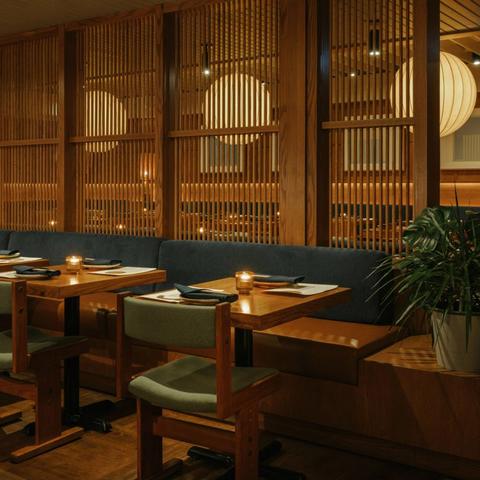
A screen of wooden dowels divides the bar and restaurants areas at Lonely Mouth

Found at the eastern end of Calgary's 17 Avenue commercial strip, only a few blocks from Frank Architecture's studio in the city, the bar serves udon made in-house and boasts an extensive sake selection.

"Lonely Mouth is a place where tradition meets innovation," said the team at Frank Architecture. "They offer a carefree and interactive dining experience, featuring a dynamic and playful menu with modern and energetic flavours."

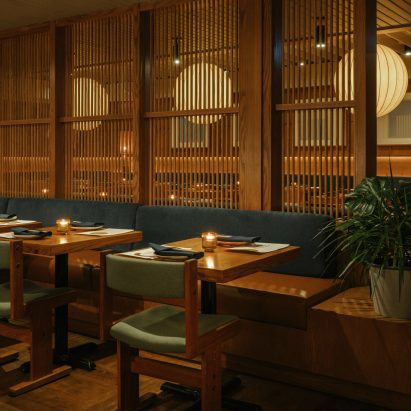
Wood panelling lines the rooms above built-in banquette seating

For the interiors, the designers chose a warm palette of green and brown tones, along with textured plaster and soft upholstery to create an intimate atmosphere.

"Inspired by Japanese minimalism, the interior takes a 'less is more' approach," the team said. "The design is very restrained."

A trio of spherical lights hang above the central row of tables

A screen of wooden dowels divides the bar and dining spaces, adding to the sense of intimacy. The restaurant's noodle maker can be seen working in the bar area, allowing guests to watch their food being prepared.

Shelving behind the bar, which displays the sake collection, was built using wood salvaged during the renovation of the space.

Green and blue upholstery complements the warm wood tones

Along the sides of the main dining area runs built-in seating with blue-fabric backs.

Wood panelling above is decorated with works by local artists Rhys Douglas Farrell, and Harry Kiyooka, who died aged 94 earlier this month.

[

Read:

Sarah Ward references 1920s Shanghai at Two Penny Chinese

](https://www.dezeen.com/2018/11/10/two-penny-chinese-art-deco-restaurant-bar-calgary-sarah-ward-interiors/)

Wooden tables form rows beside the banquettes, with an additional line through the middle of the room.

Diners at these central tables sit on chairs covered in brown velvet corduroy, while other seats are upholstered in green fabric.

Sake is displayed on repurposed shelves behind the bar

A trio of spherical, paper pendant lamps cast a dim glow into the restaurant, assisted by spotlights, fringed table lamps and candles in setting the mood.

"Light levels are dimmed and offer a soft, even glow to diners," the team said.

Textured plaster walls and fringed artworks are found near the entrance

Frank Architecture was established in 2009 by principals Kelly Morrison, Kate Allen and Kristen Lien.

Along with Calgary, the firm has an office in Banff and was longlisted for interior design studio of the year at the 2021 Dezeen Awards.

The photography is byChris Amat.

The post Frank Architecture creates intimate setting for Calgary's Lonely Mouth noodle bar appeared first on Dezeen.

#restaurantsandbars #all #interiors #instagram #restaurants #canada #calgary #japaneserestaurants

Frank Architecture creates intimate setting for Calgary's Lonely Mouth noodle bar

Canadian studio Frank Architecture has designed a Japanese restaurant in Calgary where wood panelling, low lighting and corduroy-upholstered chairs all contribute to a cosy atmosphere.

The Lonely Mouth bar and restaurant is named in reference to the Japanese concept of kuchisabishii, which means "when you're not hungry, but you eat because your mouth is lonely".

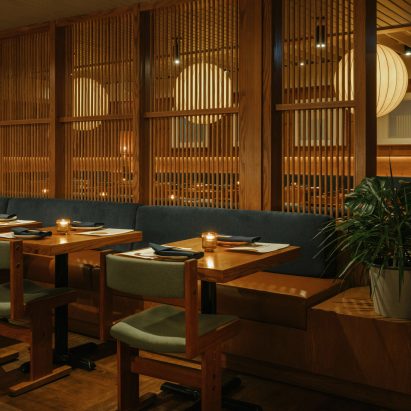
A screen of wooden dowels divides the bar and restaurants areas at Lonely Mouth

Found at the eastern end of Calgary's 17 Avenue commercial strip, only a few blocks from Frank Architecture's studio in the city, the bar serves udon made in-house and boasts an extensive sake selection.

"Lonely Mouth is a place where tradition meets innovation," said the team at Frank Architecture. "They offer a carefree and interactive dining experience, featuring a dynamic and playful menu with modern and energetic flavours."

Wood panelling lines the rooms above built-in banquette seating

For the interiors, the designers chose a warm palette of green and brown tones, along with textured plaster and soft upholstery to create an intimate atmosphere.

"Inspired by Japanese minimalism, the interior takes a 'less is more' approach," the team said. "The design is very restrained."

A trio of spherical lights hang above the central row of tables

A screen of wooden dowels divides the bar and dining spaces, adding to the sense of intimacy. The restaurant's noodle maker can be seen working in the bar area, allowing guests to watch their food being prepared.

Shelving behind the bar, which displays the sake collection, was built using wood salvaged during the renovation of the space.

Green and blue upholstery complements the warm wood tones

Along the sides of the main dining area runs built-in seating with blue-fabric backs.

Wood panelling above is decorated with works by local artists Rhys Douglas Farrell, and Harry Kiyooka, who died aged 94 earlier this month.

[

Read:

Sarah Ward references 1920s Shanghai at Two Penny Chinese

](https://www.dezeen.com/2018/11/10/two-penny-chinese-art-deco-restaurant-bar-calgary-sarah-ward-interiors/)

Wooden tables form rows beside the banquettes, with an additional line through the middle of the room.

Diners at these central tables sit on chairs covered in brown velvet corduroy, while other seats are upholstered in green fabric.

Sake is displayed on repurposed shelves behind the bar

A trio of spherical, paper pendant lamps cast a dim glow into the restaurant, assisted by spotlights, fringed table lamps and candles in setting the mood.

"Light levels are dimmed and offer a soft, even glow to diners," the team said.

Textured plaster walls and fringed artworks are found near the entrance

Frank Architecture was established in 2009 by principals Kelly Morrison, Kate Allen and Kristen Lien.

Along with Calgary, the firm has an office in Banff and was longlisted for interior design studio of the year at the 2021 Dezeen Awards.

The photography is byChris Amat.

The post Frank Architecture creates intimate setting for Calgary's Lonely Mouth noodle bar appeared first on Dezeen.

#restaurantsandbars #all #interiors #instagram #restaurants #canada #calgary #japaneserestaurants

Rockwell Group takes maximalist approach to Japanese design at Katsuya NYC restaurant

Elements of traditional Japanese architecture and design are combined and given a contemporary spin by New York studio Rockwell Group at this sushi restaurant in Manhattan.

Katsuya is the latest restaurant of its name by chef Katsuya Uechi, following locations in Los Angeles, Miami and the Bahamas all serving sushi with a Californian twist.

Katsuya serves Californian-influenced Japanese cuisine by chef Katsuya Uechi. This and top photos by Nikolas Koenig

For its interior, Rockwell Group looked to a variety of Japanese aesthetic traditions, and blended them together to create a theatrical experience.

"The interior dining rooms take a maximalist approach to Japanese aesthetics, an entertaining departure from the contemporary minimalist vogue," said the team.

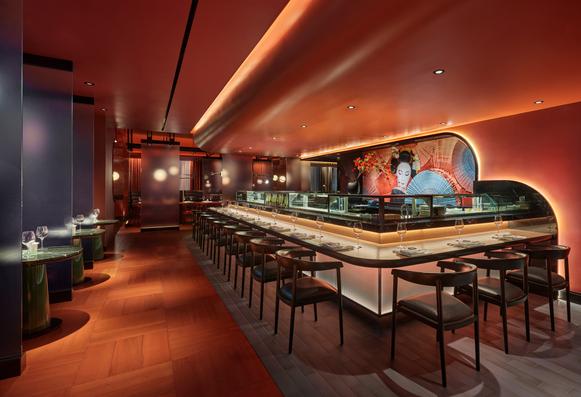
A long red-lacquered communal table occupies the centre of the dining room. Photo by Nikolas Koenig

The restaurant totals 6,890 square feet (640 square metres) and seats up to 305 diners. Guests enter past the sushi bar and lounge, which is set up for casual diners to enjoy light bites in view of the kitchen.

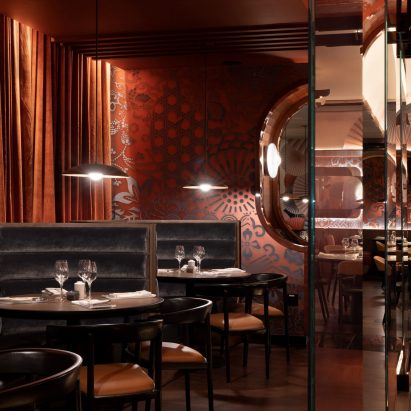
In the main dining area, the space is divided into three sections by a pair arched openings and a series of translucent glass screens subtly printed with images of wagasa – Japanese umbrellas.

Translucent screens divide up the hall-like space

The archways, shaped to reference torii and pagoda architecture, are trimmed with red lacquer and inlaid with square wooden tiles.

Screens are suspended from a black powder-coated metal framework, reminiscent of kumiki wood joinery.

Secluded banquettes are positioned towards the back. Photo by Emily Andrews

Dominated by red, the central space has a long communal table, plus several two-tops and a trio of secluded banquettes towards the back.

Small to medium-sized parties are accommodated in the section to the right, where the red tones are swapped for warm creams and the wagasa patterns appear again on the wallpaper.

Several traditional Japanese wagara motifs decorate the walls

More banquette niches are framed by curved ceilings, and decorated with other traditional wagara motifs and imagery of performers with fans.

The final indoor dining area includes a variety of table sizes, as well as a robata grill – a specialty that the chef is "renowned for pioneering in the West" according to the team.

A private dining room seats 10. Photo by Nikolas Koenig

Concentric pendant lights by Allied Maker spotlight individual tables and booths throughout the restaurant.

Meanwhile, the red-lacquered communal table is "illuminated by a custom chandelier with a lazily undulating form that appears like waves rendered in ink".

[

Read:

Rockwell Group models Casa Dani restaurant in New York on Andalusian patios

](https://www.dezeen.com/2022/02/08/casa-dani-restaurant-interiors-rockwell-group/)

A private dining room at the end of the hall-like restaurant features red-leather-backed chairs around a circular wooden table, which seats 10.

In the warmer months, a terrace influenced by autumnal Japanese gardens will provide space for 98 guests outdoors.

Screens are subtly printed with images of wagasa – Japanese umbrellas

Katsuya opened in March 2022 as one of two full-service restaurants inside the Citizens food hall, located within the Manhattan West development between Hudson Yards and Penn Station.

Rockwell Group was also responsible for the interior design of Citizens, as well as the other fine-dining option Casa Dani, which serves Andalusian cuisine in a setting to match.

Allied Maker's Concentric pendant lights are hung throughout the restaurant

The firm was founded by architect and designer David Rockwell in 1984, and is best known for hospitality projects, and production design for theatre and events.

Its studios have recently collaborated with fellow designers Joyce Wang on the first Equinox Hotel, Yabu Pushelberg for the Moxy Chelsea hotel and Diller Scofidio + Renfro to build 15 Hudson Yards and The Shed - all in New York City.

The photography is courtesy of Katsuya, unless stated otherwise.

The post Rockwell Group takes maximalist approach to Japanese design at Katsuya NYC restaurant appeared first on Dezeen.

#restaurantsandbars #all #interiors #usa #restaurants #rockwellgroup #newyorkcity #midtownmanhattan #japaneserestaurants #newyork

Stitched brick wall welcomes guests to Uchi Miami restaurant by Michael Hsu

Masonry bricks are tied together to form a curved entryway at this sushi restaurant in Miami's Wynwood neighbourhood, by Michael Hsu Office of Architecture.

At Uchi Miami, the American firm aimed to create a "perfect contrast" between the materials, techniques and styles of Japan and Florida.

Uchi Miami in Wynwood is fronted by a white structure wrapped in slats

"Uchi tells a story of tactility, honoring Japanese tradition, but has been infused with local notes," said Michael Hsu Office of Architecture.

"Wrapping, layering and stitching, inspired by native art forms, apply sophisticated design to simple objects to elevate ordinary materials found in daily life."

A wall of woven bricks by Vas Bets greets guests upon entry

Flanked by troughs filled with tropical plants, the entrance is surrounded by a pure white frame wrapped with vertical slats.

Once through the glass doors, guests are guided around to the host stand by a curved wall of concrete blocks created by locally based artist Vas Bets.

A chalk mural by Sam Angus Jackson is found above the sushi bar

The blocks are tied together with rope, which weaves through their holes in a repeated pattern that is reflected in the polished floor.

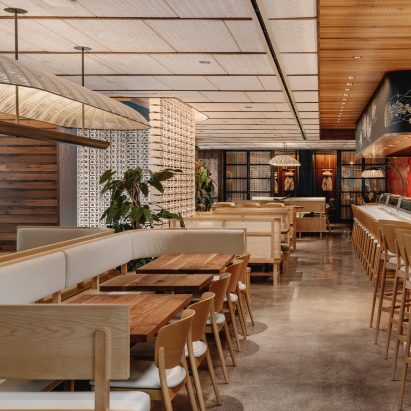
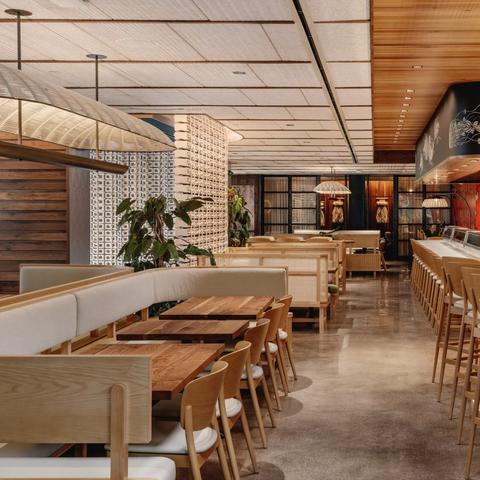
In the main dining area, a mix of banquettes, bar seating and high-top tables offers a variety of configurations for parties of different sizes.

Warbach's woven light fixtures create patterns across the ceiling

The wooden banquettes feature curved woven back panels and grey upholstered cushions – in a bouclé fabric for the backs and leather for the seats.

Walnut table tops and ash chairs match panelling on the walls and ceiling, while other surfaces are lined with bright red and orange wallpaper.

[

Read:

Pirajean Lees channels 1920s Japan in ornate Dubai restaurant interior

](https://www.dezeen.com/2021/09/05/pirajean-lees-mimi-kakushi-dubai-restaurant/)

Other artist collaborations within the restaurant include a hand-drawn chalk mural of jellyfish by artist Sam Angus Jackson, found above the sushi bar.

Hand-woven wall hangings by Miami artist Elan Byrd decorate the series of private dining areas, which run along one end of the restaurant behind black-framed glass panels.

Bright red wallpaper offers a contrast to the natural materials

Positioned over the bars and dining tables, lighting studio Warbach's bespoke fixtures continue the woven motif.

"The overhead large, custom basket light provides a warm glow to illuminate the wall's shapes and textile-inspired characteristics," said Michael Hsu's team.

The studio aimed to blend a variety of textures and materials throughout the restaurant

Michael Hsu Office of Architecture has previously completed a restaurant with a curved wooden ceiling in its home city of Austin, Texas.

The studio has also designed a remote home in Texas Hill Country and the interiors for Shake Shack's headquarters in New York City.

The photography is byChase Daniel.

Project credits:

Owner: Hai Hospitality
Architect of record: Form Group Architecture
General contractor: City Construction Group
Project management: Amicon Management
Kitchen consultant: Trimark USA
MEP: RPJ Engineering
Landscape designer: Plant the Future

The post Stitched brick wall welcomes guests to Uchi Miami restaurant by Michael Hsu appeared first on Dezeen.

#restaurantsandbars #all #interiors #usa #miami #bricks #restaurants #florida #michaelhsuofficeofarchitecture #japaneserestaurants

Oku restaurant in Mexico City features "floating tables" made of wood and steel

Curved booths are suspended over a dining room at a Japanese restaurant in Mexico City designed by local firms Michan Architecture and Escala Arquitectos.

The sushi eatery is located in the upscale neighbourhood of Jardines del Pedregal, across from a famed church known as Parroquia de la Santa Cruz del Pedregal.

Oku is a sushi restaurant in Mexico City

It is the second Oku restaurant designed by Michan Architecture. The other – which features a cave-like ceiling made of huge concrete lights – is found in the district of Lomas de Chapultepec.

For the Pedregal location, the architects worked with another local firm, Escala Arquitectos. The team aimed to elongate the space's proportions and take advantage of its height.

The restaurant is Michan Architecture's second of its kind

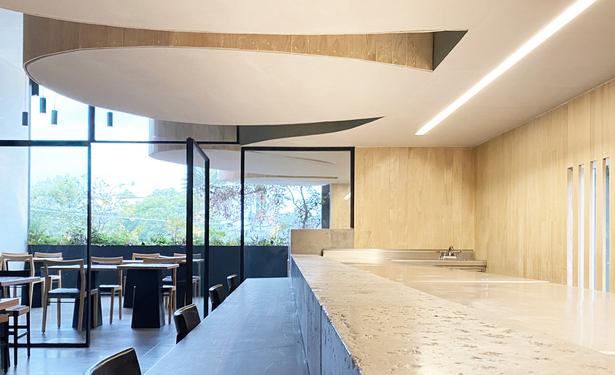
Rectangular in plan, the eatery has two levels. The lower level encompasses a sushi bar, indoor and outdoor seating, and a back-of-house zone.

Additional seating is found upstairs, where a series of "floating tables" are arrayed along a corridor.

"Floating tables" are arrayed along a corridor

"The mezzanine level features individual tables hung from the existing structure, giving guests a unique dining experience," the studio said.

Two of the tables hover above the sushi bar, and two extend over the outdoor terrace. Each has wooden walls that enclose a single booth.

Curved stairs connect Oku's two levels

A similar enclosure was used for the stairs connecting the restaurant's two levels.

The dining pods are supported by light steel members that are welded into the building's existing steel structure.

[

Read:

Samurai armour and Kanji characters inform Mexico City's Tori Tori restaurant by Esrawe Studio

](https://www.dezeen.com/2020/03/29/tori-tori-restaurant-esrawe-studio-mexico-city/)

Above the mezzanine is a drop ceiling with curved cutouts that expose the steel framing and add height to the space.

Moreover, the openings provide a "sensation of cutting and pasting the ceiling onto the tables", the architects said.

Cylindrical black lighting fixtures hang from the ceiling

Hung from the ceiling are cylindrical, black lighting fixtures, which merge electrical cables with structural elements.

Throughout the restaurant, the team used neutral colours and clad surfaces in pine, pigmented stucco and panels made of glass-fibre-reinforced concrete (GFRC).

The team used neutral colours and clad surfaces in pinewood throughout Oku

The effect is a "light and open atmosphere that plays with polished and raw finishes", the team said.

Other Japanese eateries in Mexico include Mexico City's Tori Tori by Esrawe Studio, which features elements inspired by Samurai armour, and a restaurant by TAX Architects in the coastal town of Puerto Escondido that is topped with a thatched roof.

The photography is by Alexandra Bové.

Project credits:

Architect: Michan Architecture and Escala Arquitectos
Project team: Narciso Martinez, Benjamin Espindola, Emilio Gamus, Isaac Michan
Structural engineer: Arturo Rosales + MdO
Mechanical, electrical, plumbing: RAGER, Rafael Barra

The post Oku restaurant in Mexico City features "floating tables" made of wood and steel appeared first on Dezeen.

#restaurantsandbars #all #interiors #instagram #wood #steel #mexicocity #restaurants #mexico #japaneserestaurants

YODEZEEN inserts atmospheric Japanese restaurant in former Kyiv Arsenal building

Restrooms housed within a red metal mesh structure and a central open kitchen feature in this Japanese restaurant in Kyiv by local architecture and design firm YODEZEEN.

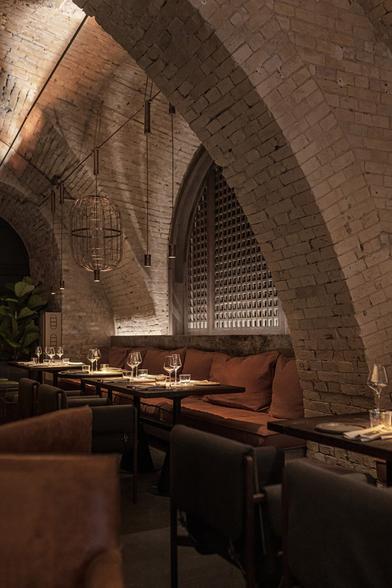
Located in an 18th-century brick building with art nouveau elements, the Virgin Izakaya Bar is in a central area of the Ukrainian city that was previously dedicated to weapons production.

The restaurant is located within a former arsenal

Izakaya refers to a type of informal bar serving drinks and small plates of food that are ubiquitous in Japan. The word izakaya (居酒屋) is made up of three kanji with the meaning: stay-drink-place.

YODEZEEN's design concept was based upon retaining the industrial building's existing architecture and all of its original art nouveau details, while creating a welcoming and contemporary design evocative of the izakaya experience.

An open kitchen and bar are located at the centre of the restaurant

Measuring 405 square metres, the Japanese restaurant's dining hall revolves around a central open kitchen that serves as the interior's focal point. Positioned at the same level as the restaurant's seating and spanning almost the entire length of the restaurant, the kitchen is edged with a long bar counter and designed to be visible from every angle.

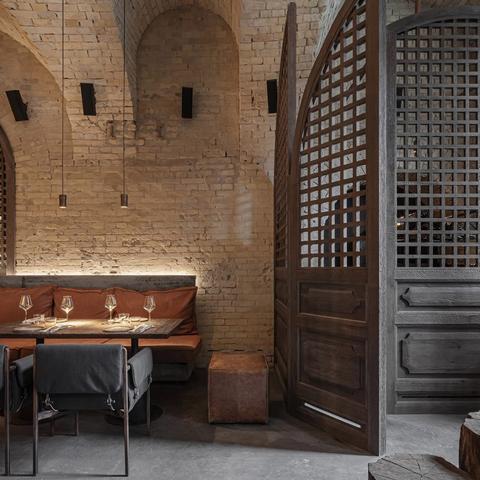
Wooden tables are placed around the main hall, and some places have single stick stools reminiscent of those found in izakaya across Japan.

Weathered wood and copper was used throughout the restaurant to add warmth

"Everything that used to be carefully hidden is now in the public realm," said the studio, which has offices in Kyiv, Los Angeles and Miami. "The guest finds himself face to face with the chef and becomes an attendee of a real culinary master class."

To add warmth to the bare brick walls and concrete surfaces, which the studio deliberately kept raw, the design team selected a palette of natural materials such as wood, copper and natural leather.

Oxidised metal panels and metal mesh were added to create zones within the interior and also create special decorative elements. This is demonstrated in the restaurant's restrooms, which are houses in an independent red metal mesh structure.

"We wanted the elements of the Japanese style not to be flashy, but to be read in certain solutions," said Artem Zverev, YODEZEEN studio co-founder and the project's lead architect.

A red metal mesh volume houses the restaurants bathrooms

"It is about the concept of restrooms, expressed in a separate building in Japanese style, about three metres high," Zverev added.

"We have implemented this interior building in the form of a red metal mesh, which made it possible to view a part of the hall from the restrooms and vice versa."

"We have created an atmospheric, conceptually complete space," concluded Zverev. "Brick walls, rough wood, oxidized metal, bare concrete, opposed to the warm and pleasant atmosphere, created by the right statement of light and greenery."

The interior of the bathrooms has a similar raw and untreated finish

The Virgin Izakaya Bar has been shortlisted for restaurant and bar interior of the year at the 2021 Dezeen Awards.

Other projects nominated in the category include another restaurant in Kyiv with bumpy clay walls and rough concrete surface by local studio Yakusha Design, and a restaurant with a lighting installation made up of a tangle of red neon tubes in Berlin.

The post YODEZEEN inserts atmospheric Japanese restaurant in former Kyiv Arsenal building appeared first on Dezeen.

#restaurantsandbars #all #interiors #restaurants #kyiv #ukraine #japaneserestaurants

YODEZEEN inserts atmospheric Japanese restaurant in former Kyiv Arsenal building

Restrooms housed within a red metal mesh structure and a central open kitchen feature in this Japanese restaurant in Kyiv by local architecture and design firm YODEZEEN.

Pirajean Lees channels 1920s Japan in ornate Dubai restaurant interior

London practice Pirajean Lees has converted a nightclub in Dubai into a restaurant informed by Japan's jazz age and the grandiose parties of silent film actor Sessue Hayakwa.

The restaurant, which serves modern twists on Japanese classics, is named Mimi Kakushi after the distinctive bob haircut worn by the young Japanese Moga, or modern girls, who adopted western fashions in the period after the first world war.

Mimi Kakushi's interior integrates elements of traditional Japanese joinery (top and above)

This jazz age aesthetic is also reflected in the interior of the eatery, which is layered with rich textures and materials including traditional joinery, hand-painted walls, beaded curtains and bespoke stained glass windows.

"Mimi Kakushi embodies Japan when jazz was swinging into 1920s Osaka, bringing modern art and western fashions to it," explained Clémence Pirajean and James Michael Lees, who founded Pirajean Lees in 2007.

The restaurant's electricals and mechanical equipment is hidden behind a straw ceiling grid

In particular, the duo looked to the larger-than-life persona of Sessue Hayakwa, Japan's first silver screen star to find success in Hollywood.

"Hayakwa perfectly personified this era," said the studio. "Known for his lavish parties, gold-plated car and castle-style mansion, Hayakwa's story became the foundation for the design."

A colonial-style Japanese bar stands near the reception

The existing architectural features of the nightclub, such as the level changes in the ceiling and structural columns, guided the spatial layout of the restaurant.

In the reception, diners are welcomed by hand-painted walls before making their way past a Japanese colonial-style bar with views across the sushi counter to the tables beyond.

The sushi counter with its open kitchen is visible throughout the restaurant

An open kitchen, visible throughout the space, creates a sense of theatre in the restaurant.

All electrical and mechanical equipment, as well as the ventilation system, is hidden behind a straw ceiling grid to preserve a "residential feel" within the commercial space.

Throughout the project, Pirajean Lees was careful to filter the strong Dubai sun, which penetrates into Mimi Kakushi from two different directions.

To the east, a bespoke stained glass window was installed on the existing facade, bathing the space in warm, amber light. To the south, a wooden bead curtain is used alongside mirrored tables and walls to refract the light.

Light is filtered into the space via a stained glass wall in the east

"Mimi Kakushi is on the top floor of the building, with dual exposure on the east and west with fully glazed elevations," the studio explained.

"It gets direct, strong sunlight all day long, which can be very uncomfortable when dining. We understood that instead, we could use it as an advantage, as a design element in itself to transform the space throughout the day as the light changes."

Sliding lattice screens can be used to divide the interior

Sliding lattice screens made from dark timber can be used to divide the open-plan restaurant into a sequence of smaller spaces for privacy and special events.

All lighting, as well as the scalloped-edged tables and a selection of the seating, were designed in-house by Pirajean Lees.

Tasseled pendant lights are reminiscent of the 1920s

Other Japanese restaurant interiors include Kotori in São Paulo, which incorporates traditional joinery techniques, and London's Maido sushi restaurant with its 1960s-style glass block wall and dark cherry wood panelling.

Photography is byMaha Nasra Eddé.

The post Pirajean Lees channels 1920s Japan in ornate Dubai restaurant interior appeared first on Dezeen.

#restaurantsandbars #all #interiors #dubai #restaurants #unitedarabemirates #japaneserestaurants

Pirajean Lees channels 1920s Japan in ornate Dubai restaurant interior

London practice Pirajean Lees has converted a nightclub in Dubai into a restaurant informed by Japan's Jazz Age and the grandiose parties of silent film actor Sessue Hayakwa.