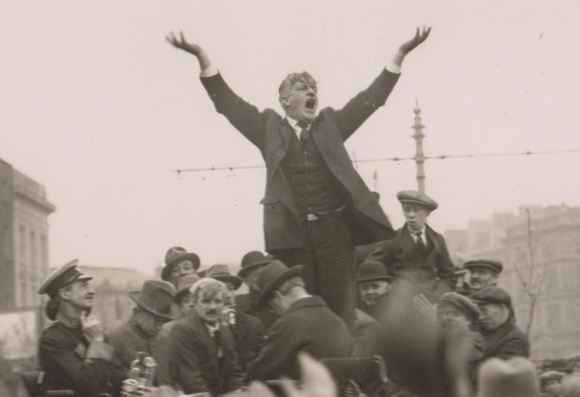
Helping took many forms, including the fight for workers' rights. Born in Liverpool to Irish parents, James Larkin took the resilience of the docks and the navvies and forged it into a global labor movement. James Larkin represents the shift from the Irish being a community that needed help, to a community that led the charge for justice and equality for all workers.

#jameslarkin #AnGortaMór #liverpool #mastodaoine

Today in Labor History August 26, 1913: The Dublin lock-out began, a 5- month strike over terrible living and working conditions, and for union recognition. At the time, some Irish workers were living with 55 people per house. The Infant mortality rate among the poor was 142 per 1,000 births. TB-related deaths were 50% higher than in England or Scotland. The main organizers of the strike were 2 syndicalists, James Larkin and IWW cofounder, James Connolly. Several workers were killed by police and by strikebreakers. Hundreds were injured. WB Yeats’ poem, September 1913, is often viewed as a commentary on the brutality of the strike. Connolly was later executed as a leader of the Easter Rising, in 1916.

#workingclass #LaborHistory #dublin #lockout #union #strike #ireland #socialism #jameslarkin #jamesconnolly #IWW #police #policebrutality

The Belfast lockout took place in Belfast from 26 April to 28 August 1907. The strike was called by Liverpool-born trade union leader James Larkin who had successfully organised the dock workers to join the National Union of Dock Labourers. The dockers, both Protestant and Catholic, had gone on strike after their demand for union recognition was refused.

#History #IrishHistory #Beflast #NorthernIreland #BelfastLockout #JamesLarkin #OnThisDay

O’Casey also said Larkin ‘had the eloquence of an Elizabethan, fascinating to all who heard him, and irresistible to the workers. He was familiar with the poetry of Shakespeare, Whitman, Shelley and Omar Khayyam, and often quoted them in his speeches.’ 3/3

#Ireland #IrishHistory #JamesLarkin #DublinLockout

Larkin was probably the most effective labour leaders in Irish history leading major strikes of 1907 (Belfast and Dublin), 1911, and the 1913 Dublin Lockout, a six-month ultimately failed standoff between Dublin workers and employers. In 1908, he founded the Irish Transport and General Workers Union. 2/3

#Ireland #IrishHistory #JamesLarkin #DublinLockout

Union Leader, James Larkin died on 30 January 1947 in Dublin. Sean O’Casey said of Larkin ‘He fought for the loaf of bread as no man before him had ever fought; but with the loaf of bread, he also brought the flask of wine and the book of verse.’ 1/3

#Ireland #IrishHistory #JamesLarkin #DublinLockout

Today in Labor History January 4, 1909: James Larkin founded the ITGWU (Irish Transport and General Workers Union) on this date in Dublin. Many of the original members of the ITGWU came from the socialist movement or from the IWW. Their logo was the Red Hand of Ulster. They were at the center of the syndicalist-led Dublin Lockout in 1913, in which 2 people died and hundreds were injured (mostly police). “September 1913,” one of the most famous of W. B. Yeats' poems, was published during the lock-out. After Larkin left for the U.S. in 1914, James Connolly led the ITGWU until his execution in 1916 for his leadership role in the Easter Rising. Connolly was a founding member of the IWW in the U.S. in 1905.

#workingclass #LaborHistory #jameslarkin #jamesconnolly #itgwu #IWW #ireland #independance #ulster #easterrising #yeats #poetry #dublin #writer #author @bookstadon

Today in Labor History August 26, 1913: The Dublin lock-out began, a 5- month strike over terrible living and working conditions, and for union recognition. At the time, some Irish workers were living with 55 people per house. The Infant mortality rate among the poor was 142 per 1,000 births. TB-related deaths were 50% higher than in England or Scotland. The main organizers of the strike were 2 syndicalists, James Larkin and IWW cofounder, James Connolly. Several workers were killed by police and by strikebreakers. Hundreds were injured. WB Yeats’ poem, September 1913, is often viewed as a commentary on the brutality of the strike. Connolly was later executed as a leader of the Easter Rising, in 1916.

#workingclass #LaborHistory #dublin #lockout #union #strike #ireland #socialism #jameslarkin #jamesconnolly #IWW #police #policebrutality

The Dublin Lockout began on 26 August 1913 as Dublin workers began to leave work in response to a call for a general strike from James Larkin. A Dublin businessman, William Martin Murphy, fired forty workers he suspects belong to the Irish Transport and General Workers' Union (ITGWU). A resulting strike and related civil unrest, the Dublin Lockout, lasted until January 1914.

#Ireland #IrishHistory #Dublin #JamesLarkin #DublinLockout #TradeUnions

The Belfast lockout took place in Belfast from 26 April to 28 August 1907. The strike was called by Liverpool-born trade union leader James Larkin who had successfully organised the dock workers to join the National Union of Dock Labourers. The dockers, both Protestant and Catholic, had gone on strike after their demand for union recognition was refused.

#History #IrishHistory #Beflast #NorthernIreland #BelfastLockout #JamesLarkin #OnThisDay