 David Grayless
A SHA instruction set is a set of extensions to the #ARM, #RISCV and #x86 #instructionSetArchitecture which support #hardwareAcceleration of the #SecureHashAlgorithm (SHA) family.

Although that *is* #UnixWorld magazine from 1985. It was thoroughly 16-bit, starting with Xenix/286 on its front cover and continuing with an MC68000-based HP supermicro. One of the articles was even about running stuff on a 32-bit AT&T 3B2.
@cstross
#Unix #InstructionSetArchitecture #ComputingHistory #retrocomputing
Inside the 8085 Microprocessor – Understanding Its Block Diagram
📱 Learn More with Piembsystech
🔗 Download: https://play.google.com/store/apps/details?id=com.piembsystech&pcampaignid=web_share
🌍 Website: https://piembsystech.com/8085-microprocessor/
#8085Microprocessor #MicroprocessorArchitecture #BlockDiagram #EmbeddedSystems #AutomotiveElectronics #MicroprocessorDesign #ProcessorArchitecture #ECUDevelopment #VehicleElectronics #DigitalElectronics #ComputerArchitecture #EmbeddedDesign #AutomotiveEngineering #MicrocontrollerProgramming #InstructionSetArchitecture
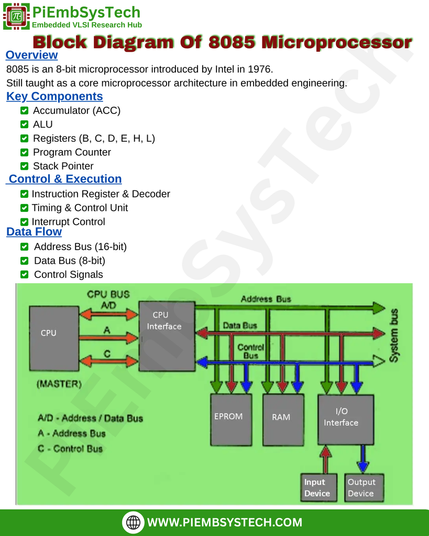
8085 Microprocessor
Join yours Educational open Source community
👉 Download Now from Google Play
🔗 https://play.google.com/store/apps/details?id=com.piembsystech&pcampaignid=web_share
👉 Visit for more :
🌍 https://piembsystech.com/8085-microprocessor/
#8085Microprocessor #EmbeddedSystems #Microcontroller #AutomotiveEmbedded
#ECUDevelopment #InstructionSetArchitecture #MemoryInterfacing #CANProtocol
#UDSProtocol #RealTimeSystems #AssemblyLanguage #EmbeddedEngineer
#MicrocontrollerVsMicroprocessor #AutomotiveTraining #IOLogic
#Intel8085 #InterruptHandling
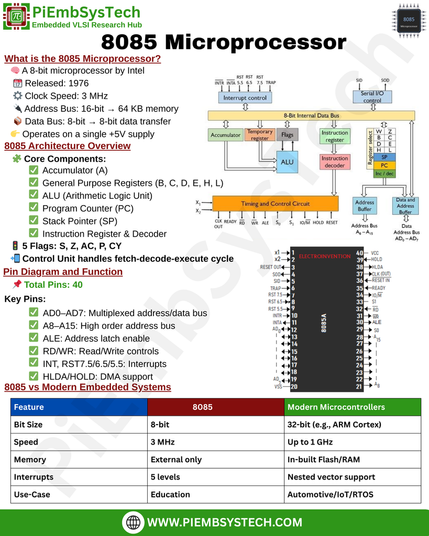
RISC-V Vector Extension overview
🔗 http://0x80.pl/notesen/2024-11-09-riscv-vector-extension.html
"The goal of this text is to provide an overview of RISC-V Vector extension (RVV), and compare — when applicable — with widespread SIMD vector instruction sets: SSE, AVX, AVX-512, ARM Neon and SVE.
[…]
The vector extension is quite a huge addition. It adds 302 instructions plus four highly configurable load & store operations."
#RISCV #RISC_V #RVV #ComputerArchitecture #ISA #InstructionSetArchitecture #CPU #CPUs #processor #processors
RISC-V State of the Union — current highlights and roadmap of RISC-V by RISC-V's chief architect
🎞 https://yewtu.be/watch?v=_oLVPFQvJbI
Slides: https://riscv-europe.org/summit/2024/media/proceedings/plenary/Tue-11-30-Krste-Asanovic.pdf
#RISCV #RISC #CPU #CPUs #architecture #ComputerArchitecture #processor #processors #ISA #InstructionSetArchitecture #hardware
If it's $1 Trillion or if it's $7 Trillion, would it go towards Open #RISC #RISCV #OpenISA #ISA #InstructionSetArchitecture #OpenInstructionSetArchitecture ?
On #RISCV in particular and the evolution of the #RISC approach to #CPU-design in general:
"Why The ISA Battles Aren't Over Yet" [2019], Hackaday (https://hackaday.com/2019/11/12/risc-v-why-the-isa-battles-arent-over-yet/).
#Hardware #Architecture #OpenRISC #POWER #SPARC #ISA #InstructionSetArchitecture
Everything is better when you can program it, right? We have software-defined radios, software-defined networks, and software-defined storage. Now a company called Ascenium wants to create a software-defined CPU. They've raised millions of dollars to bring the product to market.
The materials are a bit hazy, but it sounds as though the idea is to have CPU resources available and let the compiler manage and schedule those resources without using a full instruction set. A system called Aptos lets the compiler orchestrate those resources.
If you are astute, you'll see this has some similarity to RISC and even more to VLIW computer architectures. For more detail, there's an interview with the company's CEO over on TheNextPlatform which has some insight into how the CPU will work.
In addition to RISC and VLIW, transport-triggered architecture shares in this philosophy, too, although there have only been a few commercial versions. So the idea of pushing work to the compiler isn't new. Time will tell if Ascenium's approach is really different and beneficial or, at least, if they can make more of a mark against the three or four big CPU makers.
Of course, if you really want to reconfigure your CPU, you could do it with an FPGA. Transport-triggered architectures have an advantage there because all you have is a single instruction along with addressable units. You can even microcode those for more complex instructions or emulations.
#computerhacks #news #cpu #instructionset #instructionsetarchitecture #isa #x86

 JdeBP
JdeBP PiEmbSysTech
 Jure Repinc

 Wizards Anonymous
 JL
JL
 रञ्जित (Ranjit Mathew)
 hackaday unofficial