Gliding Like a Grasshopper
Many biorobots are built after flies and bees–insects that rely heavily on flapping flight. For small robots, this means carrying heavy batteries or remaining tethered in order to power their motors. Instead, researchers have turned to grasshoppers for a lesson in small-scale gliding.
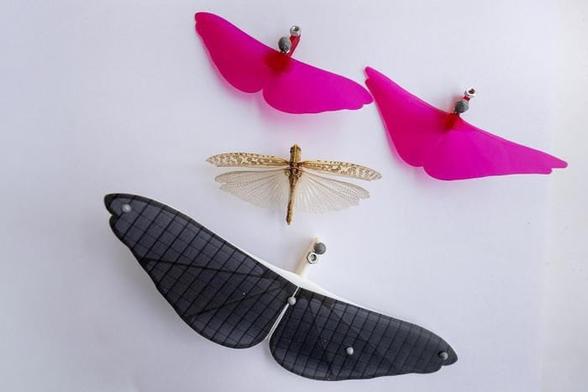
Grasshoppers have two sets of wings. The forward set provide protection and camouflage, while the hindwings are used to fly. The team studied the corrugated, foldable hindwings of the American grasshopper, then 3D-printed model wing designs and attached them to gliders. They found that the corrugated wings performed well at low angles of attack, but that non-corrugated wings–which still shared the outline and camber of the insect’s wings–were more efficient gliders over a range of conditions.
The team hopes that their grasshopper-inspired gliders give insect-like biorobots more efficient flying options. (Image credit: Princeton/S. Khan/Fotobuddy; research credit: K. Lee et al.; via Physics World)
#biology #biorobotics #fluidDynamics #gliding #insectFlight #insects #physics #scienceTracking Insects in Flight
Insects are masters of a challenging flight regime; their agility, stability, and control far outstrip anything we’ve built at their size. But to even understand how they accomplish this, researchers must manage to capture those maneuvers in the first place. Insects don’t stay in one small area, which is what the typical fixed camera motion capture set-up requires. Instead, one group of researchers has designed a system with a moveable mirror that tracks an insect’s motion in real-time, ensuring that the camera stays fixed on the insect even as it traverses a room or — for the drone-mounted version — a field.
Real-time motion tracking means that researchers can better capture detailed footage of the insect’s maneuvers in a lab environment, or they can head into the field to follow insects in the wild. Imagine tracking individual pollinators through a full day of gathering or watching how a bumblebee responds to getting hit by a raindrop mid-flight. (Video and image credit: Science; research credit: T. Vo-Doan et al.)
#biology #flappingFlight #fluidDynamics #insectFlight #physics #science
TIL that earwigs can fly. Though they mostly don't bother flying, it's a little embarrassing as someone with two biology degrees not to have known this 😳
(HT @aegilops)
They have shimmering, foldable wings that they hide away under their stiff forewings, like beetles do. Their wing deployment reminds me of an unfurling solar sail.
https://www.nationalgeographic.com/animals/article/earwig-origami-wings-how-they-work-insect-flight (includes video)
#Earwigs #FlyingInsects #InsectFlight #AnimalFacts #NationalGeographic #TodayILearned #Biology