Implementation science for planetary health

Remarks about implementation science for planetary health by Reda Sadki, Executive Director, The Geneva Learning Foundation at the Centre for Planetary Health’s research corner meeting, London School of Hygiene & Tropical Medicine (LSHTM) on December 17, 2025.

Pauline Paterson (LSHTM): We are really delighted to welcome Reda Sadki. Reda is the Executive Director of the Geneva Learning Foundation, a non-profit research organization developing new epistemological and methodological approaches for complex global health challenges. Welcome, Reda.

Reda Sadki (TGLF): Warm greetings from Geneva, Switzerland. I am very pleased to share with you what we have been learning about climate change and health – in particular, how we can move from ground truth to local action on a global scale.

Since 2021, we have been running an initiative called Teach to Reach, led by community-based health professionals from all over the world. It connects people across countries and job roles, supporting the journey from local insight to global health initiative.

The scale of this network has grown significantly. In March 2021, we started with 2,604 participants. By December 2024, at the eleventh meeting of Teach to Reach, we had 24,610 health workers participating.

Who are they? Most work in health facilities and districts. Half work for government and half for civil society organizations.

Where are they? They serve in the most fragile contexts: 62% work in remote rural areas; 47% with the urban poor; 25% with refugees or internally displaced populations. And one in five work in areas of active armed conflict.

Alongside these individuals, we are nurturing the REACH Network, a coalition of more than 4,000 locally-led organizations. This is the backdrop for how we think about leadership as the key to driving change in climate and health.

The “dark matter” of implementation science

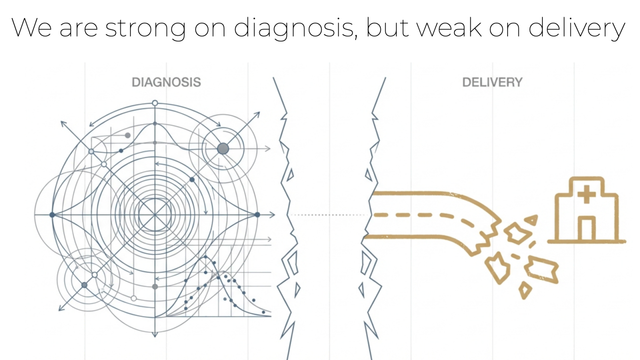
As a community working on climate change and health, we are strong – and getting stronger – on diagnosis. But we must be candid: we are weak on delivery. The science keeps getting better, but there is a gap when it comes to translating science into action.

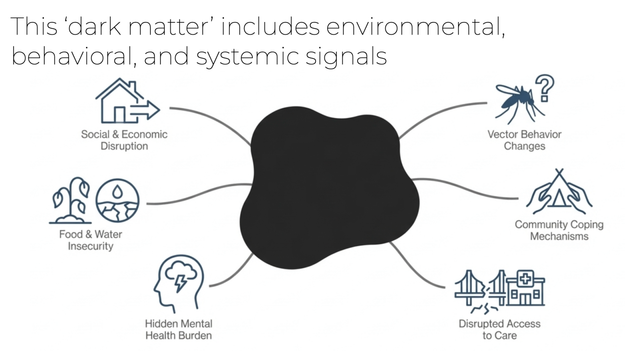
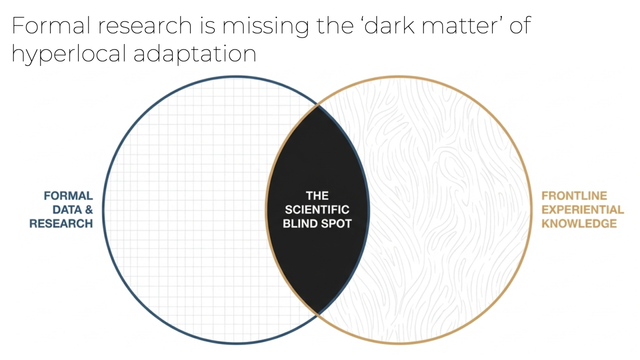
When it comes to formal research, we see what I call the ”dark matter”, a blind spot around hyperlocal adaptation and how implementation actually happens at the local level.

This dark matter includes environmental, behavioral, and systemic signals that formal research might miss: social and economic disruption, hidden mental health burdens in communities with no formal services, community coping mechanisms, and subtle changes in vector behaviors.

Now, I know that for many of you trained in epidemiology, the word “anecdote” sets off alarm bells. We are taught to devalue it for good reason: it is prone to recall bias, selection bias, and lacks denominators. A nurse in Bangladesh noticing “more heatstroke” is a signal, not a prevalence study. We are not claiming it is.

However, we have two ways to answer the questions these signals raise. We can carry out long-term, rigorous academic studies over decades. Or – given that we are past several climate tipping points – we can recognize that aggregate patterns formed by thousands of these signals offer a speed and granularity that traditional studies cannot match. This functions as a massive, distributed sentinel surveillance system. It may be “imperfect” compared to a controlled trial, but is it riskier than the alternative? The alternative is often waiting years for definitive answers while communities suffer damage that may make those findings moot.

This requires a new epistemology. Our hypothesis is that we can build a system where an anecdote becomes an eyewitness report. A health worker, traditionally seen as a “knowledge recipient” presumed ignorant of climate science, becomes a “knowledge creator”. They know things about local impacts that no one else knows, simply because they are there every day.

In July 2023, Charlotte Mbuh, TGLF’s director who started over a decade ago as a sub-national health worker from Cameroon, stood at COP28 and said:

”What we know, we know because we are here every day. We are already managing the impacts of climate change on health. We are doing the best we can, but we need your support.”

Read Charlotte Mbuh’s full statement at COP28: Climate change is a threat to the health of the communities we serve: health workers speak out at COP28

Turning experience into evidence: the global climate change and health survey

To operationalize this, we built a living laboratory powered by a global human sensor network.

In 2025, in partnership with Grand Challenges Canada and a group of 50 global funders (including Gates, Wellcome, and Rockefeller), we conducted what I have been told is the largest-ever climate and health survey, and the one with the highest level of responses from local communities in the most climate-vulnerable regions

We received responses from 6,436 health workers, primarily from the sub-national level. Because of the trust we have built over years, the Teach to Reach network contributed over 60% of these responses, ensuring we heard from the most climate-vulnerable regions.

https://www.youtube.com/watch?v=C67nYqq-hP0

Most importantly for funders, we asked about barriers to action. The top barriers were not just resource shortages, but structural issues.

Pending their formal publications, I am not yet able to share results.

These findings are signals. They generate hypotheses. Here are three examples of hypotheses grounded in health worker experirences:

  • Geh Raphaela Agwa, a midwife from Cameroon, told us: “During this unfavourable weather period, people who can paddle canoes come in and help…”. Could community-led transport solutions improve maternal health access during floods?
  • Solace Jewel Morgan, a disease control officer in Ghana, told us: “The dry season… results in dust particles known as harmatan. This leads to a high incidence of respiratory illnesses… encourage… free distribution of personal protective masks.” Could prophylactic mask distribution reduces respiratory morbidity during the harmatan season?
  • Victoire Odia, a nurse from the Democratic Republic of Congo (DRC), told us that during extreme weather events, maternity “stays were paid for by the women’s group solidarity fund.” Could micro-financing networks increase facility-based deliveries in climate-vulnerable areas?

Of course, we must distinguish between generating a hypothesis and validating an intervention. We do not claim every local idea is safe or effective immediately. But we do claim that listening is the prerequisite to testing them.

From insight to impact: the Accelerator model for implementation science

We do not just extract data. We give it back to the community to prompt action. Since 2016, we have developed an “Accelerator” system that moves from listening to implementation. It works on a simple rhythm: participants set a specific, practical goal on Monday, and on Friday, they report on what happened, receiving feedback from peers.

This brings us to a critical tension: the balance between context and content. Critics might argue that prioritizing “context over content” carries risks. What if health workers implement unproven or suboptimal strategies? That is a valid concern. However, we see this mechanism not as a way to bypass evidence, but as the most effective tool to operationalize it.

In The Geneva Learning Foundation’s Accelerator, every participant commits to work toward their countries’ goals, and to do so by using the best available global knowledge.

Learn more: What is The Geneva Learning Foundation’s Impact Accelerator?

This actually supports effective adoption and use of global guidelines, which otherwise may linger on shelves.

In fact, we have shown in the past that this mechanism increases adherence to proven protocols (e.g., WHO guidelines on heat stress or malaria control). That is one important reason why it is a powerful implementation science tool. It transforms adherence from a wish expressed in the capital city into a reality in local communities.

Furthermore, if national planners and international experts are willing to listen, they may hear back ways to improve and strengthen the global standards, as well as gain new insights into the “how” of local implementation that defies easy generalization.

When we compared this model to conventional technical assistance or “cascade training,” the results were stark :

  • Speed: Implementation was 7x faster.
  • Cost: The cost was 90% lower.
  • Sustainability: In a Ministry of Health initiative in Côte d’Ivoire, 82% of participants continued using the model without further support. 78% explicitly stated they needed no further external assistance.
  • These results give us confidence. We are not starting from zero. We are building on prior work in immunization and other areas of work where supporting implementation led to exactly these kinds of validated outcomes.

    Here are two examples of local solutions in action.

    • Côte d’Ivoire: Communities identified stagnant water as a malaria risk and organized youth-led cleanup committees to clear gutters. This resulted in a drastic, locally measured drop in malaria cases.
    • Cameroon: In response to frequent floods, communities voluntarily cleaned gutters to ensure water did not stagnate, directly impacting disease vectors.

    No one in the capital city – and certainly no one in Geneva or Seattle – knew about these initiatives.

    This leads to our most ambitious projection. If we can grow this network from 80,000 to 1 million health workers by 2030, we estimate we could save 7 million lives through simple, locally resourced projects, at a cost of less than $2 per life.

    I acknowledge this is an aggressive claim. It is a “back-of-the-envelope” calculation based on our pilot data. It assumes that local projects remain effective at scale and that we can attribute outcomes to the network. But I ask you: if there is even a glimmer of a chance that this is true – that we can save lives at a fraction of the cost of traditional interventions – isn’t it worth investing in the rigorous research to find out?

    Discussion

    Do you think MOOCs (Massive Open Online Courses) are dead?

    Reda Sadki: MOOCs have become primarily marketing tools for higher education. From a pedagogical perspective, they remain transmissive, expert to learner. I do not see how that model can deliver against complex problems. We need a two-way street. We need new ways to organize the production and circulation of knowledge.

    Thank you, Reda. I noticed in your results that food security is a major concern. Have you identified local actions focusing on food, given the challenges of working with healthcare workers who might not see this as their primary remit?

    Reda Sadki: That is a critical question. Food insecurity is one of the most worrying consequences we are tracking. We often see a mismatch where local actors tasked with, say, immunization, do not see nutrition as their lane. However, at the community level, the approach is naturally integrated – the health worker knows the vet, who knows the farmers. Those connections exist.

    We are currently preparing a major insights report that includes a specific chapter on food security. We are also designing an accelerator specifically around this topic to bring together the right set of partners, because the consequences we are documenting are dire.

    You mentioned that 78% of participants eventually said “no thank you” to further support. Ideally, shouldn’t these peer networks become self-sustaining, bypassing Geneva or London entirely?

    Reda Sadki: That is the goal. We have shown that more than half of each cohort stays in touch to continue leading local action. However, as long as resources and decision-making power remain concentrated in global centers, we cannot just “flip a switch”. We need to build bridges that facilitate that transformation. The goal is autonomy, but the reality requires us to actively dismantle the dependencies that current funding structures create.

    Are there new capabilities that we in academia need to develop urgently to support this?

    Reda Sadki: It is about moving away from being the “sage on the stage” to a “guide on the side”. For example, in our recent work, global partners and experts joined Teach to Reach sessions not to present the latest guidelines, but to listen to the challenges local practitioners faced. They then had to figure out how their expertise could be useful in response to those specific needs.

    For researchers inside academic institutions, this can be difficult. It requires starting not with a research question, but with a willingness to listen to the needs of local actors and let the research questions emerge from that reality. We know this challenges the incentive structures of academia, but we are open to partnering with researchers willing to work in this emergent, demand-driven way.

    It is a fascinating dilemma – we want to be guided by needs, but funding requires pre-set hypotheses. Reda, this has been truly impressive. Thank you for sharing these refreshing perspectives.

    Reda Sadki: Thank you. We look forward to exploring how we can collaborate. Best wishes for the holidays and the new year.

    References

  • Sadki, R., 2025. WHO Global Conference on Climate and Health: New pathways to overcome structural barriers blocking effective climate and health action. https://doi.org/10.59350/redasadki.21322
  • Sadki, R., 2024. Strengthening primary health care in a changing climate. https://doi.org/10.59350/5s2zf-s6879
  • Sadki, R., 2024. Health at COP29: Workforce crisis meets climate crisis. https://doi.org/10.59350/sdmgt-ptt98
  • Sadki, R., 2024. Critical evidence gaps in the Lancet Countdown on health and climate change. https://doi.org/10.59350/nv6f2-svp12
  • Sanchez, J.J., Gitau, E., Sadki, R., et al., 2025. The climate crisis and human health: identifying grand challenges through participatory research. The Lancet Global Health 13, e199–e200. https://doi.org/10.1016/s2214-109x(25)00003-8
  • Jones I, Mbuh C, Sadki R, Eller K, Rhoda D. On the frontline of climate change and health: A health worker eyewitness report [Internet]. The Geneva Learning Foundation; 2023. https://zenodo.org/doi/10.5281/zenodo.10204660
  • Images: The Geneva Learning Foundation Collection © 2025

    #CharlotteMbuh #climateAndHealth #epistemology #globalHealth #ImpactAccelerator #implementationResearch #LSHTM #MassiveOpenOnlineCourses #PaulinePaterson #peerLearning #TeachToReach #TheGenevaLearningFoundation
    Retrouver les enfants congolais non-vaccinés: des acteurs de tout le pays lancent le premier Accélérateur zéro-dose pour renforcer la mise en oeuvre et le suivi

    «Si je réussis mon projet de terrain, je m’attends à avoir au moins vacciné 345 enfants».

    Cet engagement n’a pas été pris par un ministre dans la capitale, mais par Jérémie Mpata Lumpungu, infirmier titulaire dans la province du Kasaï.

    Il n’était pas seul.

    Lundi 10 novembre 2025, un appel a résonné à travers la République démocratique du Congo.

    Depuis Kinshasa, le Dr Josaphat-Francois WETSHIKOY, épidémiologiste, a détaillé son objectif pour les 21 prochains jours: «récupérer 30 % des enfants» non vaccinés dans sa zone cible de 230 000.

    Barthélemy Daké Saoromou, préparant une stratégie mobile, vise «plus de 500 enfants zéro dose».

    Cette détermination palpable, venue de praticiens de tout le pays, a marqué le lancement de l’«Accélérateur d’impact zéro-dose».

    Il ne s’agit pas d’une formation ou d’un atelier de plus.

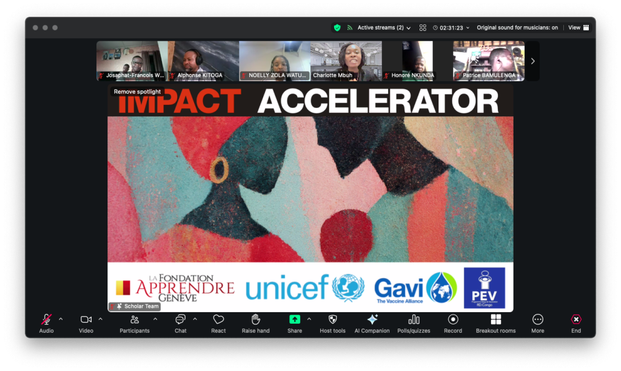
    C’est une nouvelle phase d’action, un «système de soutien» pour la mise en oeuvre et le suivi, conçu par la Fondation Apprendre Genève (TGLF), en partenariat avec l’UNICEF, avec le soutien de Gavi, et sous l’égide du Programme Élargi de Vaccination (PEV) de la RDC. En savoir plus

    Vous souhaitez rejoindre la prochaine séance de l’Accélérateur? Suivez ce lien.

    C’est, pour ses participants, un «baptême du feu».

    Du constat à l’action

    Ce nouvel élan pour la vaccination n’est pas né de rien.

    Il s’appuie sur les leçons d’un vaste exercice d’apprentissage par les pairs qui a mobilisé plus de 1 600 praticiens congolais pour développer 385 projets de terrain.

    Les résultats de cette analyse, présentés au lancement, ont été sans concession.

    La découverte la plus importante: le problème des enfants zéro dose en RDC est avant tout «un problème de gestion et de relation».

    Les praticiens ont affinée l’explication officielle inscrite dans le plan Mashako, selon laquelle le principal obstacle est que «la mère est trop occupée».

    Pour eux, la «véritable cause, la cause racine, c’est un échec du système de santé», c’est-à-dire un système qui «ne réussit pas à adapter ses services […] à la vie réelle et au travail des parents».

    Leurs analyses ont aussi pointé un problème de gestion des Relais Communautaires (RECO), qui se sentent «ignorés ou exclus de la planification», et une méfiance qui naît «en réaction à des échecs précis du système de santé», comme la mauvaise gestion des effets secondaires des vaccins.

    Une cohorte du niveau national à l’aire de santé

    Les voix qui portent ces engagements ne sont pas anonymes.

    La force de l’Accélérateur réside dans la diversité de sa cohorte.

    Les participants sont des médecins (comme le Dr Derrick Ngoyi MALOBO au Centre de santé de Kenge), des infirmiers et infirmières (comme Marlène KAPINGA MULUMBA au niveau national ou Jérémie Mpata Lumpungu au niveau local), des agents de santé publique (comme Bonnet Leteta en province) et, surtout, un grand nombre d’agents de santé communautaire (comme Martine YOWA NDAYE ou David BINWA dans leurs Aires de santé).

    Ils représentent tous les échelons du système: du niveau National à Kinshasa jusqu’au Centre de santé le plus reculé, en passant par la Province et la Zone de santé.

    Ils proviennent du Gouvernement (la majorité des participants), mais aussi de la Société civile (ONG) et du Secteur privé.

    C’est cette alliance de praticiens, du sommet à la base, qui est maintenant mise en action.

    L’action avant vendredi

    Le mécanisme de l’Accélérateur est conçu pour être radicalement concret, transformant les constats de terrain en action immédiate.

    D’abord, chaque participant doit fixer un «objectif à 30 jours».

    Il doit répondre à cinq questions: quelle communauté aider; combien d’enfants zéro dose s’y trouvent; quelles acteurs impliquer; quel est l’obstacle principal; et quel résultat mesurable atteindre en un mois.

    Ensuite, et c’est le cœur du réacteur, chaque lundi, le participant doit définir une «action spécifique et réalisable» qu’il s’engage à accomplir avant le vendredi de la même semaine.

    Lors du lancement, les engagements pour la semaine à venir étaient tangibles.

    Pour Noëlly Zola Watusadisi, médecin dans la zone de santé de Bombay qui gère 12 îlots fluviaux, son action pour la semaine n’est pas de tout faire, mais de commencer: «entrer en contact avec les infirmiers de chaque îlot» et appeler les chefs de quartier pour préparer la sensibilisation.

    David Binwa, du Nord-Kivu, a un plan similaire.

    Son action d’ici vendredi: tenir une activité avec les RECO d’ici jeudi afin d’«identifier les vrais problèmes» avant de lancer une sensibilisation de masse.

    Le rendez-vous: la redevabilité entre pairs

    L’efficacité de l’Accélérateur repose sur un dernier pilier: la redevabilité (accountability) entre pairs.

    Ce vendredi, chaque participant devra répondre à un formulaire de suivi de trois questions.

    La première: «Avez-vous vacciné des enfants à zéro dose cette semaine?»

    La seconde: «Dans quelle mesure avez-vous progressé dans la réalisation de votre action de la semaine?».

    Mais le véritable test aura lieu lundi prochain, lors de la prochaine assemblée de la cohorte.

    «Lundi prochain à l’Assemblée, déjà, vos collègues vont rechercher, est-ce qu’il est là, celui qui avait déclaré qu’il allait faire telle ou telle chose la semaine dernière», a prévenu Charlotte Mbuh, qui accompagne le groupe. «Et si vous n’êtes pas là, ils vont en faire le constat, mais si vous êtes là, ils vont vous demander est-ce que vous l’avez fait?».

    Cette pression n’est pas conçue comme une punition.

    L’objectif est de «nourrir l’entraide, de nourrir la solidarité».

    Pour soutenir ce «Mouvement congolais pour la vaccination à l’horizon 2030», 167 ambassadeurs de la Fondation ont été intronisés lors de la cérémonie.

    Ce sont eux, des praticiens de terrain, qui aideront à animer cette entraide.

    L’Accélérateur est lancé.

    Les premiers engagements sont pris.

    Le compte à rebours avant lundi prochain a commencé.

    Image: Collection de la Fondation Apprendre Genève © 2025. L’image «Échos du soin» fait émerger deux visages comme des souvenirs partagés, fragiles mais tenaces. Les formes simples et les couleurs mêlées disent la tendresse, la fatigue, et la force discrète du geste de soin, qui marque durablement celles et ceux qui donnent comme celles et ceux qui reçoivent.

    #enfantsZeroDose #equite #francophone #globalHealth #impactAccelerator #laFondationApprendreGeneve #peerLearning #rdc #republiqueDemocratiqueDuCongo #theGenevaLearningFoundation #unicef #vaccination

    What is The Geneva Learning Foundation’s Impact Accelerator?

    Imagine a social worker in Ukraine supporting children affected by the humanitarian crisis. Thousands of kilometers away, a radiation specialist in Japan is trying to find effective ways to communicate with local communities. In Nigeria, a health worker is tackling how to increase immunization coverage in their remote village. These professionals face very different challenges in very different places. Yet when they joined their first “Impact Accelerator”, something remarkable happened. They all found a way forward. They all made real progress. They all discovered they are not alone.

    The Impact Accelerator is a simple, practical method developed by The Geneva Learning Foundation that helps professionals turn intent into action, results, and outcomes. It has worked equally well in every country where it has been tried. It has helped people – whatever their knowledge domain or context – strengthen action and accelerate progress to improve health outcomes. Each time, in each place, whatever the challenge, it has produced the same powerful results.

    The social worker joins other professionals facing similar challenges. The radiation specialist connects with safety experts dealing with comparable concerns. The health worker collaborates with others working to improve immunization. Each group shares a common purpose.

    What makes the Impact Accelerator different?

    Most training programs teach you something and then send you away. You return to your workplace full of ideas but face the same obstacles. You have new knowledge but struggle to apply it. (Some people call this “knowledge transfer” but it is not only about knowledge. Others call this the “applicability problem”.) You feel alone with your challenges.

    The Impact Accelerator works differently. It stays with you as you implement change. It connects you with others facing similar challenges. It helps you take small, concrete steps each week toward your bigger goal.

    Each Impact Accelerator brings together professionals working on the same type of challenge. Social workers who support children join with others who do the same – but the group may also include teachers and psychologists they do not usually work with. Safety specialists connect with safety specialists, but also people in other job roles. It is their shared purpose that makes this diversity productive:  every discussion, every shared experience, every piece of advice directly applies to their work.

    Think of it like learning to ride a bicycle. Traditional training is like someone explaining how bicycles work. The Impact Accelerator is like having someone run alongside you, keeping you steady as you pedal, cheering when you succeed, and helping you get back on when you fall. Everyone learns to ride, together. And everyone is going somewhere.

    How does the Impact Accelerator work?

    The Impact Accelerator follows a simple weekly rhythm that fits into daily work. It is learning-based work and work-based learning.

    Monday: Set your goal

    Every Monday, you decide on one specific action you will complete by Friday. Not a vague hope or a grand plan. One concrete thing you can actually do.

    For example:

    • “I will create a safe space activity for five children showing signs of trauma.”
    • “I will develop a visual guide for the new radiation monitoring procedures.”
    • “I will meet with three community leaders to discuss vaccine concerns.”

    You share this goal with others in the Accelerator. This creates accountability. You know that on Friday, your peers will ask how it turned out.

    Wednesday: Check in with peers

    Midweek, you connect with others in your group who face the same type of challenges. You share what is working, what is difficult, and what you are learning.

    This is where magic happens. Someone else tried something that failed. Now you know to try differently. Another person found a creative solution. Now you can adapt it for your situation. You realize you are part of something bigger than yourself.

    Friday: Report and reflect

    On Friday, you report on your progress. Did you achieve your goal? What happened when you tried? What did you learn?

    This is not about judging success or failure. Sometimes the most valuable learning comes from things that did not work as expected. The important thing is that you took action, you reflected on what happened, and you are ready to try again next week.

    Monday again: Build on what you learned

    The next Monday, you set a new goal. But now you are not starting from zero. You have the experience from last week. You have ideas from your peers. You have momentum.

    Week by week, action by action, you make progress toward your larger goal.

    The power of structured support in the Impact Accelerator

    The Impact Accelerator provides several types of support to help you succeed.

    Peer learning networks

    You join a community of professionals who understand your challenges because they face similar ones. 

    Each Impact Accelerator brings together people working on the same type of challenge. This shared purpose means that every suggestion, every idea, every lesson learned is likely to be relevant to your work. The learning comes not from distant experts but from people doing the same work you do. Their solutions are practical and tested in real conditions like yours.

    Guided structure

    While you choose your own goals and actions, the Accelerator provides a framework that keeps you moving forward. The weekly rhythm creates momentum. The reporting requirements ensure reflection. The peer connections prevent isolation.

    This structure is like the banks of a river. The water (your energy and creativity) flows freely, but the banks keep it moving in a productive direction.

    Expert guidance when needed

    Sometimes you need specific technical input or help with a particular challenge. The Accelerator provides “guides on the side” – experts who offer targeted support without taking over your process. They help you think through problems and connect you with resources, but you remain in charge of your own change effort.

    What participants achieve

    Across different countries and different challenges, Impact Accelerator participants report similar outcomes.

    Increased confidence

    “Before, I knew what should be done but felt overwhelmed about how to start. Now I take one step at a time and see real progress.” This confidence comes from successfully completing weekly actions and seeing their impact.

    Tangible progress

    Participants do not just learn about change; they create it. A vaccination program reaches new communities. Safety procedures actually get implemented. Children receive support when they need it. The changes may start small, but they are real and they grow.

    Expanded networks

    “I used to feel like I was the only one facing these problems. Now I have colleagues across my country who understand and support me.” These networks last beyond the Accelerator, providing ongoing support and collaboration.

    Enhanced problem-solving

    Through weekly practice and peer exchange, participants develop stronger skills for analyzing challenges and developing solutions. They learn to break big problems into manageable actions and to adapt based on results.

    Resilience in facing obstacles

    Every change effort faces barriers. The Accelerator helps participants expect these obstacles and work through them with peer support rather than giving up when things get difficult.

    How can the same methodology work everywhere?

    The Impact Accelerator has succeeded across vastly different contexts – from supporting children in Ukrainian cities to enhancing radiation safety in Japanese facilities to improving immunization in Nigerian villages. Each Accelerator focuses on one specific challenge area, bringing together professionals who share that common purpose. Why does the same approach work for such different challenges?

    The answer lies in focusing on universal elements of successful change:

    • Breaking big goals into weekly actions;
    • Learning from peers who understand your specific context and challenges;
    • Reflecting on what works and what does not;
    • Building momentum through consistent progress; and
    • Creating accountability through a community united by shared purpose.

    Each group focuses on their specific challenge and context, but the process of creating change remains remarkably similar.

    A typical participant journey in the Impact Accelerator

    Let us follow Yuliia, a social worker in Ukraine helping children affected by the humanitarian crisis.

    Week 1: Getting started

    Yuliia joins the Impact Accelerator after developing her action plan. Her big goal: establish effective psychological support for 50 displaced children in her community center within three months.

    On Monday, she sets her first weekly goal: “During daily activities, I will observe and document how 10 children are affected.”

    By Friday, she has detailed observations. She notices that loud noises sometimes cause reactions in most children, and several withdraw completely during group activities. This gives her concrete starting points.

    Week 2: Building on learning

    Based on her observations, Yuliia sets a new goal: “I will create a quiet corner with calming materials and test it with three children who are withdrawn.”

    During the Wednesday check-in, another social worker shares how she uses art therapy for non-verbal expression with traumatized children. A colleague working in a different city describes success with sensory materials. Yuliia incorporates both ideas into her quiet corner.

    The quiet corner proves successful – two of the three children spend time there and begin to engage with the materials. One child draws for the first time since arriving at the center.

    Week 3: Creative solutions

    Yuliia’s new goal: “I will develop a simple ‘feelings chart’ with visual cues and introduce it during morning circle time.”

    Her peers from Ukraine and all over Europe – all working with children – help refine the idea. A psychologist from another region shares that abstract emotions are hard for traumatized children to identify. She suggests using colors and weather symbols instead of facial expressions. Another colleague recommends making the chart interactive rather than static.

    The feelings chart becomes a breakthrough tool. Children who never spoke about their emotions begin pointing to images. Yuliia’s colleagues can better understand and respond to children’s needs.

    Week 4: Scaling what works

    Energized by success, Yuliia aims higher: “I will train two other staff members to use the quiet corner and feelings chart, and create a simple guide for these tools.”

    By now, Yuliia has concrete evidence that these approaches work. She documents specific examples of children’s progress. Her guide is so practical that the center director wants to share it with other locations.

    The ripple effect

    Yuliia’s tools spread throughout the network of centers supporting displaced children. Through the Accelerator network, colleagues adapt her approaches for different age groups and settings. Soon, hundreds of children across Ukraine benefit from these simple but effective interventions.

    The evidence of impact

    The true test of any approach is whether it creates lasting change. Impact Accelerator participants consistently report:

    • Specific improvements in their work that they can measure and document;
    • Sustained changes that continue after the Accelerator ends;
    • Solutions that others adopt and spread;
    • Professional growth that enhances all their future work; and
    • Networks that provide ongoing support and learning.

    These outcomes appear whether participants work on mental health support in Ukraine, radiation safety in Japan, or immunization in Nigeria. The challenges differ, but the pattern of success remains consistent.

    How we prove the Accelerator makes a difference

    In global health, the biggest challenge is proving that your intervention actually caused the improvements you see. This is called “attribution.” How do we know that better health outcomes happened because of the Impact Accelerator and not for other reasons?

    The Geneva Learning Foundation solves this challenge through a three-step process that connects the dots between learning, action, and results.

    Step 1: Measuring where we start

    Before participants begin taking action, they document their baseline – the current situation they want to improve. For example:

    • A social worker records how many children show severe trauma symptoms.
    • A radiation specialist documents current safety incident rates.
    • A health worker notes the vaccination coverage in their area.

    These starting numbers give us a clear picture of where improvement begins.

    Step 2: Tracking progress and actions

    Every week, participants complete “acceleration reports” that capture two things:

    • The specific actions they took; and
    • Any changes they observe in their measurements.

    This creates a detailed record connecting what participants do to what happens as a result. Week by week, the picture becomes clearer.

    Step 3: Proving the connection

    Here is where the Impact Accelerator becomes special. When participants see improvements, they must answer a crucial question: “How much of this change happened because of what you learned and did through the Accelerator?”

    But they cannot just claim credit. They must prove it to their peers by showing:

    • Exactly which actions led to which results;
    • Why the changes would not have happened without their intervention; and
    • Evidence that their specific approach made the difference.

    This peer review process is powerful. Your colleagues understand your context. They know what is realistic. They can spot when claims are too bold or when someone is being too modest. They ask tough questions that help clarify what really caused the improvements.

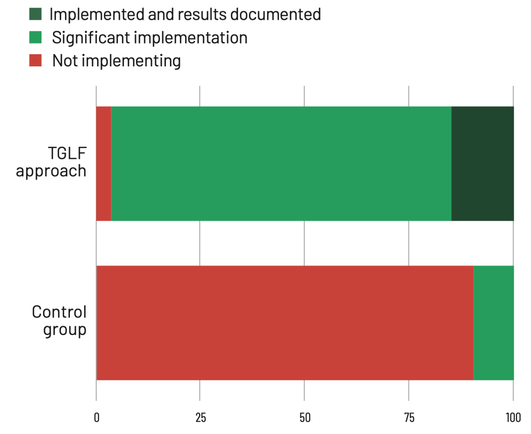
    After the first-ever Accelerator in 2019, we compared the implementation progress after six months between those who joined this final stage and a control group that also developed action plans, but did not join.

    Why this method works

    This approach solves several problems that make attribution difficult:

  • Traditional studies often cannot capture the complexity of real-world change. The Impact Accelerator’s method shows not just that change happened, but how and why it happened.
  • Self-reporting can be unreliable when people work alone. But when you must convince peers who understand your work, the reports become more accurate and honest.
  • Numbers alone do not tell the whole story. By combining measurements with detailed descriptions of actions and peer validation, we get a complete picture of how change happens.
  • The invitation to act

    Around the world, professionals like you are transforming their work through the Impact Accelerator. They start with the same doubts you might have: “Can I really create change? Will this work in my context? Do I have time for this?”

    Week by week, action by action, they discover the answer is yes. Yes, they can create change. Yes, it works in their context. Yes, they can find time because the Accelerator fits into their real work rather than adding to it.

    The Impact Accelerator does not promise overnight transformation. It offers something better: a proven process for creating real, sustainable change through your own efforts, supported by peers who understand your journey.

    If you work in a field where you seek to make a difference, the Impact Accelerator can help you move from good intentions to meaningful impact. The same process can work for you.

    The question is not whether the Impact Accelerator can help you create change. The question is: What change do you want to create?

    Your journey can begin Monday.

    Image: The Geneva Learning Foundation Collection © 2025

    References

    Sadki, R., 2022. Learning for Knowledge Creation: The WHO Scholar Program. https://doi.org/10.59350/j4ptf-x6x22

    Umbelino-Walker, I., Szylovec, A.P., Dakam, B.A., Monglo, A., Jones, I., Mbuh, C., Sadki, R., Brooks, A., 2024. Towards a sustainable model for a digital learning network in support of the Immunization Agenda 2030 –a mixed methods study with a transdisciplinary component. PLOS Global Public Health 4, e0003855. https://doi.org/10.1371/journal.pgph.0003855

    Watkins, K.E., Sadki, R., Kim, K., Suh, B., 2019. Changing Learning Paradigms in a Global Health Agency, in: Evidence-Based Initiatives for Organizational Change and Development. IGI Global, pp. 693–703. https://doi.org/10.4018/978-1-5225-6155-2.ch050

    Watkins, K.E., Sandmann, L.R., Dailey, C.A., Li, B., Yang, S.-E., Galen, R.S., Sadki, R., 2022. Accelerating problem-solving capacities of sub-national public health professionals: an evaluation of a digital immunization training intervention. BMC Health Services Research 22. https://doi.org/10.1186/s12913-022-08138-4

    #attribution #continuousLearning #healthOutcomes #impactAccelerator #leadership #learnByDoing #newLearning #peerLearning #genevaLearningFoundation