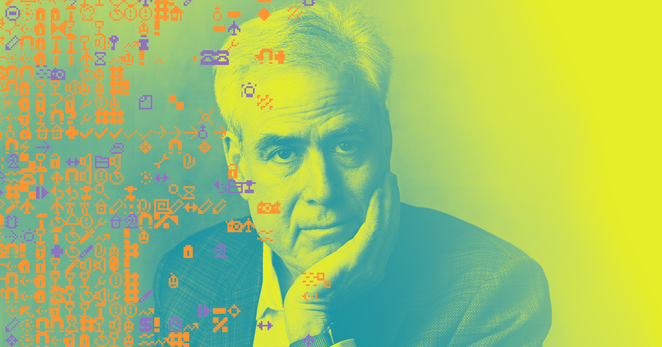
@thoughtshrapnel During an interview @Casey @kevin, Dr. Haidt dismissed the potential downstream effects of policies based on his public advocacy work (which he separates from his scholarly work).
In anthro, we’ve already had our “Benjamin Spock Moment” and some became wary of such work. Is there an intellectual filiation to current approaches in #SystemsThinking?
#HowMightWe pay attention to #Unthink? https://www.nytimes.com/2026/01/16/podcasts/jonathan-haidt-strikes-again-what-you-vibecoded-an-update-on-the-forkiverse.html
Jonathan Haidt Strikes Again + What You Vibecoded + An Update on the Forkiverse

“If we can’t win on social media, then we definitely can’t win on A.I.,” says Haidt.

The New York Times

“People before programs, programs before personalities.”

#HowMightWe work together towards #EpistemicJustice through #OpenEducation without falling through traps of #OpenWashing and #fauxpen?

https://www.tandfonline.com/doi/full/10.1080/01930826.2024.2351248

Grateful that @pkirn is able to cover research @Silpayamanant

“It’s not enough, then, to just be a scholar.”
Precisely. #HowMightWe bring scholarship to ensure that “the next four millennia of human civilization [benefits from] as much preserving as the last four”?

https://cdm.link/2024/03/music-notation-on-a-4000-year-timeline/

Music notation on a 4000-year timeline and more of music beyond Europe - CDM Create Digital Music

There's no need to imagine the history and conception of music as beginning and ending in western Europe. The history of music is far older, richer - and stranger than that. Here's a glimpse of some of that and more resources to help broaden our sense of what music can be.

CDM Create Digital Music

@lightweight It might be useful to focus on the phenomena themselves. Yes, including #LibreWashing, #Fauxpen, as well as the whole distinction between software freedom and open source development. There are diverse actors taking different postures which may or may not jibe with our values. Dispassionately, we can still describe the “Ecosystem of Open” with diverse initiatives taking root despite counteracting forces.

In other words, #HowMightWe design this ecosystem for the common good?

Glad this type of insight is going through #HR and #management ranks, via MIT Sloan School of Management & Deloitte. While much of it has been obvious, on the ground for a long time, it’s been difficult to get "powers that be” to adapt longstanding practices. #HowMightWe align our actions to foster #EquitableWorkplaces, from #HigherEd enrollment and #ProfessionalDevelopment to #hiring and #freelancing?

@actualham @JamesGG
Sounds like this blogpost is making the rounds and sparking a renewed discussion in #OpenEducation beyond #OER.

@cogdog @oeglobal

https://connect.oeglobal.org/t/where-have-we-come-from-a-2015-ugh/4809

#HowMightWe move into collective action towards our shared goals? While #OEweek is a celebration of all things OE, there's a generative tension when we bring things in a new context.

Where Have we Come from a 2015 UGH

Open Education Week is, yes, a celebration of the achievements of Open Education and OER, but where do we have some critical exchanges about it? We have had a few open discussions during the OEWeek Live conversations such as what defines the “open movement”. And a few people have asked about how much is at stake by become more tied/beholden to commercial platforms and systems. So not for fighting but some good back and forth I am tossing one into the mix. I am prompted by a tweet this morning ...

OE Global Connect

@weblearning At the risk of raising controversy: part of the point, for me, is that there's more to #OpenEducation than "Open Content" (OERs and such). And opening up EdTech is more than leveraging LibreTexts or Pressbooks.
Useful, to me in this case, is Paul Stacey's #LandscapeOfOpen (before he became Executive Director @oeglobal).
https://edtechfrontier.com/2018/02/08/starting-anew-in-the-landscape-of-open/

The #HowMightWe question then brings business models in a broader context. Especially if we overcome #OpenWashing.

Starting Anew in the Landscape of Open

Paul Stacey
A useful dimension of the fediverse, in my experience is that #MediaLiteracy experts like @Julie are able to work through important issues with the ways many of us have framed "news". We keep saying that Masto and other parts of this federated scene feels like the early Web or even the early Internet. May it also be an opportunity to rebuild our "media diets" on renewed foundations?
#HowMightWe build an appropriate media ecosystem favouring #EpistemicDiversity and #CriticalThinking?

So…

#HowMightWe “thoughtfully discuss Ethnic Identity in Electronic Music”? And how could this relate to #Thoughtfulness more generally?

For instance, is it possible to go from the 1D “pros and cons” to something #multidimensional?

Ha!
Too bad I missed
Lorna's #OER22 preso about #OpenTextbooks for #MusicEducation.
https://blogs.ed.ac.uk/opentextbooks/

Outside of my dayjob in OE, been slowly getting through a longterm, self-funded, informal, and fairly chaotic for #InclusiveMusicalLearning.

For a teaser:

> #HowMightWe build knowledge through music beyond #pianocentrism and #StaffNotation?

Not to be provocative. Hoping to be #ThoughtProvoking instead. https://www.rebus.community/t/alt-text-for-music-notation/1304/12

Open e-Textbooks for Access to Music Education – This is the blog of the Open e-Textbooks for Access to Music Education project. This project is a collaboration between the Reid School of Music and Education, Design and Engagement, and is generously funded by a Student Experience Grant.