 Spirituality & Religious Studies
Kabbalah, Part 2
Ultimately, it’s necessary to show compassion toward oneself as well as to share compassion with others. This “selfish” enjoyment of God’s blessings, but only to empower oneself to assist, is an important aspect of “Restriction” & is considered a kind of golden mean in kabbalah.
This corresponds to the sefira of Adornment (Tiferet) being part of the “Middle Column.” The golden mean (or Golden middle way) is the desirable middle between 2 extremes, 1 of excess & the other of deficiency.
The most esoteric Idrot sections of the classic Zohar make reference to hypostatic male & female Partzufim (Divine Personas) displacing the Sephirot, manifestations of God in particular anthropomorphic symbolic personalities based on Pardes & midrashic narratives.
Lurianic Kabbalah places these at the center of our existence. Rather than earlier Kabbalists, these are placed at the center of our existence. Rather than earlier Kabbalah’s Sephirot, which Luria saw as broken in Divine crisis.
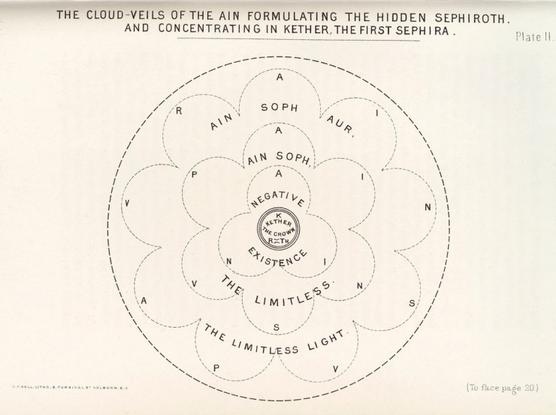
Medieval Kabbalists believe that all things are linked to God through these emanations, making all levels in creation reflect its particular roots in supernal divinity. Kabbalists agreed with the divine transcendence described as the Ein Sof, the unknowable Godhead.
They reinterpreted the theistic philosophical concept of creation from nothing, replacing God’s creative act with panentheistic continual self-emanation by the mystical Ayin Nothingness/Nothing sustaining all spiritual & physical realms as successively more corporeal garments, veils, & condensations of divine immanence. This is when the divine encompasses or is manifested in the material world.
The innumerable levels of descent divide into 4 comprehensive spiritual worlds: Atziluth (“Closeness” Divine Wisdom), Beriah (“Creation” Divine Understanding), Yetzirah (“Formation” Divine Emotions), Assiah (“Action” Divine Activity), with a preceding 5th World, Adam Kadmon (“Primordial Man” Divine Will). Sometimes excluded due to its sublimity. Together, the whole spiritual heaven forms the Divine Persona/Anthropos.
In Kabbalah, Adam Kadmon (also called Adam Elyon or Adam Ila’ah, sometimes abbreviated as A’K) is the 1st of 4 Worlds that came into being after the contraction of God’s infinite light.
Hasidic thought extends the divine immanence of Kabbalah by holding that God is all that really exists, all else being completely undifferentiated from God’s perspective. This view can be defined as a cosmic monistic panentheism. Acosmism denies the reality of the universe, seeing it as ultimately illusory, & only the infinite unmanifest Absolute as real. Monism attributes oneness or singleness to a concept, such as existence.
According to this philosophy, God’s existence is higher than anything that this world can express. Yet He includes all things of this world within His divine reality in perfect unity. So that the creation affected no change in Him at all. This paradox, as seen from dual human & divine perspectives, is dealt with at length in Chabad texts. Chabad philosophy comprises the teachings of the leaders of Chabad-Lubavitch, a Hasidic movement led by the Schneersohn family & formerly based in Lyubavichi, Russian Empire.
Foundational texts of Medieval Kabbalism conceived evil as a demonic parallel to the holy, called the Sitra Achra (the “Other Side”), & the qlippoth (“husks/shells”) that cover & conceal the holy, are nurtured from it, & yet also protect it by limiting its revelation.
In a radical notion, the root of evil is found within the 10 holy Sephirot, through an imbalance of Gevurah, the power of “Strength/Judgment/Severity.” Gevurah is necessary for Creation to exist as it counterposes Chesed (“loving-kindness”), restricting the unlimited divine bounty within suitable vessels, so forming the Worlds.
However, if Man sins (actualizing impure judgment within his soul), the supernal Judgment is reciprocally empowered over the Kindness, introducing disharmony among the Sephirot in the divine realm & exile from God throughout Creation. The demonic realm, though illusory in its holy origin, becomes the real apparent realm of impurity in lower Creation.
In the Zohar, the sin of Adam & Eve (who embodied Adam Kadmon below) took place in the spiritual realms. Their sin was that they separated the Tree of Knowledge (10 sefirot within Malkuth, representing Divine transcendence).
This introduced the false perception of duality into lower creation, an external Tree of Death nurtured from holiness, & an Adam Belial of impurity.
In Lurianic Kabbalah, evil originates from a primordial shattering of the sephirot of God’s Persona before creation of the stable spiritual worlds, mystically represented by the 8 kings of Edom (the derivative of Gevurah) “who died” before any king reigned in Israel from Genesis 36.
In the divine view from above within Kabbalah, emphasized in Hasidic Panentheism, the appearance of duality & pluralism below dissolves into the absolute Monism of God, psychologizing evil. Though impure below, what appears as evil comes from a divine blessing too high to be contained openly. The mystical task of the righteous Divine Oness & absolute good is to “convert bitterness into sweetness, darkness into light.”
Kabbalistic doctrine gives man the central role in Creation, as his soul & body correspond to the supernal divine manifestations. In Christian Kabbalah, this scheme was universalized to describe Harmonia mundi, the harmony of Creation within man.
In Judaism, it gave a profound spiritualization of Jewish practice. The esoteric teachings of kabbalah gave the traditional mitzvot observances the central role in spiritual creation. Whether the practitioner was learned in this knowledge or not.
Accompanying normal Jewish observance & worship with elite mystical kavanot intentions gave them theiurgic power. But sincere observance by common folk, especially in the Hasidic popularization of kabbalists, could replace esoteric abilities. Many kabbalists were also leading legal figures in Judaism.
Medieval Kabbalah elaborates particular reasons for each Biblical mitzvah, & their role in harmonizing the supernal divine flow, uniting masculine & feminine forces on High. With this, the feminine Divine presence in this world is drawn from exile to the Holy One Above.
The 613 mitzvot (according to Jewish tradition, the Torah contains 613 commandments) are embodied in the organs & souls of man. Lurianic Kabbalah incorporates this in the rectification of exiled divinity. Jewish mysticism, in contrast to Divine transcendence, rationalizes human-centered reasons from Jewish observance, giving Divine-immanent providential cosmic significance to the daily events in the worldly life of man in general, & the spiritual role of Jewish observance in particular.
The Kabbalah states that the human soul has 3 elements: the nefesh, ru’ach, & neshamah. The nefesh is found in all humans, & enters the physical body at birth. It’s the source of one’s physical & psychological nature. The next 2 parts of the soul aren’t implanted at birth. But can be developed over time. Their development depends on the actions & beliefs of the individual. They’re said to only fully exist in people spiritually awakened.
A common way of explaining the 3 parts of the soul is as follows:
- Nefesh: The lower part, or “animal part,” of the soul. It’s linked to instincts & bodily cravings. This part of the soul is provided at birth.
- Ruach: The middle soul, the “spirit.” It contains the moral virtues & the ability to distinguish between good & evil.
- Neshamah: The higher soul, or “super-soul.” This separates man from all other life-forms. It’s related to the intellect & allows man to enjoy & benefit from the afterlife. It allows 1 to have some awareness of the existence & presence of God.
- Chayyah: The part of the soul that allows 1 to have an awareness of the divine life force itself.
- Yehidah: The highest plane of the soul, in which 1 can achieve as full a union with God as is possible.
Reincarnation, the transmigration of the soul after death, was introduced into Judaism from the Medieval period onwards, called Gilgul neshamot (“cycles of the soul”). The concept doesn’t appear often in the Hebrew Bible or classic rabbinic literature. It was rejected by different Medieval Jewish philosophers.
However, the Kabbalists explained several spiritual passages in reference to Gilgulim. The concept became central to the later Kabbalah of Isaac Luria, who systematized it as the personal parallel to the cosmic process of rectification. Through Lurianic Kabbalah & Hasidic Judaism, reincarnation entered popular Jewish culture as a literary motif.
Tzimtzum (Constriciton/Concentration) is the primordial cosmic act whereby God “contracted” His infinite light, leaving a “void” into which the light of existence was poured. This allowed the emergence of independent existence that wouldn’t become nullified by the pristine Infinite Light, reconciling the unity of the Ein Sof with the plurality of creation.
This changed the 1st creative act into 1 of withdrawal/exile, the antithesis of the ultimate Divine Will. In contrast, a new emanation after the Tzimtzum shone into the vacuum to begin creation. But led to an initial instability called Tohu (Chaos), leading to a new crisis of Shevirah (Shattering) of the sephirot vessels.
The shards of the broken vessels fell down into the lower realms, animated by remnants of their divine light, causing primordial exile within the Divine Persona before the creation of man. Exile & enclothement of higher divinity within lower realms throughout existence requires man to complete the Tikkun olam (Rectification) process. Rectification Above corresponds to the reorganization of the independent sephirot into relation Partzufim (Divine Personas), previously referred to obliquely in the Zohar.
From the catastrophe stems the possibility of self-aware Creation, & also the Kelipot (Impure Shells) of previous Medieval kabbalah. The metaphorical anthropomorphism of the partzufim accentuates the sexual unifications of the redemption process, while Gilgul reincarnation emerges from the scheme. Uniquely, Lurianism gave formerly private mysticism the urgency of Messianic social involvement.
According to interpretations of Luria, the catastrophe stemmed from the “unwillingness” of the residue imprint after the Tzimtzum to relate to the vitality that began creation. The process was arranged to shed & harmonize the Divine Infinity with the latent potential of evil.
The creation of Adam would’ve redeemed existence. But his sin caused a new shevirah of Divine vitality, requiring the Giving of the Torah to begin Messianic rectification. Historical & individual history becomes the narrative of reclaiming exiled Divine sparks.
Kabbalistic thought extended Biblical & Midrashic notions that God enacted Creation through the Hebrew language & through the Torah into a full linguistic mysticism. In this, every Hebrew letter, word, number, even accent on words of the Hebrew Bible, contains Jewish mystical meanings, describing the spiritual dimensions within exoteric ideas, & it teaches the hermeneutic methods of interpretation for ascertaining these meanings.
Names of God in Jerusalem have further prominence, though infinite meaning turns the whole Torah into a Divine name. As the Hebrew name of things is the channel of their life force, parallel to the sephirot, so concepts such as “holiness” & “mitzvot” embody ontological Divine immanence, as God can be known in manifestation as well as transcendence.
The infinite potential of meaning in the Torah, as in the Ein Sof, is reflected in the symbol of the 2 trees of the Garden of Eden. The Torah of the Tree of Knowledge is the external, finite Halachic Torah, enclothed within which the mystics perceive the unlimited infinity of the plurality of meanings of the Torah of the Tree of Life.
As early as the 1st century BCE, Jews believed that the Torah & other canonical texts contained encoded messages & hidden meanings. Gematria is 1 method for discovering its hidden meanings. In this system, each Hebrew letter also represents a number. By converting letters to numbers, Kabbalists were able to find a hidden meaning in each word. This method of interpretation was used extensively by various schools.
Like the rest of the rabbinic literature, the texts of kabbalah were once part of an ongoing oral tradition. Though over the centuries a lot of the oral tradition has been lost. Jewish forms of esotericism existed over 2,000 years ago. Ben Sira (born 170 BCE) was a Hellenistic Jewish scribe, sage, & allegorist from Seleucid-controlled Jerusalem of the Second Temple period) warns against it, saying: “You shall have no business with secret things.”
Nonetheless, mystical studies were undertaken & resulted in mystical literature, the 1st being the Apocalypse literature of the 2nd & 1st pre-Christian centuries & which contained elements that carried over to later kabbalah.
Throughout the centuries, many texts have been produced. Among them the ancient descriptions of Ser Yetzirah, the Heichalot mystical ascent literature, the Bahir, Sefer Raziel HaMalakh, & the Zohar, the main texts of Kabbalah exegesis.
Classical mystical Bible commentaries are included in fuller versions of the Mikrarot Gedolot (Main Commentators). Cordoveran systemization is presented in Pardes Rimonim, philosophical articulation in the world of the Maharal (a.k.a. Rabbi Loew was an important Talmudic scholar, Jewish mystic, mathematician, astronomer, & philosopher), & Lurianic rectification in Etz Chayim.
You can see Kabbalah in modern times also. The singer Madonna is a follower of Kabbalah, having been seen at their Hollywood location. Along with other various celebs.
Make a one-time donation
Your contribution is appreciated.
DonateMake a monthly donation
Your contribution is appreciated.
Donate monthlyMake a yearly donation
Your contribution is appreciated.
Donate yearly #1stCenturyBC #Acosmism #AdamBelial #AdamElyon #AdamIlaAh #AdamKadmon #Anthropos #Assiah #Atziluth #Ayin #Bahir #BenSira #Beriah #Chabad #ChabadLubavitch #Chayyah #ChristianKabbalah #Circa170BCE #Edom #EinSof #EtzChayim #Exegesis #GardenOfEden #Genesis36 #Gevurah #GilgulNeshamot #Godhead #GoldenMean #GoldenMiddleWay #HarmoniaMundi #HasidicJudaism #HasidicMovement #HasidicPanentheism #HebrewsBible #Heichalot #HolyOne #Idrot #Israel #Jerusalem #JewishMysticism #Judaism #Kabbalah #Kabbalists #Kelipot #LurianicKabbalah #Lyubavichi #Maharai #Malkuth #MiddleColumn #Midrash #MikrarotGedolot #Mitzvot #Monism #Nefesh #Neshamah #Panentheistic #Pardes #PardesRimonim #Partzufim #Qlippoth #Reincarnation #Ruach #RussianEmpire #Schneersohn #SecondTemple #SeferRazielHaMalakh #SefiraOfAdornment #Sephirot #SerYetzirah #Shevirah #SitraAchra #Tiferet #TikkunOlam #Tohu #TreeOfDeath #TreeOfKnowledge #Tzimtzum #Yehidah #Yetzirah #Zohar