It’s October 2024 and I’m sitting here in my creative maker studio, wearing a bright t-shirt that excitedly bellows “MQTT 25”! To my left is a top-end Bambu Lab X1C 3D printer, that uses MQTT internally for communication. On my wall are a variety of connected gadgets that display data or that light up in response to MQTT notifications. Node-RED is sitting quietly on a Raspberry Pi in the corner, processing MQTT messages as they come and go.
Today is the 25th anniversary of the publication of what would become the initial MQTT specification.
The co-creator of MQTT is my good friend Andy Stanford-Clark, who announced the event on Mastodon:
Happy Birthday, #MQTT!
25 today 🙂 xxx
— Andy S-C (@andysc) 2024-10-22T06:13:54.991Z
I’m not going to post a complete history of the past two (plus) decades of this technology, but for those just joining… what the heck is MQTT, and… how did I come to be involved?
Connecting things
Here’s the tl;dr – MQTT is a network protocol that was originally designed to enable small devices on lightweight or patchy networks (we’re going back to the late 1990s, remember!) to publish and collect / receive data. Say you’re an environmental monitoring device in a far-flung area where there’s occasional network coverage, and you have limited power available – it’s important that you use power and network bandwidth and availability efficiently, to send sensor information (in a minimal, but useful, format) to a larger system. MQTT is a great fit here. It turns out that a highly optimised and efficient protocol like this, also scales up extremely well. As networks got better (faster, more stable, and more widespread), and as we moved through a period of greater access to efficient computing devices for edge-of-network, home automation, and in-your-pocket use cases, MQTT remained highly valuable. The simplicity of the protocol is very powerful.
What’s my connection?
In 2001 I got my second full-time job after university, and joined IBM as an IT Specialist – a consultant working with IBM software, primarily on-site with their customers, implementing what we used to call business integration, message queueing, application connectivity, middleware etc.
Within a few years I was pretty experienced within the IBM middleware portfolio – I’d been helping to implement banking payment systems and other projects using “full size” IBM MQ. Around that time, IBM was starting a marketing push around something they would ultimately call Smarter Planet. I’d gravitated towards IBM’s fantastic Hursley Lab as an engineering hub in the UK, the home of MQ and also, the base of Andy Stanford-Clark, who was one of my mentors. A bunch of us from there started to hack with this MQTT thing, which was at that time externally published as a protocol, but little-known or implemented outside of IBM. I became something of an accidental advocate for MQTT, and looking back now, I count that as my first “developer relations / developer advocacy” role, even though it was informal and my day job was something different1.
Looking back in this blog, I was posting about MQTT regularly back through ~2009-2011, which was really the period where we started to make progress in socialising the protocol beyond smaller IBM implementations. We went from having a small number of message brokers – the enterprise and very expensive IBM WebSphere Message Broker, and the excellent but closed-source microbroker and, also closed-source but freely-available Really Small Message Broker from the labs – to Roger Light‘s creation of the Open Source Mosquitto, which remains one of the more widely-used free implementations out there2. I was one of the folks who had the keys to the MQTT Twitter account and community website, and one of my goals as developer advocate was sharing and promoting all of the cool ways that folks were using the protocol3.
In 2011 I was heavily involved in IBM’s donation of its MQTT implementations to the Eclipse community, as the Eclipse Paho project. After I left IBM in 2012, I continued to have a strong connection, and I played a role on the Paho project through my next job at Cloud Foundry; but, after I joined Twitter in 2014 I needed to step back from formal involvement. That was the time at which MQTT went through formal standardisation, at OASIS and ISO/IEC.
Success and growth
It is not my place or part in the story to talk in depth about the different companies that have thrived in the past 15 years, and helped to make MQTT as ubiquitous as it has become, but it is truly one of my most proud personal achievements, helping this technology grow to beyond the walls of IBM – into an open protocol success story. Today, 25 years on, it is in many things and places you may not realise – hobbyists and makers use it, it’s used in (for example) Dyson’s air filters and their associated apps, in 3D printer control systems, in home alerting, and across industry and manufactuing. It’s almost certain that more than one of the apps on your phone right now, is using MQTT somewhere in the stack.
Andy Stanford-Clark recently did a “fireside chat” with our friends at HiveMQ. This is worth a look, and a much better place to learn more. HiveMQ also have a podcast series called The Unstructured Message that you can subscribe to for more!
https://www.youtube.com/watch?v=JYYo7ycQLu4
A small (but timely) update
As a small 25th birthday present to the community from me, I thought it was beyond time to forget about the old project account over on X4, and move us to a similarly open protocol and standards-based platform – Mastodon!
You can now follow @[email protected]!
It feels like a long time, but also only yesterday – to celebrate our 25th birthday, we've joined the open social web. This is our first message posted on the Fediverse via ActivityPub!
— MQTT (@mqtt) 2024-10-22T09:51:12.460Z
Here’s to the next 25 years (or more) of MQTT 🎉
Thanks to everyone – developers, users, enthusiasts across the community – for your support!
One year, this cost me a bad PBC rating – I’d spent too much time on the fun community stuff over my client focus; early career lesson learned. ↩︎Roger made mosquitto after hearing Andy Stanford-Clark talk about his connected smart home at the very first OggCamp, in 2009; 10 years from the date the specification was created. ↩︎Weirdly, one of my most popular YouTube videos remains a 2009 clip of using MQTT and PHP together. It’s 15 years old! ↩︎If you are not off X already, please get away from there. ↩︎ Like it? Share it -
https://andypiper.co.uk/2024/10/22/mqtt-turns-25-heres-how-it-has-endured/
#100DaysToOffload #eclipsePaho #history #hivemq #IBM #internetOfThings #iot #messaging #mosquitto #MQTT #openSource #openStandards #protocols #Technology
 DelegateVoid
 Andy S-C
 Andy Piper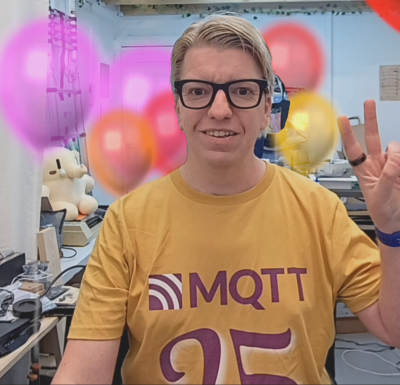
 simplyblock
 Simon Walters
 Frank Delporte


 Boris Builds
 heise online (inoffiziell)