The Slow Leak in the Basement of a Good Man’s Soul

2,906 words, 15 minutes read time.

The engine of the black SUV hummed with a precision that cost more than Jaxson Thorne’s first three cars combined, a low-frequency vibration that usually settled his nerves after a ten-hour shift of managing regional logistics. Tonight, however, the leather seat felt like a stranger’s lap. Jaxson sat in his driveway, the headlights cutting a sharp, clinical path through the suburban drizzle, watching the rhythmic sweep of the windshield wipers. He didn’t want to go inside, but he didn’t have anywhere else to go. This was the quiet rot of a Tuesday night, the kind of silence that doesn’t just sit there but actively eats at the edges of a man’s identity. He looked at his hands on the steering wheel—clean, manicured, and utterly steady—and realized he couldn’t remember the last time he’d felt a genuine spark of conviction that wasn’t tied to a quarterly profit margin or a homeowner’s association dispute. He was forty-five years old, a man of standing, a man who provided, yet he felt like a ghost haunting his own life. The drift hadn’t happened in a single, catastrophic moment of rebellion; it had happened in increments of a thousandth of an inch, a slow migration away from the shore until the lighthouse was nothing more than a flickering memory on a dark horizon.

Jaxson grew up in a house where the Bible was as permanent as the foundation, and as a younger man, he’d carried a fire that felt unquenchable. He remembered the intensity of his early twenties, the way he spoke about faith with a raw, unpolished grit that made him feel like he was part of something cosmic. But life has a way of sanding down the sharp edges of a man’s soul. Career ladders require a certain kind of weight distribution, and slowly, Jaxson began to trade the “foolishness” of the Gospel for the “wisdom” of the world. He told himself it was maturity. He told himself that being a “real man” meant being self-reliant, stoic, and unshakeable. He stopped asking God for direction and started asking his financial advisor for projections. He didn’t stop going to church; he just stopped being present when he was there. He became a professional spectator, a man who could recite the creeds but couldn’t feel the weight of the cross. It was the “slow leak” phenomenon—the tire doesn’t go flat because of a blowout; it goes flat because of a microscopic puncture that saps the pressure over a long, unremarkable haul.

Stepping into the house, the air smelled of lemon polish and expensive candles, a curated scent that masked the stale reality of his marriage. Sarah was in the kitchen, her silhouette framed by the high-end cabinetry they’d spent three months picking out. They spoke in the shorthand of roommates—logistics about the kids’ soccer schedules, the upcoming gala, the leak in the upstairs faucet. Jaxson felt a surge of irritation that he immediately suppressed under a layer of practiced apathy. This was his primary defense mechanism: the mask of the “Good Provider.” If he paid the bills and kept the lawn pristine, no one had the right to ask what was happening in the cellar of his heart. He was hiding in plain sight, concealing a growing hunger for something he couldn’t name, a hunger he occasionally tried to dull with another glass of expensive bourbon or thirty minutes of scrolling through the curated lives of people he didn’t even like. He was living out the warning of Hebrews 2:1, letting the truth slip away through the cracks of his daily grind, distracted by the very things he thought were the markers of his success.

The pride of a man is a strange, architectural thing; it builds high walls that eventually become a prison. Jaxson viewed his self-reliance as a virtue, a shield against the perceived weakness of needing anyone—including the Creator. He had succumbed to the modern masculine myth that vulnerability is a defect, a crack in the armor that allows the enemy in. In reality, his refusal to be vulnerable was the very thing that was suffocating him. He was tired of the performance. He was tired of being the man who had it all together while feeling like his internal compass was spinning aimlessly. That night, as he lay in bed listening to the digital hum of the house, the words of a long-forgotten sermon echoed in his mind: “What does it profit a man to gain the world and lose his own soul?” It wasn’t a thunderclap; it was a cold, sharp realization that he had achieved everything he ever wanted only to find that he had lost the person he used to be. He was a successful executive, a respected neighbor, and a spiritual corpse.

The following Saturday, Jaxson found himself in the garage, the one place where he felt he could still work with his hands and escape the digital noise. He was trying to fix an old chainsaw that hadn’t been started in three years. He pulled the cord repeatedly, his muscles straining, his face reddening with a familiar, boiling anger. The machine was stubborn, clogged with old, gummy fuel—a perfect metaphor for his own spirit. He wanted to throw the damn thing across the driveway. He wanted to scream at the sky. His anger wasn’t really about the chainsaw; it was about the crushing weight of his own inadequacy, the realization that he couldn’t “manage” his way out of this spiritual drought. He sat down on a grease-stained stool, his breath coming in ragged gasps, and for the first time in a decade, he didn’t try to fix it. He just sat in the mess. He thought about the lust for status that had driven him, the pride that had isolated him, and the fear that if anyone saw the real Jaxson Thorne, they would walk away in disgust. He was the man in the mirror, and for once, he didn’t like the guy looking back.

In the Bible, there’s a story about a man named Samson, a guy who was the epitome of masculine strength but who drifted so far that he didn’t even realize the Spirit of the Lord had left him until it was too late. Jaxson felt that chill in his bones. He realized he had been living on the fumes of a faith he’d inherited rather than a relationship he’d cultivated. He had become a “form of godliness” that denied the power thereof. He stood up, wiped the grease from his hands with a rag that was already too dirty to be effective, and walked toward the back of the garage where an old, leather-bound Bible sat under a stack of home improvement magazines. He pulled it out, the dust puffing into the air like a ghost. He didn’t look for a “feel-good” verse. He looked for the truth. He found himself in the book of James, reading about the man who looks in the mirror and immediately forgets what he looks like. That was him. He had forgotten his true identity as a son of the King, trading it for the temporary identity of a middle-manager in a dying world.

The drift is never a straight line; it’s a series of small compromises. Jaxson thought back to the moments where he chose work over his kids’ bedtimes, where he chose the clever lie over the difficult truth, where he chose the comfort of his own ego over the radical call of discipleship. He had been “conformed to this world,” just as Paul warned, and the transformation was almost complete. He felt a sudden, visceral need to break something—not the chainsaw, but the cycle. He realized that being “real” didn’t mean being perfect; it meant being honest about the wreckage. It meant admitting that his self-reliance was a lie and his pride was a shroud. He bowed his head over the workbench, surrounded by the smell of gasoline and sawdust, and whispered a prayer that wasn’t a rehearsed liturgy. It was a guttural, desperate plea for a U-turn. “I’m lost,” he said, the words catching in his throat. “I’ve got everything, and I’ve got nothing. Bring me back.”

The weeks that followed weren’t a montage of instant success. There were no cinematic breakthroughs where all his problems vanished. Instead, it was the grueling work of reclamation. Jaxson had to start showing up—not as the polished version of himself, but as the man who was struggling. He started by talking to Sarah, not about the faucet or the gala, but about the void. He told her he was scared, a confession that felt like pulling a tooth without anesthesia. He expected her to look at him with contempt; instead, she looked at him with a relief that broke his heart. She had been watching him drift for years, unable to reach him through the fog of his own making. The “Hardboiled” exterior he thought was protecting his family was actually the very thing that was keeping them out. He realized that a man’s strength isn’t measured by how much he can carry alone, but by his courage to admit when the load is too heavy.

The modern world tells men that they are the sum of their utility—what they can build, what they can earn, what they can conquer. But Jaxson Thorne was learning that a man is actually defined by what he submits to. He began to see his work not as his identity, but as his mission field. He stopped using his anger as a tool for control and started using his discipline as a tool for service. He found a small group of men who didn’t care about his title or his SUV, men who were also tired of the performance. They met in a back room of a local diner on Friday mornings, smelling of cheap coffee and honesty. They talked about the things men aren’t supposed to talk about—the lure of the screen, the bitterness of unfulfilled dreams, the struggle to lead when you feel like a follower. In those moments, Jaxson felt the pressure gauge of his soul finally start to rise. The leak wasn’t fully plugged, but he was finally paying attention to the hiss.

The drift is a natural law of the spiritual world; if you aren’t rowing, you are moving downstream. Jaxson understood now that he couldn’t just “be a good guy” and expect to stay on course. He had to be intentional. He had to be visceral about his faith, treating it with the same intensity he brought to his career, but with a different focus. He stopped trying to be the hero of his own story and started letting God be the protagonist. He found that the more he gave up his need for status, the more status he actually had in the eyes of his children. They didn’t want a “Good Provider” who was a stranger; they wanted a father who was present, even if he was flawed. He began to see that his weaknesses weren’t obstacles to God’s power, but the very platforms where that power could be displayed. It was a complete inversion of everything he had spent twenty years building.

One evening, a few months into his “reclamation project,” Jaxson found himself back in his SUV in the driveway. The headlights were still cutting through the darkness, but the feeling in his chest was different. He wasn’t avoiding the house. He wasn’t hiding from the silence. He looked at the steering wheel, then up at the stars peeking through the clouds. He thought about the man he had been—the one who thought he was in control while he was actually being swept away by the current of a shallow culture. He thought about the man he was becoming—someone who was still a work in progress, still prone to pride, still tempted by the old shortcuts, but someone who was finally facing the right direction. He put the car in park, killed the engine, and stepped out into the night air. The air felt colder, sharper, and more real than it had in years.

The drift is dangerous because it’s comfortable. It’s the path of least resistance. But for Jaxson Thorne, the comfort had become a slow-motion suicide of the spirit. He realized that “being real” as a man didn’t mean being a “tough guy” in the traditional sense; it meant having the toughness to face the truth about himself. It meant acknowledging that his pride was a hollow shell and his self-reliance was a sinking ship. He walked toward his front door, not as a man who had conquered the world, but as a man who had been conquered by grace. And for the first time in a very long time, he knew exactly who he was. He wasn’t his job title, his bank account, or his reputation. He was a man who had been lost at sea and was finally, painfully, and gloriously, findng his way home. The basement of his soul was still a bit damp, but the leak had been found, and the repair work—the hard, masculine, beautiful work of repentance—had finally begun.

Author’s Note

The story of Jaxson Thorne isn’t a story about a villain; it’s a story about the “good man” who slowly falls asleep at the wheel. In our modern world, we often wait for a catastrophic failure—a scandal, a bankruptcy, or a collapse—to signal that something is wrong. But for most men, the greatest threat isn’t a sudden explosion; it’s the spiritual drift. The writer of Hebrews gives us a stark warning in Hebrews 2:1: “We must pay the most careful attention, therefore, to what we have heard, so that we do not drift away.” The Greek word for “drift away” describes a ship that has slipped its moorings or a ring sliding off a finger. It is effortless. You don’t have to do anything to drift; you simply have to stop anchoring yourself to the Truth. For the modern man, this drift usually happens in the pursuit of legitimate things—career, provision, and status. We become like the man described in James 1:23-24, catching a glimpse of our true selves in the mirror of the Word, but then walking away and immediately forgetting who we are. We trade our identity as sons of God for our identity as “producers,” and in that trade, we lose our compass.

To understand the weight of this drift, we can look to the ancient imagery found in the Book of Enoch. While not in the standard biblical canon, this text was a visceral part of early spiritual thought and contains a haunting warning for the “decent” man. In Enoch 22, the prophet is shown four divisions where the spirits of the dead are held until judgment. While there are places for the righteous and the overtly wicked, there is a specific, hollow place for those who were incomplete. These were the men who weren’t necessarily “evil” by the world’s standards—they weren’t criminals or monsters—but they also never sought the Light. They lived in a gray, lukewarm middle ground. This is the “Good Man’s Trap.” We think that because we aren’t “bad,” we are safe. But the drift doesn’t take you to the wicked division; it takes you to the hollow one. It leads to a state where you are “morally neutral” but spiritually dead. In the Grit-Lit reality of the soul, there is no such thing as standing still. If you aren’t rowing toward the Fountain of Life, the current is already carrying you toward the void.

Here is the hard truth: Neutrality is a death sentence. The world wants you to believe that as long as you provide, stay out of jail, and keep your lawn green, you’ve won. But Revelation 3:16 offers a visceral warning to the lukewarm: “Because you are lukewarm—neither hot nor cold—I am about to spit you out of my mouth.” God has no use for a “decent” man who has no heart for Him. Apathy is more dangerous than outright rebellion because it is harder to detect. The man who is actively rebelling knows he is at war; the man who is drifting thinks he is just enjoying the ride. Your self-reliance is a counterfeit armor that will shatter the moment it meets eternity. Your “goodness” is a filthy rag (Isaiah 64:6) if it’s used as a shield to keep God at a distance. The “middle division” is full of men who thought they had more time to get real. The drift is natural, but it isn’t inevitable. It’s time to stop the SUV, step out of the noise, and re-anchor your life to the only Foundation that doesn’t shift with the culture. Don’t wait for the shipwreck to realize you’ve lost your way. Do you recognize the “slow leak” in your own life, or are you still trying to convince yourself the tire is full?

SUPPORTSUBSCRIBECONTACT ME

D. Bryan King

Sources

Disclaimer:

The views and opinions expressed in this post are solely those of the author. The information provided is based on personal research, experience, and understanding of the subject matter at the time of writing. Readers should consult relevant experts or authorities for specific guidance related to their unique situations.

#ArmorOfGod #biblicalManhood #biblicalMasculinity #biblicalTruth #BookOfEnoch #ChristianLiving #ChristianMen #Enoch22 #faithAndWork #findingGodInTheMundane #fourDivisionsOfTheDead #graceForMen #gritLit #hardboiledFiction #Hebrews21 #honestFaith #identityInChrist #James1Mirror #JaxsonThorne #leadershipAndFaith #lukewarmChristianity #lukewarmHeart #masculineFaith #masculineGrit #masculineSpirituality #Matthew1626 #midlifeCrisis #modernDiscipleship #modernManStruggles #overcomingPride #prideInMen #reclamation #redemptionStory #religiousComplacency #religiousDrift #repentance #Revelation316 #selfReliance #shortStoryForMen #slowLeakSoul #soulSearching #spiritualApathy #spiritualDiscipline #spiritualDrift #spiritualHunger #spiritualRestoration #spiritualWarfare #suburbanFaith #urbanFaith #vulnerability

The Weight of a Clean Desk

1,866 words, 10 minutes read time

Jackson Vance sat in the quiet, sterile glow of his corner office, the kind of space that smelled of expensive carpet cleaner and the faint, ozone tang of high-end printers. It was 7:45 PM, and the rest of the floor was a graveyard of empty ergonomic chairs and darkened monitors. Jackson was a middle manager at Sterling & Associates, a man who had built his reputation on being the guy who never broke a sweat. He was the bridge between the erratic demands of the executive suite and the grinding reality of the production floor. To the men who worked under him, Jack was the iron pillar; to the men above him, he was the reliable gear that never squeaked. He was a hard worker, a man who viewed his career as a testament to his character, and he had spent fifteen years ensuring that the mirror he presented to the world was devoid of even a fingerprint of failure.

The crisis hadn’t been his fault, not exactly. A junior analyst had fat-fingered the projections on the logistics overhaul, and a third-party vendor had missed a delivery window that Jack had warned was too tight. It was a perfect storm of institutional incompetence, but as the project lead, the shadow of the looming disaster fell squarely on Jack’s desk. When the Senior VP walked in that morning, looking for someone to bleed, Jack felt a primitive surge of fear. It wasn’t just fear of losing the job; it was the fear of losing the “Jack Vance” that people believed in. He saw the look of expectation in the VP’s eyes—the belief that Jack always had a contingency. In that split second, instead of laying out the honest wreckage caused by others, Jack offered a half-truth. He told them the delay was a “strategic pause” he had authorized to optimize the final rollout. He lied to protect the image of the man who was always in control.

The trouble with a lie isn’t the first breath it takes; it’s the constant oxygen it demands to stay alive. For Jack, that initial deception began to mutate within hours. To maintain the “strategic pause” narrative, he had to silence the junior analyst with a veiled threat and fabricate a series of emails to the vendor that made it look like the delay was intentional. He was a deacon at his church, a man who sat in the second pew and nodded along to sermons about the truth setting you free, yet here he was, weaving a shroud of dishonesty to wrap around his professional corpse. It was the masculine urge to be the provider who never faltered, the king of a hill that was actually a pile of shifting sand. He had convinced himself that protecting his status was the same thing as protecting his family’s future.

Every hour that passed made the truth harder to reach. He sat at his desk, staring at the polished mahogany surface, feeling the familiar, acidic burn of the secret sitting in the pit of his stomach. He was a slave to his reputation, a prisoner in a cell he had decorated with his own accolades. The Bible speaks of the heart being deceitful above all things, and Jack was currently the lead architect of his own deception. He wasn’t just lying to the firm; he was lying to the Man in the Mirror, trying to convince the Spirit of God that his intentions were pure even if his methods were crooked. He thought of his father, a man who worked forty years in a mill and never had a clean fingernail but never told a lie he couldn’t stand behind. Jack had the clean fingernails, the title, and the salary, but he felt like a hollow shell of the man his father had been.

When he finally left the office, the city lights felt like interrogators. He drove home in a daze, the hardboiled reality of his situation stripping away the last of his pretenses. He realized then that he had spent his life trying to manage his sin instead of repenting of it. He had treated his pride like a landscaping project, trimming the edges so it looked intentional, rather than seeing it for the rot that it was. He walked through his front door, and the domestic peace of his home felt like a mockery. Sarah was in the kitchen, her face bright with the kind of trust that made Jack want to vomit. She asked how the “optimization” was going, having heard the sanitized version of his day over a brief text. Jack felt the lie slide out of his throat like oil, confirming that everything was under control.

Dinner was a slow-motion interrogation of his soul. His son talked about a kid at school who got caught cheating on a math test, calling the boy a loser for not just owning up to it. Jack looked down at his plate and felt the irony like a physical blow. He tried to pivot to a “teachable moment,” his voice sounding hollow even to his own ears. It is a peculiar kind of hell for a man to preach a truth he isn’t living. He felt like a Pharisee in a tailored suit, straining at gnats while swallowing camels. He realized that his attempt to “protect” his family by lying had actually been a way of keeping them at a distance. He had traded intimacy for an image. He had chosen to be respected by a stranger rather than truly known by his wife.

By the time the house went quiet, the weight of the deception had become a physical burden, a phantom pressure on his chest that made every breath a labor. He sat in his darkened home office, the glow of the laptop screen etching deep lines into his face. He had the power to end it. He could type the email now—the full confession, the admission that he had panicked and lied to cover a mistake that wasn’t even his. He could choose the light. But he also knew the cost. Sterling & Associates didn’t value “growth through failure”; they valued results. A confession would likely mean the end of his career there, the loss of the lifestyle he had worked fifteen years to build, and the public shattering of the “Iron Pillar” persona.

He looked at the “Send” button on a draft that contained the truth, and then he looked at the file he had created to further the lie—the one that would successfully shift the blame entirely onto the vendor and keep his record spotless. The Bible’s teaching on honesty wasn’t a set of restrictive rules; it was a blueprint for survival, a warning that what is hidden will eventually be shouted from the rooftops. He knew what a “good” man would do. He knew what the man he pretended to be at church would do. But he also knew the man who had bills to pay, a son who looked up to him, and a pride that wouldn’t let him crawl.

Jackson Vance reached out, his finger hovering over the mouse. The silence in the room was absolute, save for the ticking of the clock on the wall—a steady, rhythmic reminder that time was running out for him to choose who he actually was. The mirror was still polished, the desk was still clean, and the image was still intact. For now. He closed his eyes, the weight of the world resting on a single click, caught between the man he was and the man he desperately wanted everyone to think he was. The cursor flickered, a heartbeat in the dark, waiting for him to decide if the cost of the light was worth the price of the shadow.

Author’s Note: The Choice in the Dark

I chose to leave Jackson Vance’s story unfinished for a specific reason. Most stories give us the comfort of a resolution—we get to see the hero redeem himself or the villain face his come-uppance. But in the real world, the most defining moments of a man’s life happen in that suffocating silence between the temptation and the action.

The cliffhanger isn’t just a literary device; it’s a mirror. Jackson is sitting in the dark, caught between the “Iron Pillar” persona that pays the mortgage and the broken man who needs the truth to breathe again. I wanted to give you, the reader, the space to sit in that chair with him and weigh the biblical cost of the decision.

Scripture and church history don’t shy away from the danger of the “polished mirror.” Consider these truths as you think about Jackson’s next move:

  • The Weight of History: Early church history tells us that the disciples and the first followers of Christ faced a much simpler, deadlier version of Jackson’s dilemma. For many of them, the price of “saving their image” and their lives was a single sentence renouncing Christ. They could have lied to stay safe. They could have played the middle ground to keep their status in society. Instead, they stood in the visceral reality of the truth, even when it meant accusing the powerful religious elite of their day for the crucifixion of Jesus. They chose the shadow of the cross over the safety of a lie.
  • Proverbs 28:13: “Whoever conceals their sins does not prosper, but the one who confesses and renounces them finds mercy.” Jackson is currently trying to prosper through concealment, but at what cost to his soul?
  • Luke 12:2: “There is nothing concealed that will not be disclosed, or hidden that will not be made known.” The “Iron Pillar” is a temporary structure; the truth has a way of outlasting our ability to hide it.
  • Ephesians 5:13: “But everything exposed by the light becomes visible—and everything that is illuminated becomes a light.” Jackson’s fear is exposure, but the Bible suggests that exposure is actually the starting point for healing.

I’m curious to hear your perspective: How does this story end in your mind? Does Jackson click “Send” on the confession and risk the fallout, or does he commit to the lie and live with the ghost of his integrity?

More importantly, I want to ask you to be honest with yourself: Have you ever been in Jackson’s shoes? Have you ever felt that visceral, primitive fear of your reputation cracking, and found yourself weaving a half-truth just to keep the image polished? We often think of “bearing false witness” as a grand, malicious act, but as Jackson shows us, it’s usually a defensive maneuver born out of pride and the fear of being seen as “less than.”

Leave a comment with your ending for Jackson Vance. Let’s talk about the cost of the light and the price of the shadow.

SUPPORTSUBSCRIBECONTACT ME

D. Bryan King

Sources

Disclaimer:

The views and opinions expressed in this post are solely those of the author. The information provided is based on personal research, experience, and understanding of the subject matter at the time of writing. Readers should consult relevant experts or authorities for specific guidance related to their unique situations.

#authenticity #biblicalRepentance #biblicalTruth #christianFictionForMen #ChristianMartyrdom #ChristianShortStory #churchDeaconLife #disciplesOfChrist #earlyChurchHistory #faithInTheWorkplace #fearOfVulnerability #gritLit #halfTruthsInBusiness #hardboiledChristianStory #integrityInLeadership #JacksonVanceStory #Luke122 #masculineFaith #menSIntegrity #middleManagementStruggle #modernChristianLiving #moralDilemma #overcomingPride #professionalEthics #Proverbs2813 #psychologicalTollOfLying #religiousHypocrisy #reputationVsCharacter #selfReliance #spiritualGrowthForMen #standingForTruth #workplaceHonesty

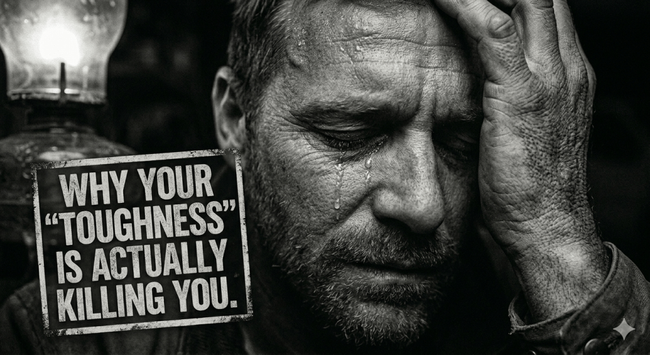
Why Your “Toughness” Is Actually Killing You

2,605 words, 14 minutes read time.

The internal combustion engine of Mark Miller’s life ran on a very specific, highly refined grade of silence. As a residential electrician, Mark spent his daylight hours navigating the skeletal frames of houses, pulling miles of copper wire through the dark, cramped spaces between studs. He liked the work because it was logical; if a circuit was broken, you found the fault, you spliced the wire, and the light came back on. There was a clear beginning, a definitive end, and a blueprint to follow that never asked him how he felt about the voltage. He was forty-two years old, with hands that felt like sandpaper and a reputation for being the most reliable man in the county, a guy who could troubleshoot a complex three-way switch in a blackout without ever breaking a sweat or losing his cool. Neighbors saw the white van in his driveway and the way he meticulously coiled his hoses on the lawn and they called him “steady,” a pillar of the community who never caused a scene and always had a polite, non-committal nod for everyone he passed.

But the steady hum of Mark’s life was actually the sound of a man redlining in a vacuum, a high-performance machine vibrating itself to pieces because it had no exhaust system for the pressure building inside. For Mark, and for the generations of Millers who came before him, the emotional spectrum had been pruned down to a single, functional utility: anger. Anything else—fear, sadness, the bone-deep weariness of a life that felt like a treadmill—was viewed as a system failure, a leak in the line that needed to be plugged with steel wool and buried behind drywall. He lived by an unwritten code that suggested a man’s strength was measured by the size of the burden he could carry without grunting, a philosophy that made him a “good man” in the eyes of a society that prizes manageable, quiet producers, but a ghost in the eyes of a God who designed him for more. This was the “Ideal Man” of the 2020s, a man who was low-key praised by the world while he was effectively dying inside, using the “Digital Sedative” of screens and the chemical anesthetic of a bottle to silence a heart he no longer knew how to read.

The ritual usually began around 6:30 PM, the moment the heavy work boots hit the mudroom floor with a dull thud that signaled the end of Mark the Electrician and the beginning of Mark the Ghost. He would walk into the kitchen, offer his wife a clipped “hey” that carried the weight of a thousand unspoken frustrations, and head straight for the cabinet. The first pour of bourbon was a tactical strike, a way to “take the edge off” the jagged static of the day’s demands. It was a well-oiled machine of numbing where he would transition from the physical labor of the world into a self-imposed fog, a state of nothingness where he didn’t have to process the fact that his oldest son was failing algebra or that his wife’s eyes held a desperate, searching quality that he lacked the vocabulary to address. He wasn’t looking for trouble; he was looking for an exit strategy from reality, a way to bypass the “still, small voice” of God that often whispered in the silence of the evening, calling him to lead his home with something more than just a paycheck and a functioning water heater.

Mark believed he was being strong by bottling it all up, but the Bible paints a radically different picture of masculinity, one modeled after Jesus Christ, who was anything but a stoic, unfeeling statue. We often forget that the shortest verse in Scripture, “Jesus wept” in John 11:35, is perhaps one of the most masculine moments in history because it shows a King who was not afraid to feel the weight of death and loss. Jesus didn’t numb out when the weight of the world pressed down on Him; in the Garden of Gethsemane, when the agony reached its peak and He was literally sweating drops of blood, He didn’t reach for a bottle or a digital distraction. He fell to His knees and faced the Father, naming His distress and surrendering His heart to the only One who could hold it. Mark Miller, however, saw vulnerability as a defect, unaware that by amputating his ability to feel sadness or fear, he was also killing his capacity to feel true joy or deep connection. He was effectively a man in a hazmat suit, protected from the pain of the world but unable to feel the warmth of the sun or the touch of the people he loved.

The breaking point arrived on a Tuesday, a day that started with the same gray monotony as every other, but ended with a confrontation that Mark’s bourbon couldn’t drown out. He was sitting in his garage at his woodworking bench, a space that was supposed to be a creative outlet but had become a “hobby closet” where he hid from his family under the guise of being productive. He was working on a custom walnut dining table, a piece of high-end furniture that would eventually sell for thousands of dollars to a client who wanted the “authentic” look of hand-crafted wood. Mark was incredibly talented, but as he ran the plane over the dark grain, he wasn’t thinking about the beauty of the timber; he was thinking about the conversation he’d had earlier with his boss, a younger man who had spent thirty minutes questioning Mark’s efficiency on a job site. Mark hadn’t said a word, he’d just nodded politely while his jaw tightened until it ached, burying the white-hot flash of prideful anger deep into his chest where it could sit and ferment alongside all the other unexpressed emotions of the last decade.

The garage door creaked open, and his youngest son, Leo, walked in holding a plastic toy truck that had lost a wheel. The boy didn’t say anything at first, just stood there in the periphery of the sawdust-chilled air, watching his father work with a surgical, cold precision. Mark didn’t look up, his mind already calculating how many more passes he needed to make the surface level, and more importantly, how many more minutes he had until he could justify going back inside for another glass of bourbon to “keep the edge away.” Leo finally spoke, his voice small and cracking with a vulnerability that Mark found instinctively irritating. “Dad, can you fix this? It broke when I was playing outside.” Mark stopped the plane, the silence of the garage suddenly feeling heavy and suffocating, like the air inside a sealed vault. He looked at the toy, then at his son’s face, which was a mirror of his own—trying to be brave, trying not to show that he was upset about a small thing, already learning the Miller family tradition of the “non-committal smile.”

In that moment, a wave of something other than anger surged up in Mark’s chest, something he couldn’t name because he’d spent twenty years deleting the files for it. It was a mixture of grief for his own lost childhood, fear that he was raising a son who would become a ghost just like him, and a sudden, sharp realization that he was losing a battle he didn’t even know he was fighting. He thought about the warning in 1 Peter 5:8, “Be sober-minded; be watchful. Your adversary the devil prowls around like a roaring lion, seeking someone to devour.” He realized that it was incredibly hard to be watchful when you were sedated by a digital glow or a high-proof spirit. The lion wasn’t coming for his house or his bank account; the lion was devouring the heart of his home while Mark sat on the couch watching strangers live lives on a screen because he was too “tired” to pursue his own. He was the “Ideal Man” the world wanted—manageable, quiet, and fundamentally absent—but he was a far cry from the Biblical Man God demanded: one who engages reality with the strength of the Spirit.

Mark looked at the broken truck and then back at the walnut table that represented his escape, his expensive way of telling his family “do not disturb.” He felt the familiar pull of the “Society Approved” path—tell the boy “not now,” give him a pat on the head, and sink back into the numbing comfort of his routine. But for the first time in his life, the spiritual anesthetic failed to kick in. The “still, small voice” he had been ignoring was no longer a whisper; it was a roar. It was telling him that true rest isn’t found in a six-pack or a weekend bender of isolation, but in the presence of Christ, the only one who can take a heart of stone and turn it back into a heart of flesh. The truth cut through the fog like a lightning bolt: he wasn’t being a “good man” by staying quiet; he was being a coward who was afraid to feel the weight of his own life.

“Come here, Leo,” Mark said, his voice sounding raspy and foreign to his own ears, as if he were using a muscle that had been atrophied for years. He sat the boy down on a stool, and instead of just taking the truck and fixing it with his back turned, he sat next to him. He didn’t just fix the wheel; he started to talk. Not about the truck, and not about the weather, but about the day. He told his son that he was frustrated about work, and that he was sorry for being “gone” even when he was sitting right there in the room. He didn’t have the “full range of God-given feelings” mastered yet, but he was naming the fear and the weariness for the first time. As he spoke, he felt a strange sensation in his chest, a lightness that felt more like strength than any amount of “toughness” he’d ever displayed. He was finally confronting the sin of his own passivity with the truth of his need for grace.

The story of Mark Miller doesn’t end with a perfect family dinner and a cinematic sunset; it ends with a man standing at a decision point, realizing that the “Ritual of Disappearing” has to die so that he can truly live. Ephesians 5:18 warns us not to get drunk with wine, which leads to debauchery, but to be filled with the Spirit. For Mark, that meant realizing that his bourbon and his “hobby closet” were just different names for the same idol: comfort. He had to learn that the “Imago Dei,” the image of God in man, includes the capacity to weep, to feel compassion, and to be “sober-minded” enough to see the needs of those around him. He had to put down the remote, cork the bottle, and wake up to the reality that his family didn’t need a “nice” ghost who never caused trouble; they needed a living, breathing man who was willing to be real, even when his voice shook.

The struggle for the modern Christian man isn’t necessarily the drink or the hobby itself, but the “why” behind them. If you are using your life’s work or your evening distractions to silence the call of God to lead, to repent, or to grow, you are merely a well-maintained machine in a world that needs a soul. Real strength isn’t found in the ability to suppress emotion; it’s found in the courage to surrender those emotions to the Father, just as Jesus did in the garden. It’s time to stop being “manageable” for a world that wants you numb and start being “dangerous” for a Kingdom that wants you awake. Mark Miller didn’t finish the walnut table that night; instead, he left the garage lights on, walked into the house, looked his wife in the eye without the non-committal smile, and for the first time in a decade, told her exactly how he was feeling. The circuit was finally complete, and for the first time in a long time, the lights were truly on.

Author’s Note

We have all been there—standing in the kitchen after a long shift, staring into the middle distance while the world keeps spinning around us. We are often broken, numb, and desperately trying to find something, anything, to fill the void that a hard day and a heavy heart leave behind. Society has taught us that as long as we are providing and staying quiet, we are “good men,” but that lie only serves to turn us into ghosts in our own homes. We hide in our “hobby closets” or behind the amber glow of a bottle, not because we are evil, but because we are exhausted and don’t have the vocabulary to express the pressure building inside.

To be clear, the act of having a drink from time to time or pursuing a hobby isn’t the inherent sin; the biblical concern is the loss of self-control and using these things as an exit strategy from reality. This story of Mark Miller is a mirror for every man who has used a “digital sedative” or a weekend bender to silence the still, small voice of God. We must remember that real strength isn’t found in bottling up fear until we become manageable machines for the world. It’s found in the courage to be “sober-minded” and “watchful,” surrendering our hearts to the Father just as Jesus did when the weight of the world was at its heaviest.

We are reminded in Ezekiel 36:26, “I will give you a new heart and put a new spirit in you; I will remove from you your heart of stone and give you a heart of flesh.” God doesn’t want us to stay numb or “steady” in our stone-like silence; He wants to restore our capacity to feel, lead, and love. It’s time to stop disappearing into the fog and start being the living, breathing men our families—and our Creator—call us to be.

SUPPORTSUBSCRIBECONTACT ME

D. Bryan King

Sources

Disclaimer:

The views and opinions expressed in this post are solely those of the author. The information provided is based on personal research, experience, and understanding of the subject matter at the time of writing. Readers should consult relevant experts or authorities for specific guidance related to their unique situations.

#1Peter58 #avoidantBehaviorInMen #biblicalMasculinity #breakingGenerationalSilence #christianFatherhood #ChristianMenStruggles #ChristianShortStory #digitalSedative #emotionalHealthForMen #emotionalIntelligenceForMen #escapingReality #Ezekiel3626 #faithBasedHealing #fearOfVulnerability #findingPurpose #GardenOfGethsemane #gritLit #hardboiledFiction #heartOfStoneToHeartOfFlesh #hidingWeaknesses #internalCombustionOfSilence #JesusWept #John1135 #John1135Meaning #leadershipInTheHome #maleIdentityInWork #MarkMiller #modernManIdentity #modernManProfile #namingEmotions #nonCommittalSmile #overcomingNumbness #parentingWithVulnerability #processingAnger #repentingOfPassivity #residentialElectricianStory #soberMindedLiving #societalPressureOnMen #spiritualAlertness #spiritualAnesthetic #SpiritualGrowth #statusAndPride #surrenderToGod #theManageableMan #trueRestInChrist #vulnerabilityAsStrength #watchfulLife #woodworkingHobby

The Salt and the Scale: Reclaiming the Masculine Mission of the Gospel

1,634 words, 9 minutes read time.

The modern man has been fed a sterilized, pastel version of the Gospel that would make the rugged laborers of the first-century Levant gag. We have turned the command to be “Fishers of Men” into a polite invitation to a tea party, stripping away the salt, the scales, and the bone-deep exhaustion that defines the call. When Jesus stood on the shore of the Sea of Galilee and called Peter and Andrew, He wasn’t looking for polite conversationalists or moral bookkeepers; He was recruiting a crew for a grueling, dangerous rescue mission into the chaos of the human condition. This was a tactical pivot from one form of grit to another, demanding men who understood that the Kingdom of God isn’t built in a cathedral, but hauled out of the murky depths of a broken world. The life you are currently living—sanitized, comfortable, and risk-averse—is a betrayal of the calling that was forged in the spray of the sea and the weight of the dragnet. You are called to the deep, yet you are content to sit on the dock and polish your boots while the world drowns. It is time to face the brutal reality of the fisherman’s craft and realize that if your faith doesn’t smell like sweat and struggle, it isn’t the faith Jesus demanded.

Biblical Manhood and the No-Judgment Reality of the Catch

The first pillar of this calling is the absolute destruction of the “gatekeeper” mentality that plagues modern Christian circles. In the commercial fishing industry of the first century, a fisherman casting a dragnet did not have the luxury of pre-screening the catch; he cast into the deep and hauled in whatever the sea yielded. This is the “no-judgment” reality that men today fail to grasp because they are too busy acting like moral auditors rather than rescue workers. When you view the world through the lens of a fisherman, you realize that fish are simply creatures of nature, acting according to their environment. They are not “good” or “bad” while they are in the water; they are simply the catch. Your obsession with judging a man’s beliefs or actions before you even get him into the boat is a coward’s excuse to avoid the work of the haul. You want a clean catch without the mess of the water, but the Gospel demands that you throw the net over the side and embrace the chaos.

This requires a fundamental shift in how you view the “lost.” They are not enemies to be defeated or subjects to be analyzed; they are souls submerged in an element that is slowly killing them. A fisherman understands that the net is the instrument of grace, an unmerited invitation to a different world. If you find yourself standing on the shore, pointing fingers at the “sinners” in the water, you have failed the most basic requirement of the crew. You are not the judge; you are the deckhand. The sorting happens on the shore, at the end of the age, and notably, it is handled by the Master, not the fishermen. Your pride has convinced you that you are the quality control officer, but the truth is you are just another man on the rope. Stop waiting for the world to “clean up” before you engage; the cleaning happens after the catch, and it isn’t your job to begin with.

Tactical Intelligence and Reading the Water of the Human Condition

A man who cannot read the water will never fill a boat, and a man who does not understand the pressures of his fellow man will never lead a soul to Christ. Success on the Sea of Galilee required more than just strong arms; it required an intimate, tactical knowledge of currents, thermal layers, and the behavior of the prey in the dark. This is the “Reading the Water” argument that most men ignore because it requires actual effort and observation. You are sleepwalking through your interactions, oblivious to the “water” your neighbors, coworkers, and friends are drowning in. They are submerged in the freezing currents of debt, the crushing pressure of failing marriages, and the silent, dark depths of isolation. If you cannot sense the shift in the “weather” of a man’s life, you are useless to the mission. You must develop the discernment to see beneath the surface of the “I’m fine” mask that every man wears.

Developing this tactical intelligence means you stop speaking in platitudes and start speaking in reality. You have to know the depth at which a man is struggling to know where to cast the net. This isn’t “empathy” in the soft, modern sense; it is reconnaissance. It is the hardboiled realization that every man you meet is fighting a war you know nothing about, and your job is to find the opening. If you aren’t paying attention to the environment—the culture, the local struggles, the specific weights that are dragging men down—then you are just splashing around in the shallows and wondering why your net is empty. The mission requires a sharp mind and a cold eye for detail. You must become a student of the human condition, learning the signs of a soul that is gasping for air so you can be there with the rope when the time is right.

The Brutal Necessity of the Brotherhood and the Hidden Labor

The most dangerous lie you’ve bought into is that the Christian life is a solo trek. In the first century, the dragnet was a massive, heavy tool that required a coordinated crew and multiple boats to operate effectively. The “Power of the Net” is the power of the brotherhood, and the fact that you are trying to “fish” alone is why you are failing. A lone man on a rope is a man who will eventually be pulled into the water himself. The mission demands a crew of men who know their place on the line, who row in sync, and who don’t let go when the weight becomes unbearable. If you don’t have a “foxhole” of men who are as committed to the haul as you are, you aren’t a fisherman; you’re a hobbyist. You need the collective strength of the brotherhood to pull against the current of a world that wants to keep its own. This is about shared labor, shared risk, and the total abandonment of the “lone wolf” ego that is rotting your spiritual potential.

Furthermore, you must accept the “Hidden Nature” of this work. Most of your labor will happen in the dark, beneath the surface, where there is no applause and no immediate sign of success. Fishing is an act of persistent, gritty faith; you cast the net into the murky deep because you trust the mechanics of the mission, not because you see the fish. You must learn to work the depths without needing to see the prize every five minutes. The modern man is addicted to instant feedback, but the Kingdom of God moves at the pace of the haul. It is long hours of silence, repeated casts, and the back-breaking work of pulling in a net that feels empty until the very last moment. If you can’t handle the anonymity of the deep-water grind, you will quit long before the catch arrives. The soul of a man is deep water, and the work of reaching it is often invisible, thankless, and slow.

Your current disaster of a life—the stagnation, the boredom, the feeling of uselessness—is the direct result of you standing on the pier while the Master is calling for a crew. You have traded the salt and the struggle for a padded chair and a comfortable life, and your soul is dying because of it. To be a “Fisher of Men” is to embrace the smell of scales, the sting of the salt-burn, and the reality that you will get dirty. It means engaging with the “smelly” parts of human existence—the addictions, the failures, the raw, unrefined nature of men—without flinching. Stop making excuses for your lack of impact and stop waiting for a “safer” opportunity. There is no safety in the deep, only the mission. The tide is turning, the boat is pushing off, and the Master is looking at you. Either get your hands on the rope and start hauling, or admit that you’d rather rot on the shore than live the life you were made for.

Call to Action

The boat is leaving the shore, and the Master isn’t looking for spectators. He’s looking for a crew. You have two choices: stay on the dock, safely clutching your clean clothes and your excuses, or get your hands on the rope.

Stop waiting for a “better time” to get your life in order. Stop pretending that your silence is “patience” when it’s actually cowardice. The mission is messy, the water is deep, and the stakes are eternal.

Get on your knees, find your crew, and get back into the haul. The deep is calling. Will you answer, or will you rot?

SUPPORTSUBSCRIBECONTACT ME

D. Bryan King

Sources

Disclaimer:

The views and opinions expressed in this post are solely those of the author. The information provided is based on personal research, experience, and understanding of the subject matter at the time of writing. Readers should consult relevant experts or authorities for specific guidance related to their unique situations.

#activeFaith #ancientFishingTechniques #ancientLevantHistory #authenticFaith #biblicalArcheology #biblicalCommunity #biblicalEndurance #biblicalFishermen #biblicalLabor #biblicalManhood #biblicalMetaphors #biblicalMission #biblicalRescueMission #BiblicalStrength #biblicalTacticalIntelligence #biblicalTeamBuilding #biblicalWisdom #brotherhoodOfBelievers #ChristianBrotherhood #ChristianDiscipleship #ChristianDuty #ChristianLifeForMen #ChristianMenSGuide #ChristianResilience #ChristianVocation #churchForMen #commercialFishingBible #discipleshipForMen #discipleshipStrategy #discipleshipTraining #dragnetFishing #faithAndLabor #faithUnderPressure #firstCenturyFishing #FishersOfMen #gospelCall #GospelGrit #GospelOfMark #gospelTruth #GreatCommissionForMen #gritLit #hardboiledFaith #kingdomWork #masculineChristianity #masculineSpirituality #menSMinistry #NewTestamentManhood #saltOfTheEarth #seaOfChaos #SeaOfGalileeFishing #SeaOfGalileeHistory #SimonPeter #spiritualDiscernment #spiritualGrit #spiritualHarvest #spiritualLeadershipForMen #spiritualMission #spiritualWarfareForMen

The Iron Vault and the Only Key That Fits

2,715 words, 14 minutes read time.

The engine of the 1998 Silverado rumbled with a rhythmic, mechanical cough that Mark Sullivan felt deep in his marrow, a vibration that served as the only soundtrack to his 5:00 AM commute. To the world, Mark was a pillar of the local community—a man of calloused hands, steady eyes, and a silence that most neighbors mistook for profound wisdom. He was the guy you called when a pipe burst or when the church roof needed a patch after a summer storm, and he always showed up with a toolbox and a tight-lipped nod. But as the gray dawn began to bleed over the horizon of the industrial park where he worked as a foreman, Mark felt the familiar, heavy pressure in his chest, a sensation he had lived with for so long he had started to believe it was simply the weight of being a man. He had been raised in a world where emotions were like luxury goods—unnecessary, expensive, and likely to break when you needed them most—and so he had narrowed his internal vocabulary down to a single, functional tool: a quiet, simmering frustration that he called “getting things done.”

Mark’s father had been a man of granite and gravel who taught him that a man’s worth was measured in what he produced and what he could endure without complaining. “Crying is for those who don’t have a job to do,” his father would say, and Mark had taken that gospel to heart, building a life that was a fortress of self-reliance and stoic isolation. When his wife, Sarah, tried to reach into the dark rooms of his heart, asking him how he felt about the mounting bills or the way their oldest son was struggling in school, Mark would simply tighten his jaw and talk about the logistics of the budget or the necessity of discipline. He wasn’t being cruel, at least not intentionally; he was simply operating within the only framework he knew, believing that to admit fear was to invite collapse, and to admit sadness was to admit defeat. He viewed his own heart as a high-pressure boiler—something to be monitored and contained, never opened, because he was terrified that if he ever let the steam out, there would be nothing left but a cold, empty shell.

The crisis began on a Tuesday, a day that started with the mundane bite of cold coffee and ended with a phone call that threatened to crack the foundation of Mark’s carefully constructed world. His brother, David, the one person who had always shared the unspoken burden of their father’s legacy, had been involved in a multi-car pileup on the interstate. As Mark stood in the sterile, fluorescent glare of the hospital waiting room, surrounded by the scent of antiseptic and the muffled sounds of grieving families, he felt a strange, terrifying paralysis. He wanted to scream, he wanted to collapse, and he wanted to beg God for a miracle, but the machinery of his psyche wouldn’t allow it. Instead, he sat with his back perfectly straight, his hands folded in his lap like two slabs of stone, while his mind frantically cycled through the logistics of insurance, hospital bills, and who would cover David’s shifts at the warehouse. He was a man drowning in a shallow pool, unable to simply stand up and breathe because he didn’t know how to acknowledge that he was wet.

Hours passed, and the doctors eventually emerged with news that was grim but not final—David was alive, but the recovery would be long, painful, and uncertain. When Sarah arrived at the hospital, her face etched with genuine, raw sorrow, she reached out to hold Mark’s hand, only to find it as rigid as a piece of rebar. She looked at him, her eyes searching for a crack, a tear, or even a flicker of the terror she knew must be behind his eyes, but she found only the foreman. “Mark, you can let it out,” she whispered, her voice a soft contrast to the humming machinery of the ICU. “He’s your brother. You’re allowed to be scared.” Mark pulled his hand away, not out of anger, but out of a desperate need to maintain the internal pressure that kept him upright, snapping back that being scared wouldn’t fix David’s shattered pelvis or pay for the physical therapy. He walked away from her, heading toward the hospital chapel not to pray, but to find a place where he could be alone with the suffocating silence of his own making.

Inside the chapel, a small, dimly lit room that smelled of old wood and spent candles, Mark sat in the back pew and stared at a simple wooden cross on the wall. He felt a surge of something hot and volatile rising in his throat—not the clean, cold anger he used to solve problems at the job site, but something far more primal and agonizing. He thought about the shortest verse in the Bible, the one he had memorized as a child but never truly understood: “Jesus wept.” For years, Mark had viewed that verse as a historical footnote, a momentary lapse in the strength of the Savior, rather than a divine blueprint for what it meant to be fully human. He had always preferred the image of Jesus driving the money changers out of the temple with a whip, a God of action and righteous fury, because that was a version of masculinity he could mimic. But as he sat in the silence, the image of a weeping God began to gnaw at his pride, challenging the notion that strength was synonymous with being an unfeeling monolith.

He began to think about the Garden of Gethsemane, a story he had heard a thousand times, but now it felt visceral, like a punch to the gut. He saw a man—the Son of God—so overwhelmed by the weight of what was coming that he sweat drops of blood, a man who didn’t hide his agony from his friends but begged them to stay awake and watch with him. Mark realized, with a sudden and terrifying clarity, that he had spent his entire life trying to be “stronger” than Jesus. He had tried to be a man who didn’t need to lean on others, a man who didn’t need to cry out in the dark, and in doing so, he had effectively shut himself off from the very grace he claimed to follow. His self-reliance was not a virtue; it was a form of idolatry, a worship of his own ability to endure until he eventually broke. He was a man who had built a cage out of his own ribs to protect a heart he no longer knew how to use.

The silence of the chapel began to feel heavy, pressing against his chest until he could barely draw a breath, and for the first time in thirty years, Mark Sullivan didn’t try to fix the feeling. He didn’t try to plan his way out of the sorrow or rationalize the pain into a checklist of tasks. He simply sat there, staring at the cross, and admitted to the empty room that he was terrified. He whispered the words out loud, his voice cracking like dry timber: “I am scared, and I don’t know what to do.” The admission felt like pulling a plug from a dam. The anger that had been his constant companion for decades suddenly felt thin and transparent, a cheap mask for a soul that was starving for the permission to feel. He realized that by only allowing himself to feel anger, he had effectively blinded himself to the full spectrum of the life God had intended for him, missing the deep compassion and the restorative power of shared grief.

As the tears finally came—slow and hesitant at first, then racking his frame with the force of an earthquake—Mark felt a strange, paradoxical sensation of lightness. It wasn’t the relief of a problem being solved, but the relief of a truth being told. He wept for his brother, he wept for the years he had spent as a ghost in his own home, and he wept for the father who had taught him that his heart was a liability. In that moment of absolute vulnerability, the “Hardboiled” exterior he had polished for so long began to crumble, revealing something raw and unfinished underneath. He understood then that the “Real Man” he had been trying to be was a caricature, a hollow suit of armor that offered protection but denied intimacy. True strength, he realized, wasn’t the ability to hold it all in; it was the courage to pour it all out at the feet of the One who had crafted the heart in the first place.

When Mark finally walked out of the chapel, the world looked different—not because the circumstances had changed, but because the man looking at them had. He found Sarah in the hallway, still waiting, her face a mask of weary concern. He didn’t offer her a plan or a platitude. Instead, he walked up to her, took her hands in his, and let his shoulders drop. “I’m terrified, Sarah,” he said, and this time he didn’t pull away when she pulled him into a hug. He felt the warmth of her presence, a comfort he had denied himself for years because he thought he had to be the one providing the comfort, never receiving it. He was learning, in the span of a few heartbeat-heavy minutes, that surrender wasn’t a sign of weakness, but the ultimate act of faith. To be real was to be broken, and to be broken was to finally be in a position where God could do some actual work.

The following weeks were the hardest of Mark’s life, but they were also the most honest. He spent hours by David’s bedside, and instead of talking about the mechanics of the surgery or the logistics of the insurance, he talked about their childhood, their fears, and the way he missed their father despite the old man’s flaws. He found that by naming his emotions—fear, guilt, hope, and sadness—they lost their power to haunt him. He started attending a men’s group at the church, not as the guy who fixed the roof, but as a man who was learning how to breathe again. He told the other men, most of whom were hiding behind their own masks of stoicism, that he had spent his life building a vault for his heart, only to realize that he had locked himself in from the inside. He spoke about the God who weeps, the God who feels, and the God who invites us to do the same.

Mark Sullivan still drives that 1998 Silverado, and he still shows up with his toolbox when a neighbor’s pipe bursts, but the silence that surrounds him is different now. It’s no longer the silence of a tomb, but the quiet of a man who is listening. He understands that anger is a valid emotion, but it is a terrible master, and that the “God-given feelings” he once feared are actually the language of the soul. He has learned that real masculinity isn’t found in the absence of emotion, but in the mastery of it—the ability to stand in the middle of a storm, acknowledge the fear, and then choose to move forward in the strength of a Savior who knows exactly what it feels like to hurt. Mark is no longer a foreman of a construction crew who happens to be a man; he is a man of God who happens to be a foreman, and the difference is the weight of a heart that is finally, mercifully, heavy with the truth.

Author’s Note: The Myth of the Unbreakable Man

For many men, there are limited options for emotions. From a young age, we are handed a script that says we must be the stoic provider, the unshakable rock, and the silent fixer. The world likes to push men into a “performance” they want—a curated version of masculinity that prizes production over personhood—but this mask is entirely unsustainable for all men. When we live as though anger is the only acceptable outlet for our hearts, we don’t become stronger; we simply become more brittle.

The story of Mark Sullivan is a reflection of the modern man’s struggle to reconcile his God-given design with the world’s rigid expectations. We often treat our inner lives like a high-pressure boiler, fearing that one leak of “weakness” will lead to a total explosion. Yet, Scripture shows us that a life of faith is not a life of suppression, but one of surrender and profound emotional depth.

The Scriptural Foundation

The Bible does not call us to be unfeeling machines; it calls us to be whole. Here are the truths that anchor our need to be real:

  • The Humanity of Christ: We often forget that the most powerful Man to ever walk the earth was also the most emotionally expressive. In John 11:35, the shortest verse carries the heaviest weight: “Jesus wept.” He didn’t just observe grief; He entered into it. In the Garden of Gethsemane, Matthew 26:38 records Him saying, “My soul is overwhelmed with sorrow to the point of death.” If the Savior of the world could express agony and ask for support, why do we think we are above it?
  • The Promise of a New Heart: God’s goal for us isn’t to harden us into stone, but to make us alive. Ezekiel 36:26 promises: “I will give you a new heart and put a new spirit in you; I will remove from you your heart of stone and give you a heart of flesh.” A heart of flesh feels, it bleeds, and it heals.
  • Strength in Vulnerability: We spend our lives trying to be “self-made,” but God’s strength is perfected when we stop performing. 2 Corinthians 12:9 reminds us that His grace is sufficient and His power is made perfect in weakness.

The TL;DR of Mark’s Story: Mark Sullivan, a man who viewed silence as strength, realized that his self-reliance was actually a cage. By looking at the example of a weeping, compassionate Savior, he learned that true masculinity isn’t about containing the pressure—it’s about having the courage to be honest before God and his family. Real men don’t just “get it done”; they bring their whole hearts to the One who made them.

Call to Action

It’s time to stop mistake-proofing your life and start living it. If you’ve spent years building a vault around your heart, believing that silence is strength and numbness is a badge of honor, you aren’t becoming a better man—you’re just becoming a ghost. Real strength doesn’t hide behind a clenched jaw or a “rub some dirt on it” theology; real strength has the guts to look at the Father and say, “I can’t carry this alone.”

Don’t wait for a tragedy to break the seal.

  • Name the weight: Identify one thing you’ve been “bottling up” this week—whether it’s fear about your job, a hidden struggle, or a lingering hurt—and bring it to God in prayer without the filters.
  • Find your circle: Stop being the “lone wolf.” Reach out to one brother you trust and be honest about where you’re actually at. Vulnerability isn’t a liability; it’s the only way to build a real foundation.
  • Follow the Pattern: Study the life of Jesus, not just as a conqueror, but as the Man who wept, the Man who felt compassion, and the Man who asked for help in the Garden.

The vault was never meant to be your home. Step out, lay down the heavy armor of self-reliance, and let God give you a heart of flesh for your heart of stone.

SUPPORTSUBSCRIBECONTACT ME

D. Bryan King

Sources

Disclaimer:

The views and opinions expressed in this post are solely those of the author. The information provided is based on personal research, experience, and understanding of the subject matter at the time of writing. Readers should consult relevant experts or authorities for specific guidance related to their unique situations.

#authenticFaith #biblicalManhood #biblicalMasculinity #buildingGodlyCharacter #ChristianForemanStory #christianShortStoryForMen #emotionalIntelligenceForMen #emotionalStunting #faithBasedGrit #fatherhoodAndEmotions #GethsemaneForModernMen #gritLit #hardboiledChristianFiction #healingForMen #identityInChrist #JesusWeptMeaning #masculineSpirituality #menSMentalHealthAndFaith #modernChristianLiving #overcomingAnger #overcomingStoicism #processingEmotionsAsAMan #realisticChristianFiction #religiousStoryAboutPride #selfRelianceVsFaith #sheddingTheMask #spiritualGrowthForMen #surrenderingToGod #vulnerabilityAsStrength

It's GritLit weekend! Stelliform has a nice prize in the silent auction. Bid & you could win two books by GritLit alum Rebecca Campbell and a Stelliform canvas tote.

Items will be available at the Homewood Suites by Hilton after our final gritLIT event on April 19. GritLit can also arrange local delivery or pick-up. Thank you so much for your support of Hamilton literary arts 📚.

Let the bidding begin! https://loom.ly/y4DmDM8

#GritLIT #SilentAuction #IndiePress #SmallPressPublishing

The High Cost of Keeping Up

3,108 words, 16 minutes read time.

Caleb shifted the gear into park, but he didn’t turn off the ignition. The heater was blowing a dry, dusty warmth against his face, and the old sedan hummed with a familiar, tired vibration. He sat there for a moment, the grocery bags in the passenger seat settling with a soft plastic crinkle. Through the windshield, the world was tinted in the muted shades of a late November afternoon, and his eyes, almost against his own will, drifted to the house across the street. The Miller place was glowing. It wasn’t just the professional-grade landscaping or the way their windows caught the dying light; it was the sheer, unapologetic Newness of it all. Parked in their driveway was a pristine, midnight-blue truck, the kind with a grill that looked like a wall of chrome and tires that had never seen a speck of real dirt. Caleb looked at his own hands, calloused and stained from a morning spent wrestling with a rusted lawnmower blade, and felt a sudden, sharp pang of something that wasn’t quite anger, but felt just as heavy.

He wasn’t a bitter man. If you asked the guys at the warehouse or the deacons at the church, they’d tell you Caleb was the first one to show up with a toolbox when a neighbor’s basement flooded. He loved his wife, he took pride in his work, and he usually thanked God for the roof over his head before he closed his eyes at night. But lately, the roof felt lower. The walls felt thinner. Every time he saw Miller—a guy who was perfectly nice, who always waved, who once gave Caleb’s son a signed baseball—Caleb felt a strange, hollow ache in his chest. It wasn’t that he wanted Miller to lose what he had; it was just that Miller’s “more” made Caleb’s “enough” feel like “nothing.” It was a slow-acting poison, a quiet thief that slipped into his house every time he scrolled through a filtered feed or looked across the pavement. It made the life he had built with his own sweat look like a consolation prize.

He finally killed the engine, and the sudden silence was louder than the humming had been. He stayed in the seat, staring at the chrome across the street until it blurred. He thought about the ancient words from the stone tablets, the ones about not desiring your neighbor’s house or his ox or his anything else. He used to think that command was for people with black hearts, for people who plotted and schemed. He didn’t realize it was also for the tired men in driveways who just wanted to feel like they weren’t failing a test they never signed up for. The coveting wasn’t a violent act; it was a slow erosion of his own gratitude. It was the way he looked at his wife’s aging kitchen and saw only the chipped Formica instead of the thousand meals she had cooked there with love. It was the way he looked at his son and wondered if the boy noticed the difference between their life and the one across the street.

The front door of his house opened, and a rectangle of warm, yellow light spilled out onto the porch. Sarah stood there, wrapped in an oversized cardigan, looking for him. She didn’t have a designer coat or a life that looked like a magazine spread, but she had a way of looking at him that usually made him feel like a giant. Today, however, he felt small. He felt like a man who was bringing home a bag of generic cereal and a heart full of shadows. He realized then that the “stuff” across the street wasn’t the enemy. The truck wasn’t the problem. The problem was the way he was letting the image of another man’s life become a judge over his own. He was standing in the middle of a beautiful, messy, blessed life, and he was ignoring the fire in his own hearth because he was too busy staring at the sparks from his neighbor’s chimney.

He stepped out of the car, the cold air hitting him like a splash of water. He grabbed the grocery bags, the plastic handles digging into his palms. He took one last look at the blue truck, the chrome glinting in the twilight, and he made a conscious, painful effort to let it go. It didn’t belong to him, and he didn’t belong to it. He turned his back on the Miller house and walked toward the yellow light of his own porch. It was just a house with a squeaky step and a mortgage that wasn’t paid off, but as he reached the door and Sarah smiled at him, he felt the weight in his chest loosen just a fraction. He wasn’t cured, and the itch of comparison would surely come back tomorrow, but for tonight, he chose to walk into the warmth he actually had.

Inside, the smell of roasted chicken and floor wax met him—a scent that usually meant home, but tonight felt like a reminder of the ordinary. He set the groceries on the counter, his movements heavy and deliberate. Sarah was humming a hymn, something about mercies being new every morning, and the sound grated against the static still buzzing in his brain. He wanted to tell her about the truck. He wanted to complain about the unfairness of a world where some men glide while others grind their gears into dust, but the look on her face stopped him. She looked content. It was a terrifying kind of peace, the kind that didn’t require a receipt or a warranty to stay valid.

“Caleb, you okay?” she asked, pausing with a wooden spoon in her hand. “You look like you’ve been chasing the wind.”

“Just tired, Sar,” he said, and it wasn’t a lie, though it wasn’t the whole truth. “The traffic was a bear.” He moved to the sink to wash his hands, staring at the window above the basin. It looked out over the backyard, where the grass was long and the shed door hung on a single, rusted hinge. He saw the work that needed to be done, the endless list of repairs that sucked the marrow out of his weekends. In his mind, the Miller’s backyard was a sanctuary of pavers and fire pits, a place where labor was something you paid for, not something that broke your back. He squeezed the soap too hard, a green streak of liquid trailing down the stainless steel.

He sat down at the table, the old wood groaning under his weight. His son, Leo, came skidding into the room with a drawing in his hand, a chaotic explosion of crayons that was supposed to be a spaceship. The boy held it up with a grin that suggested he had just painted the Sistine Chapel. Caleb looked at the drawing, then at his son’s scuffed knees and the hand-me-down shirt that was a size too large. A voice in the back of his head—a gritty, cynical whisper—reminded him that Miller’s kid probably had the best of everything. New cleats. A private tutor. A future paved with gold leaf.

“That’s great, buddy,” Caleb said, but his voice sounded hollow to his own ears. He felt like a fraud. How could he teach his son about being a man of God when he was currently measuring his own soul against a neighbor’s driveway? He realized that coveting wasn’t just a personal sin; it was a generational shadow. If he didn’t kill the rot now, he’d pass the infection down to the boy, teaching him to look at the world as a series of gaps to be filled rather than a landscape to be explored.

Later that night, after the house had gone quiet and the only sound was the wind rattling the loose pane in the bedroom, Caleb lay awake. The moonlight sliced through the blinds, casting a ladder of shadows across the ceiling. He thought about the rich young ruler in the stories, the man who had everything but couldn’t let go of the one thing that owned him. Caleb didn’t have much, but he realized he was being owned by the things he didn’t have. The lack was becoming his idol. He sat up, the sheets rustling, and put his feet on the cold floor. He didn’t go to the window this time. He knelt.

It wasn’t a pretty prayer. There were no stained-glass words or theological flourishes. It was the prayer of a man in the trenches, a man tired of his own skin. I’m sorry, he whispered into the dark. I’m sorry for making Your grace small. I’m sorry for acting like You’ve held out on me. He stayed there for a long time, the silence of the house pressing in around him. He didn’t feel a sudden surge of magic, but he felt the fever break. The truck across the street was still there, and his siding was still warping, but for the first time in months, the air in his own lungs felt like it was enough to live on. He went back to bed, and as he closed his eyes, he didn’t see the chrome; he saw the yellow light of his own kitchen, and for tonight, it was plenty.

The next morning broke with the same relentless grey, but the air felt thinner, easier to swallow. Caleb stood in the kitchen, the linoleum cold beneath his socks, watching the coffee pot hiss and sputter. He didn’t look out the front window. Instead, he watched Sarah come into the room, her hair sleep-mussed and her eyes soft. He realized then that he had been looking at her for weeks as a co-conspirator in a life of “less than,” rather than the woman who had stood in the rain with him to bury his father and held his hand through every lean December. He walked over and kissed her temple, the scent of her shampoo hitting him like a grounded reality.

“You’re in a better mood,” she noted, leaning into him as she reached for a mug.

“Just realized I’ve been acting like a man with a hole in his pocket,” Caleb said, his voice low and raspy. “Worrying about what’s falling out instead of what’s actually in there.”

He left for work ten minutes early. As he backed the sedan out, the familiar metallic cough of the engine didn’t grate on his nerves the way it had the day before. It was just a machine doing its job, carrying him to a place where he could earn a living for the people he loved. He passed Miller’s house. The blue truck was gone, likely already whisking its owner toward some glass-towered office. For a split second, the old itch flared up—a phantom limb of desire—but Caleb choked it out. He focused on the weight of the steering wheel and the way the heater finally kicked in, warming his hands.

At the warehouse, the day was a grind of inventory and logistics, the kind of repetitive labor that usually gave his mind too much room to wander into dark corners. But today, he stayed in the present. When a coworker complained about the measly Christmas bonus or the boss’s new boat, Caleb just nodded and kept moving. He wasn’t being a martyr; he was being a soldier. He was guarding the perimeter of his own peace, knowing that once you let one “if only” through the gates, the rest of the army would follow. He found a strange, gritty satisfaction in the work itself, the physical reality of crates and clipboards acting as an anchor against the drift of aspiration.

By the time he pulled back into his neighborhood that evening, the sun had already dipped below the horizon, leaving the sky a bruised purple. He saw the Miller house, the lights glowing with that same expensive warmth. But as he turned into his own driveway, he saw something else. Leo was in the front yard, bundled in a coat that was still a little too big, kicking a deflated soccer ball against a tree. The boy saw the car and dropped the ball, his face lighting up as if a king had just arrived in a golden carriage.

Caleb killed the engine and sat for a heartbeat. The siding was still warped. The porch still needed paint. The bank account was still a source of strategic planning rather than comfort. But as he stepped out of the car and his son tackled his knees, Caleb looked up at the grey sky and felt a sudden, sharp clarity. The rot was gone. It hadn’t been replaced by a new truck or a bigger house, but by the quiet, dangerous realization that he already had everything he needed to be the man he was supposed to be. He picked up the boy, felt the cold wind on his face, and walked into his house, leaving the rest of the world to its own shadows.

The following Sunday, Caleb stood in the back of the sanctuary, his hands shoved deep into his pockets. The preacher was speaking on the desert wanderings, on the way a whole generation of people had looked at a land of promise and saw only the giants they didn’t have the strength to fight. Caleb listened, but his mind kept drifting back to the driveway. It was raining again, a cold, needle-like drizzle that blurred the stained glass, and for the first time in a long time, he felt like he was standing on solid ground. He wasn’t there to ask for a promotion or a windfall; he was there to offer up the only thing he had left—his pride.

After the service, he ran into Miller in the foyer. The man was dressed in a suit that cost more than Caleb’s first car, but up close, in the harsh fluorescent light of the fellowship hall, Caleb noticed the deep, dark circles under Miller’s eyes. He noticed the way the man’s hands trembled slightly as he reached for a paper cup of lukewarm coffee.

“Hey, Caleb,” Miller said, his voice sounding thin, like wire stretched too tight. “Good to see you.”

“You too, Jim,” Caleb replied. He looked at the man, really looked at him, and the last of the green rot dissolved. He didn’t see a rival. He didn’t see a titan of industry. He saw a man who looked like he hadn’t slept in a week, a man who was probably white-knuckling his own steering wheel for reasons Caleb would never know. “You doing alright? You look a little worn down.”

Miller paused, a strange, flickering look passing over his face—a momentary crack in the polished veneer. “Just life, you know? It’s a lot to keep moving. Sometimes I think the more you have, the more you’re just a servant to the things you own.” He gave a hollow laugh and shook his head. “Anyway, see you around, neighbor.”

Caleb watched him walk away, moving toward that midnight-blue SUV with the heavy stride of a man carrying a pack full of lead. He realized that the “shining city on a hill” he had been envying was actually a fortress under siege. He felt a sudden, sharp pang of genuine compassion for Miller, a prayer that the man would find a way to set the weight down before it crushed him.

He walked out to his own car, the one with the dent in the rear fender and the upholstery that smelled like damp earth. He turned the key, and when the engine sputtered and finally caught, Caleb didn’t wince. He drove home through the grey afternoon, pulling into his driveway and looking at his house. It was small. It was old. It was imperfect in a thousand visible ways. But as he stepped through the door, he heard the sound of Leo’s laughter and the clatter of plates in the kitchen. He saw the warped siding and the peeling paint, and instead of seeing failure, he saw a shelter that had held firm against every storm. He was a man who owned very little, but as he sat down at his table and took Sarah’s hand, he knew he was the richest man on the block. He had finally learned the grittiest truth of all: that the only thing a man truly possesses is the peace he refuses to trade away.

Author’s Note

Coveting is a quiet rot. It doesn’t start with a heist; it starts in the driveway. It’s the hollow sound of a man measuring his soul against his neighbor’s chrome.

We’ve turned “enough” into a moving target. We look at the man next door and decide our own blessings are insults. We forget that a house is just wood and nails, and a truck is just iron and grease. When you let another man’s life define your value, you aren’t just losing your peace—you’re committing a slow suicide of the spirit.

Scripture isn’t a suggestion. It’s a blueprint for survival.

“For where your treasure is, there your heart will be also.” — Matthew 6:21

If your treasure is the midnight-blue paint on a truck that isn’t yours, your heart is already in the dirt.

This story isn’t about being poor. It’s about being free. It’s about the grit it takes to kill the envy before it kills you. It’s about the man who stops staring at the sparks from his neighbor’s chimney and starts tending to the fire in his own hearth.

The high cost of keeping up is everything you actually own. Your peace. Your gratitude. Your son’s respect.

Stop looking across the street. Look at your hands. Look at your wife. Look at the God who gave you breath. That is the only math that matters.

The rest is just noise. Leave it in the driveway.

Call to Action

If this story struck a chord, don’t just scroll on. Join the brotherhood—men learning to build, not borrow, their strength. Subscribe for more stories like this, drop a comment about where you’re growing, or reach out and tell me what you’re working toward. Let’s grow together.

D. Bryan King

Sources

Disclaimer:

The views and opinions expressed in this post are solely those of the author. The information provided is based on personal research, experience, and understanding of the subject matter at the time of writing. Readers should consult relevant experts or authorities for specific guidance related to their unique situations.

#biblicalContentment #biblicalManhood #blueCollarFaith #characterStudy #ChristianEthics #ChristianLiving #ChristianMasculinity #ChristianShortStory #ChristianTestimony #contentmentInChrist #covetousness #dailyBread #envyInMen #faithAndWork #faithBasedFiction #familyValues #gospelHope #gospelCenteredLiving #gratitude #gritLit #heartOfMan #heartPosture #homeLife #humbleLiving #internalConflict #killingEnvy #lifeOfCaleb #marriageAndFaith #materialismInChurch #menSDevotionalStory #mentalHealthAndFaith #midlifeCrisisFaith #modernMaterialism #moralDilemma #narrativeTheology #neighborhoodRivalry #overcomingGreed #peaceOfGod #peaceOverPressure #pressureToSucceed #pursuingHoliness #raisingGodlySons #redemptiveFiction #religiousFiction #religiousNarrative #resistingTemptation #saltAndLight #socialComparison #spiritualFreedom #SpiritualGrowth #spiritualRot #spiritualWarfare #statusAnxiety #stewardship #struggleWithComparison #tenthCommandment #trueWealth

Editor of The Strand: “like 2% of the time you hit the jackpot. I just feel so good. It’s worth it.”

“...the Washington Post echoed the critic Edmund Wilson’s famous verdict quoted above, saluting Cain’s “gruff, direct style that embodied the forcefulness of uncluttered colloquial speech and gave it the unobtrusive grace of good poetry”. https://www.theguardian.com/books/2023/may/26/james-m-cain-lost-story-blackmail-strand-magazine-andrew-gulli #lit #JamesMCain #Poet #GritLit

Lost story by ‘poet of the tabloid murder’ James M Cain discovered in Library of Congress

Strand Magazine will publish Blackmail, a tale of a blind Korean war veteran, found by New York editor Andrew Gulli

The Guardian