Bryan King
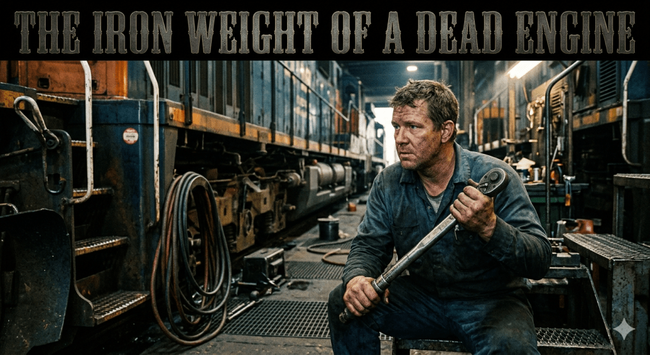
The Iron Weight of a Dead Engine
2,984 words, 16 minutes read time.
The rain in this city doesn’t wash anything away; it just pushes the grime from the rail yards into the drainage ditches, mixing with the diesel fuel and the regret. I sat in the cab of my truck, the engine ticking as it cooled, listening to the rhythm of the storm against the windshield. My name is Silas Thorne. I’ve spent the better part of a decade as a lead locomotive technician, a job that runs on precision, calloused hands, and a refusal to let anyone tell me how to overhaul a prime mover. Out here, deep in the guts of a two-hundred-ton diesel-electric engine, the only authority that matters is the one that follows the technical manual or holds the torque wrench. It’s a clean existence, mechanically speaking. There are no gray areas in a seized cylinder liner, and there’s no room for someone else’s opinion when you’re the one deciding whether a locomotive is fit for the tracks. But lately, the silence in my house, the kind that settles in after the radio goes dead, has started to feel less like peace and more like a verdict. It’s a stubborn kind of pride, the type that keeps you standing in the rail yard long after your shift is over because you’d rather soak through than admit you’re tired of carrying the weight alone.
I’ve always been the guy who keeps his head down and his mouth shut. That’s how you survive in the shop. In the world I grew up in, showing a chink in the armor was an invitation for someone to drive a wedge right through it. You keep your struggles locked behind your teeth. If you’re angry, you channel it into the grit of stripping down a traction motor. If you’re lonely, you bury it under the stress of shipping schedules and failed inspections. It’s a self-reliant creed, a gospel of the heavy iron. But lately, the Bible study flyer that’s been sitting on my kitchen counter—the one my sister keeps leaving there—has started to look less like an invitation and more like a threat. It speaks of accountability, of community, of submission to a higher authority than the one staring back in the mirror. To me, that sounds like a surrender. It sounds like handing over the keys to a life I built bolt by bolt with my own sweat, and I’ve never been one for giving up control.
The irony isn’t lost on me. I know the story of Jonah. Most men in the industry know it, even if they don’t admit they’ve read it. It’s the ultimate tale of a man who thought he could outrun his own reality, who thought he knew better than the voice that had been calling him since he was a kid. Jonah wanted to go to Tarshish; he wanted to run away from the discomfort of accountability, from the burden of a message he didn’t want to deliver. He was a man who prized his own comfort and his own status over the messy, complex reality of God’s mercy. I see myself in that running. I see myself in the way I look at my life—as a closed system, a closed loop where I am the beginning and the end. I’ve spent years building a fortress of status and mechanical competence, convinced that if I just work hard enough, I won’t have to deal with the inherent brokenness that everyone else seems to be stumbling through.
There’s a specific kind of arrogance in thinking you don’t need an anchor. I look at the guys in the shop, men who are just as hardened by grease and vibration as I am, and I wonder what they’re hiding. We talk about rail specs, about injector timing, about the price of alloy steel, but we never talk about the fact that we’re all holding onto the edge of a cliff. We treat our pride like a heavy-duty frame, a structure that supports our identity, but it’s actually the rust eating away at the integrity of the whole machine. I remember thinking that admitting I needed help was a failure of masculinity. I thought that being a man meant being a monolith—impenetrable, unmovable, and entirely self-contained. The Bible calls this heart-hardening, a refusal to bow to an authority that isn’t of our own making. It’s the pride that keeps us locked in the storm, shivering in our own trucks, convinced that asking for shelter is the same thing as admitting we’re a mechanical failure.
The truth is, we are all running to our own versions of Tarshish. Maybe it’s not a boat for you. Maybe it’s a twelve-hour shift in the yard so you never have to be alone with your own thoughts. Maybe it’s a bottle, or a string of shallow distractions, or a fierce, defensive temper that keeps people at a distance. We build these lives, these elaborate structures of self-reliance, and we pray they never collapse. But they always do. The wind comes, the rain falls, and the foundations we laid in our own strength turn out to be nothing more than shifting ballast. I’ve lived with that anxiety for years, the subtle, creeping fear that one day the engine will seize permanently, and I won’t be able to fix it with the tools I have in my kit. I’ve held onto my autonomy like a prize fighter holding onto a title belt, unaware that the weight of the belt is the very thing keeping me from breathing.
When you look at the structure of accountability described in the scriptures, it isn’t about being told what to do by some distant, uncaring force. It’s about being known. That’s the part that terrifies men like me. We’re okay with being respected for our work, but we’re paralyzed by the idea of being truly seen. To be known is to have your weaknesses laid out on the workbench, to have your anger, your lust, your pride, and your failures examined by someone else. It feels like an execution. We fear that if we take off the mask, there won’t be anything left underneath but a hollow, rusted casing. But that’s the lie we’ve been sold. We’ve been led to believe that our value is tied to our utility, to what we can produce, what we can fix, and how much we can control. The reality is that the authority we resist is the only thing that offers us an identity that doesn’t depend on our performance.
I spent Tuesday night at that study, the one I’d been avoiding for months. I didn’t go because I had a sudden epiphany or because the heavens opened up. I went because the weight of the silence in my truck had finally become heavier than the weight of my pride. Walking into that room felt like walking onto the shop floor where the technical diagrams were written in a language I didn’t understand. There were men there—machinists, engineers, guys who clearly spent their days trying to keep their own internal mechanisms from locking up. We didn’t talk about the union or the latest management nightmare. We talked about the things we usually leave in the dark. Someone mentioned the concept of “yielding,” and for a second, I felt a physical resistance in my chest. It felt like a betrayal of everything I’d worked to build. But then I looked around, and I saw that none of these guys were weak. They were just finished with the pretense of being indestructible.
There’s a passage about the heart being deceitful above all things, and that’s a tough pill for a man who prides himself on his diagnostic skills. We trust our gut. We trust our experience. We trust the logic we’ve developed over years of trial and error in the shop. But when you’re building your life on your own logic, you’re just stacking parts in a void. You might get a good look at the track ahead for a while, but eventually, the physics of the fall win. Yielding isn’t about giving up your manhood; it’s about realizing that you were never designed to carry the world on your shoulders in the first place. That’s a divine burden, and we aren’t divine. When we try to be our own gods, we don’t end up with more power; we end up with more isolation. We become the sailors on Jonah’s boat, panicking as the sea rises, realizing that the storm is there specifically because of the weight we refused to drop.
It’s about the struggle to be real, really real, in a world that demands you be a caricature of strength. We live in a culture that incentivizes the suppression of the soul. If it doesn’t serve the bottom line, if it doesn’t increase your standing as a provider, it’s not worth your time. That’s the lie. True strength is the ability to stand in the truth of your own limitations. It’s the courage to admit that you’ve been chasing a ghost of independence that has only left you more trapped. I think about the men who feel like they have to keep the performance going, the ones who wake up every morning and put on the greasy coveralls before they even touch the floor. It’s an exhausting way to exist. It’s a life defined by defense, by keeping people out and keeping the truth locked away in the locker room.
Accountability is the act of opening the door. It’s deciding that you don’t want to live in the storm anymore, even if you’re the one who caused it. When we resist authority, we’re really just resisting the possibility of healing. We think that if we are held accountable, we will be crushed, but it’s the exact opposite. Accountability is the structure that allows the overhaul to actually happen. You can’t fix a seized engine if you’re unwilling to strip it down to the block. You can’t seal a leak if you’re too proud to admit the seal is blown. I’ve spent my life convinced that I could just paint over the rust, keep the surface shiny, and hope the engine wouldn’t notice. But the engine always knows. You can’t lie to the machine you inhabit.
The transition from self-reliance to submission is the hardest work I’ve ever done. It’s not a one-time event; it’s a daily demolition. Every morning, I have to choose to lay down the tools I use to protect myself. I have to admit that I don’t have all the answers for the chaos of my own life. It’s a humbling thing to realize that the smartest guy in the shop is often the one who is most lost, simply because he refuses to ask for a manual or a mentor. I’ve stopped looking at the Bible as a set of demands that infringe on my freedom and started looking at it as a set of technical specifications for a human life that actually works. It’s not about stifling my drive or my ambition; it’s about aligning those things with a purpose that is actually sustainable.
I look at the guys at that table now, and I don’t see competitors. I see brothers in the same trench, fighting the same battle against the urge to hide and the addiction to control. We talk about the pride that almost cost one guy his marriage, the anger that nearly got another fired from his lead role. There’s no posturing. There’s no need to project an image of success because we’ve already admitted that the image is a lie. That kind of honesty is more intimidating than anything I’ve faced in a rail yard, but it’s also the only thing that makes me feel like I’m actually living. It’s the difference between building a façade and building a engine that can actually pull its own weight. A façade is just for the supervisors to look at; a functioning engine is where you go to be restored.
I’m still the guy who likes things done right. I’m still the guy who appreciates the sharp line of a calibrated gauge and the solid weight of a well-seated gasket. But I’m starting to understand that the most important repair job I’ll ever undertake isn’t made of steel or iron. It’s the internal architecture of my own character, and for the first time, I’m willing to listen to the Architect. It doesn’t mean I’m perfect, and it doesn’t mean the rain has stopped. The rain is still coming down, and the city is still just as gritty as it was when I started this story. But the truck isn’t running anymore, and I’m not sitting in the dark waiting for a storm that I’m trying to ignore. I’m going inside. I’m letting go of the steering wheel, and for once, the weight of the world doesn’t feel like it’s going to break my back. That’s the secret, I guess. The moment you stop trying to be the foundation, you finally find the one that’s actually capable of holding you up. It’s a strange, terrifying, and ultimately beautiful surrender. And for a man who has spent his whole life trying to keep the train on the tracks by force of will, it’s the first time I’ve ever felt truly safe.
Author’s Note: The Myth of the Lone Wolf
As men, we like to think that if we just tighten the bolts hard enough, nothing will ever break. We spend our lives in the shop, on the road, or in the office, convinced that the only way to keep the engine of our lives running is to be the only one holding the wrench. I know that feeling because I’ve lived it, and I have seen many more men that are the same way; it’s the way we think. We’ve been conditioned to believe that asking for help is an admission of mechanical failure, and that admitting you’re lost is the ultimate surrender of your command.
But look at the design. Even Jesus, the man who carried the weight of everything, didn’t do it alone. He chose twelve. He didn’t just pick associates or colleagues; He chose men to walk with Him, eat with Him, and see the unfiltered reality of His life. He understood that a man without a tribe is a man waiting to drift. Meanwhile, most of us are out here trying to navigate the wreckage with maybe two or three distant friends—men we see once a year if we’re lucky, and who we wouldn’t dare tell the truth to if we did.
I’ve been lucky. I found a group of men a while back—a tribe that actually pulled no punches. We sat in that room and tore down the façades. Some of those guys are still in my corner, iron sharpening iron, every single day. But let’s be honest: the road is narrow, and the toll is high. We’ve lost a few along the way. Some guys couldn’t handle the heat of being fully known; others got distracted by the siren call of their own pride and drifted back into the isolation of the storm. It hurts to lose them, but it’s a reminder that this kind of brotherhood isn’t for the faint of heart.
Proverbs 27:17 tells us, “As iron sharpens iron, so one person sharpens another.” But iron doesn’t get sharpened by sitting on a shelf; it gets sharpened by friction, by heat, and by hard, direct contact. You can’t be sharpened by someone who stays at a distance. You can’t be sharpened by a “friend” who is just there for the good times and the shallow talk.
The “strong, silent, independent man” is a design flaw. It’s a machine built for a static environment, not for the real, grinding friction of this world. When we hold onto our pride like it’s a load-bearing wall, we don’t realize the rot is already at the foundation. We are so busy keeping up the appearance of a locomotive that can pull any load, we fail to notice we’ve been running on an empty tank for years.
This story isn’t just about the mechanics of the rail yard; it’s about the mechanics of the human heart. Resisting authority—biblical or otherwise—is usually just a fancy way of saying we are afraid to let anyone else see our blueprints. We fear that if we’re exposed, we’ll be condemned. The paradox is that true freedom isn’t found in total autonomy. It’s found in the surrender to an authority that actually knows how we were built to function, and in the company of men who will hold us to that standard when we’d rather quit.
If you’re reading this and you feel that tightness in your chest, know this: you aren’t being asked to break. You’re being asked to be built properly. You don’t have to live in the storm of your own making. Stop running to your own version of Tarshish. Find a church with a real men’s group, and if you can’t find one, start one. Stop waiting for someone to give you permission—because that invitation isn’t coming. A man doesn’t wait for a sign to step up; he takes the initiative.
It is time we start a campaign for our own souls: Find your twelve—or your three—and start being real. The storm doesn’t stop because you’re fast; it stops because you finally drop the weight and let someone help you carry it.
SUPPORTSUBSCRIBECONTACT MED. Bryan King
Sources
- The Book of Jonah, Chapter 1: The Call and the Flight
- Proverbs 27:17: Iron Sharpens Iron
- Jeremiah 17:9: The Deceitful Heart
- Matthew 10:1-4: The Choosing of the Twelve Disciples
- The Art of Manliness: The Critical Importance of Male Friendship
- Psychology Today: Why Men Need Friends (And Why They Struggle to Find Them)
- NPR: The Hidden Crisis of Male Loneliness
- Men’s Health: Addressing the Male Loneliness Epidemic
- The Gospel Coalition: Why Men Need Friends, Not Just Acquaintances
- Desiring God: How to Build a Men’s Discipleship Group
- Assemblies of God: The Necessity of Authentic Brotherhood
- Cru: The Struggle for Male Vulnerability
- FaithGateway: Biblical Accountability Explained for Modern Men
- Bible.com: The Power of Accountability Reading Plan
- Focus on the Family: Navigating the Challenges of the Lonely Man
- Christianity Today: Why Men Need Other Men to Survive
- Samaritan’s Purse: Finding Community and Purpose
- K-LOVE: The Life-Changing Impact of Men’s Small Groups
- Ligonier Ministries: Devotional on Proverbs 27:17
- Bible Odyssey: Jonah and the Reluctant Prophet
- BibleStudyTools: Defining Biblical Accountability
- GotQuestions: Why Discipleship is Essential for Men
- Biblica: Defining the Modern Man of God
- Lifeway: Creating Small Group Environments for Men
- Church Answers: Men Need More Than Just Sunday Attendance
- USCCB: Resources on Men and Discipleship
- All Pro Dad: The Importance of Having a Tribe
- Man in the Mirror: The Reality of Modern Male Struggles
- FamilyLife: Developing Deep Male Friendships
- Crossway: Practical Steps to Start a Men’s Group
Disclaimer:
The views and opinions expressed in this post are solely those of the author. The information provided is based on personal research, experience, and understanding of the subject matter at the time of writing. Readers should consult relevant experts or authorities for specific guidance related to their unique situations.
#accountabilityForMen #accountabilityPartners #authenticFaith #authenticManhood #biblicalManhood #biblicalMasculinity #breakingTheLoneWolfMyth #buildingALegacy #buildingCharacter #buildingCommunity #ChristianBrotherhood #ChristianLeadership #communityOverControl #emotionalHealthForMen #faithInAction #faithInTheWorkplace #faithBasedMentoring #findingPeace #findingYourTribe #howToStartAMenSGroup #intentionalFriendship #intentionalRelationships #ironSharpensIron #maleLonelinessEpidemic #manOfGod #masculineIdentity #menSAccountability #menSBibleStudy #menSDiscipleship #menSMinistry #menSSmallGroups #mentalToughness #modernMaleStruggles #overcomingAnger #overcomingIsolation #overcomingLifeSStorms #overcomingLust #overcomingPride #PersonalGrowth #purposeForMen #resistingAuthority #scriptureForMen #selfRelianceVsFaith #spiritualFoundations #spiritualGrowthForMen #spiritualTransformation #stopWaitingForPermission #strengthInSurrender #theWeightOfPride #vulnerabilityInMen