Bryan King
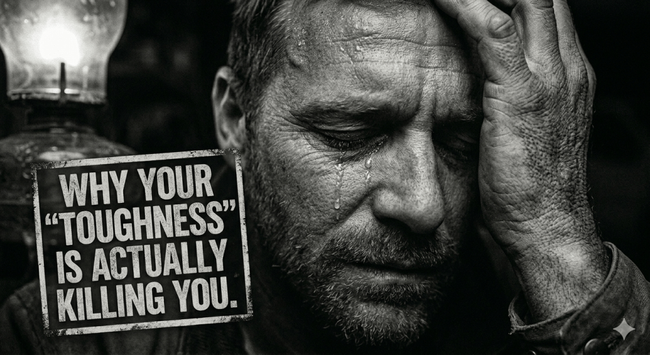
Why Your “Toughness” Is Actually Killing You
2,605 words, 14 minutes read time.
The internal combustion engine of Mark Miller’s life ran on a very specific, highly refined grade of silence. As a residential electrician, Mark spent his daylight hours navigating the skeletal frames of houses, pulling miles of copper wire through the dark, cramped spaces between studs. He liked the work because it was logical; if a circuit was broken, you found the fault, you spliced the wire, and the light came back on. There was a clear beginning, a definitive end, and a blueprint to follow that never asked him how he felt about the voltage. He was forty-two years old, with hands that felt like sandpaper and a reputation for being the most reliable man in the county, a guy who could troubleshoot a complex three-way switch in a blackout without ever breaking a sweat or losing his cool. Neighbors saw the white van in his driveway and the way he meticulously coiled his hoses on the lawn and they called him “steady,” a pillar of the community who never caused a scene and always had a polite, non-committal nod for everyone he passed.
But the steady hum of Mark’s life was actually the sound of a man redlining in a vacuum, a high-performance machine vibrating itself to pieces because it had no exhaust system for the pressure building inside. For Mark, and for the generations of Millers who came before him, the emotional spectrum had been pruned down to a single, functional utility: anger. Anything else—fear, sadness, the bone-deep weariness of a life that felt like a treadmill—was viewed as a system failure, a leak in the line that needed to be plugged with steel wool and buried behind drywall. He lived by an unwritten code that suggested a man’s strength was measured by the size of the burden he could carry without grunting, a philosophy that made him a “good man” in the eyes of a society that prizes manageable, quiet producers, but a ghost in the eyes of a God who designed him for more. This was the “Ideal Man” of the 2020s, a man who was low-key praised by the world while he was effectively dying inside, using the “Digital Sedative” of screens and the chemical anesthetic of a bottle to silence a heart he no longer knew how to read.
The ritual usually began around 6:30 PM, the moment the heavy work boots hit the mudroom floor with a dull thud that signaled the end of Mark the Electrician and the beginning of Mark the Ghost. He would walk into the kitchen, offer his wife a clipped “hey” that carried the weight of a thousand unspoken frustrations, and head straight for the cabinet. The first pour of bourbon was a tactical strike, a way to “take the edge off” the jagged static of the day’s demands. It was a well-oiled machine of numbing where he would transition from the physical labor of the world into a self-imposed fog, a state of nothingness where he didn’t have to process the fact that his oldest son was failing algebra or that his wife’s eyes held a desperate, searching quality that he lacked the vocabulary to address. He wasn’t looking for trouble; he was looking for an exit strategy from reality, a way to bypass the “still, small voice” of God that often whispered in the silence of the evening, calling him to lead his home with something more than just a paycheck and a functioning water heater.
Mark believed he was being strong by bottling it all up, but the Bible paints a radically different picture of masculinity, one modeled after Jesus Christ, who was anything but a stoic, unfeeling statue. We often forget that the shortest verse in Scripture, “Jesus wept” in John 11:35, is perhaps one of the most masculine moments in history because it shows a King who was not afraid to feel the weight of death and loss. Jesus didn’t numb out when the weight of the world pressed down on Him; in the Garden of Gethsemane, when the agony reached its peak and He was literally sweating drops of blood, He didn’t reach for a bottle or a digital distraction. He fell to His knees and faced the Father, naming His distress and surrendering His heart to the only One who could hold it. Mark Miller, however, saw vulnerability as a defect, unaware that by amputating his ability to feel sadness or fear, he was also killing his capacity to feel true joy or deep connection. He was effectively a man in a hazmat suit, protected from the pain of the world but unable to feel the warmth of the sun or the touch of the people he loved.
The breaking point arrived on a Tuesday, a day that started with the same gray monotony as every other, but ended with a confrontation that Mark’s bourbon couldn’t drown out. He was sitting in his garage at his woodworking bench, a space that was supposed to be a creative outlet but had become a “hobby closet” where he hid from his family under the guise of being productive. He was working on a custom walnut dining table, a piece of high-end furniture that would eventually sell for thousands of dollars to a client who wanted the “authentic” look of hand-crafted wood. Mark was incredibly talented, but as he ran the plane over the dark grain, he wasn’t thinking about the beauty of the timber; he was thinking about the conversation he’d had earlier with his boss, a younger man who had spent thirty minutes questioning Mark’s efficiency on a job site. Mark hadn’t said a word, he’d just nodded politely while his jaw tightened until it ached, burying the white-hot flash of prideful anger deep into his chest where it could sit and ferment alongside all the other unexpressed emotions of the last decade.
The garage door creaked open, and his youngest son, Leo, walked in holding a plastic toy truck that had lost a wheel. The boy didn’t say anything at first, just stood there in the periphery of the sawdust-chilled air, watching his father work with a surgical, cold precision. Mark didn’t look up, his mind already calculating how many more passes he needed to make the surface level, and more importantly, how many more minutes he had until he could justify going back inside for another glass of bourbon to “keep the edge away.” Leo finally spoke, his voice small and cracking with a vulnerability that Mark found instinctively irritating. “Dad, can you fix this? It broke when I was playing outside.” Mark stopped the plane, the silence of the garage suddenly feeling heavy and suffocating, like the air inside a sealed vault. He looked at the toy, then at his son’s face, which was a mirror of his own—trying to be brave, trying not to show that he was upset about a small thing, already learning the Miller family tradition of the “non-committal smile.”
In that moment, a wave of something other than anger surged up in Mark’s chest, something he couldn’t name because he’d spent twenty years deleting the files for it. It was a mixture of grief for his own lost childhood, fear that he was raising a son who would become a ghost just like him, and a sudden, sharp realization that he was losing a battle he didn’t even know he was fighting. He thought about the warning in 1 Peter 5:8, “Be sober-minded; be watchful. Your adversary the devil prowls around like a roaring lion, seeking someone to devour.” He realized that it was incredibly hard to be watchful when you were sedated by a digital glow or a high-proof spirit. The lion wasn’t coming for his house or his bank account; the lion was devouring the heart of his home while Mark sat on the couch watching strangers live lives on a screen because he was too “tired” to pursue his own. He was the “Ideal Man” the world wanted—manageable, quiet, and fundamentally absent—but he was a far cry from the Biblical Man God demanded: one who engages reality with the strength of the Spirit.
Mark looked at the broken truck and then back at the walnut table that represented his escape, his expensive way of telling his family “do not disturb.” He felt the familiar pull of the “Society Approved” path—tell the boy “not now,” give him a pat on the head, and sink back into the numbing comfort of his routine. But for the first time in his life, the spiritual anesthetic failed to kick in. The “still, small voice” he had been ignoring was no longer a whisper; it was a roar. It was telling him that true rest isn’t found in a six-pack or a weekend bender of isolation, but in the presence of Christ, the only one who can take a heart of stone and turn it back into a heart of flesh. The truth cut through the fog like a lightning bolt: he wasn’t being a “good man” by staying quiet; he was being a coward who was afraid to feel the weight of his own life.
“Come here, Leo,” Mark said, his voice sounding raspy and foreign to his own ears, as if he were using a muscle that had been atrophied for years. He sat the boy down on a stool, and instead of just taking the truck and fixing it with his back turned, he sat next to him. He didn’t just fix the wheel; he started to talk. Not about the truck, and not about the weather, but about the day. He told his son that he was frustrated about work, and that he was sorry for being “gone” even when he was sitting right there in the room. He didn’t have the “full range of God-given feelings” mastered yet, but he was naming the fear and the weariness for the first time. As he spoke, he felt a strange sensation in his chest, a lightness that felt more like strength than any amount of “toughness” he’d ever displayed. He was finally confronting the sin of his own passivity with the truth of his need for grace.
The story of Mark Miller doesn’t end with a perfect family dinner and a cinematic sunset; it ends with a man standing at a decision point, realizing that the “Ritual of Disappearing” has to die so that he can truly live. Ephesians 5:18 warns us not to get drunk with wine, which leads to debauchery, but to be filled with the Spirit. For Mark, that meant realizing that his bourbon and his “hobby closet” were just different names for the same idol: comfort. He had to learn that the “Imago Dei,” the image of God in man, includes the capacity to weep, to feel compassion, and to be “sober-minded” enough to see the needs of those around him. He had to put down the remote, cork the bottle, and wake up to the reality that his family didn’t need a “nice” ghost who never caused trouble; they needed a living, breathing man who was willing to be real, even when his voice shook.
The struggle for the modern Christian man isn’t necessarily the drink or the hobby itself, but the “why” behind them. If you are using your life’s work or your evening distractions to silence the call of God to lead, to repent, or to grow, you are merely a well-maintained machine in a world that needs a soul. Real strength isn’t found in the ability to suppress emotion; it’s found in the courage to surrender those emotions to the Father, just as Jesus did in the garden. It’s time to stop being “manageable” for a world that wants you numb and start being “dangerous” for a Kingdom that wants you awake. Mark Miller didn’t finish the walnut table that night; instead, he left the garage lights on, walked into the house, looked his wife in the eye without the non-committal smile, and for the first time in a decade, told her exactly how he was feeling. The circuit was finally complete, and for the first time in a long time, the lights were truly on.
Author’s Note
We have all been there—standing in the kitchen after a long shift, staring into the middle distance while the world keeps spinning around us. We are often broken, numb, and desperately trying to find something, anything, to fill the void that a hard day and a heavy heart leave behind. Society has taught us that as long as we are providing and staying quiet, we are “good men,” but that lie only serves to turn us into ghosts in our own homes. We hide in our “hobby closets” or behind the amber glow of a bottle, not because we are evil, but because we are exhausted and don’t have the vocabulary to express the pressure building inside.
To be clear, the act of having a drink from time to time or pursuing a hobby isn’t the inherent sin; the biblical concern is the loss of self-control and using these things as an exit strategy from reality. This story of Mark Miller is a mirror for every man who has used a “digital sedative” or a weekend bender to silence the still, small voice of God. We must remember that real strength isn’t found in bottling up fear until we become manageable machines for the world. It’s found in the courage to be “sober-minded” and “watchful,” surrendering our hearts to the Father just as Jesus did when the weight of the world was at its heaviest.
We are reminded in Ezekiel 36:26, “I will give you a new heart and put a new spirit in you; I will remove from you your heart of stone and give you a heart of flesh.” God doesn’t want us to stay numb or “steady” in our stone-like silence; He wants to restore our capacity to feel, lead, and love. It’s time to stop disappearing into the fog and start being the living, breathing men our families—and our Creator—call us to be.
SUPPORTSUBSCRIBECONTACT MED. Bryan King
Sources
- Mark Miller: The Ideal Modern Man Profile
- The Struggle of the Digital Sedative
- Society’s Flawed Definition of a Good Man
- Modern Masculinity and the Mask of Passivity
- The Spiritual Anesthetic of Hobbies and Alcohol
- Jesus as the Model for the Biblical Man
- The Importance of Being Sober-Minded and Watchful
- Mark Miller: A Study in Reliability and Numbness
- The Non-Committal Smile: Avoiding Conflict
- Ghost in the Hallway: The Cost of Emotional Absence
- The Ritual of Disappearing after Sundown
- The Mechanics of Numbing: A Well-Oiled Machine
- The Pour: Using Bourbon to Keep the Edge Away
- The Binge: Losing Hours to Digital Vacuums
- Watching Strangers Live: The Cost of Exhaustion
- Escaping into Digital Battles to Avoid Real Ones
- Dying Quietly: The Internal Ache of Purposelessness
- The Manageable Man: Why the World Praises Passivity
- Biblical Masculinity vs. Society’s Nice Guy
- Escaping Heavy Reality: The Modern Man’s Path
- Engaging Reality with the Strength of the Spirit
- Hobbies: A Place to Hide or a Place to Recharge
- Confronting Sin with Truth: The Biblical Mandate
- Comfort vs. the Kingdom: A Man’s Ultimate Goal
- <a href=”
Disclaimer:
The views and opinions expressed in this post are solely those of the author. The information provided is based on personal research, experience, and understanding of the subject matter at the time of writing. Readers should consult relevant experts or authorities for specific guidance related to their unique situations.
#1Peter58 #avoidantBehaviorInMen #biblicalMasculinity #breakingGenerationalSilence #christianFatherhood #ChristianMenStruggles #ChristianShortStory #digitalSedative #emotionalHealthForMen #emotionalIntelligenceForMen #escapingReality #Ezekiel3626 #faithBasedHealing #fearOfVulnerability #findingPurpose #GardenOfGethsemane #gritLit #hardboiledFiction #heartOfStoneToHeartOfFlesh #hidingWeaknesses #internalCombustionOfSilence #JesusWept #John1135 #John1135Meaning #leadershipInTheHome #maleIdentityInWork #MarkMiller #modernManIdentity #modernManProfile #namingEmotions #nonCommittalSmile #overcomingNumbness #parentingWithVulnerability #processingAnger #repentingOfPassivity #residentialElectricianStory #soberMindedLiving #societalPressureOnMen #spiritualAlertness #spiritualAnesthetic #SpiritualGrowth #statusAndPride #surrenderToGod #theManageableMan #trueRestInChrist #vulnerabilityAsStrength #watchfulLife #woodworkingHobby