 Bryan King
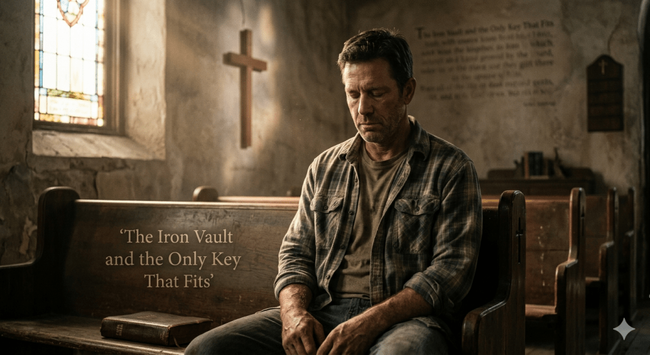
The Iron Vault and the Only Key That Fits
2,715 words, 14 minutes read time.
The engine of the 1998 Silverado rumbled with a rhythmic, mechanical cough that Mark Sullivan felt deep in his marrow, a vibration that served as the only soundtrack to his 5:00 AM commute. To the world, Mark was a pillar of the local community—a man of calloused hands, steady eyes, and a silence that most neighbors mistook for profound wisdom. He was the guy you called when a pipe burst or when the church roof needed a patch after a summer storm, and he always showed up with a toolbox and a tight-lipped nod. But as the gray dawn began to bleed over the horizon of the industrial park where he worked as a foreman, Mark felt the familiar, heavy pressure in his chest, a sensation he had lived with for so long he had started to believe it was simply the weight of being a man. He had been raised in a world where emotions were like luxury goods—unnecessary, expensive, and likely to break when you needed them most—and so he had narrowed his internal vocabulary down to a single, functional tool: a quiet, simmering frustration that he called “getting things done.”
Mark’s father had been a man of granite and gravel who taught him that a man’s worth was measured in what he produced and what he could endure without complaining. “Crying is for those who don’t have a job to do,” his father would say, and Mark had taken that gospel to heart, building a life that was a fortress of self-reliance and stoic isolation. When his wife, Sarah, tried to reach into the dark rooms of his heart, asking him how he felt about the mounting bills or the way their oldest son was struggling in school, Mark would simply tighten his jaw and talk about the logistics of the budget or the necessity of discipline. He wasn’t being cruel, at least not intentionally; he was simply operating within the only framework he knew, believing that to admit fear was to invite collapse, and to admit sadness was to admit defeat. He viewed his own heart as a high-pressure boiler—something to be monitored and contained, never opened, because he was terrified that if he ever let the steam out, there would be nothing left but a cold, empty shell.
The crisis began on a Tuesday, a day that started with the mundane bite of cold coffee and ended with a phone call that threatened to crack the foundation of Mark’s carefully constructed world. His brother, David, the one person who had always shared the unspoken burden of their father’s legacy, had been involved in a multi-car pileup on the interstate. As Mark stood in the sterile, fluorescent glare of the hospital waiting room, surrounded by the scent of antiseptic and the muffled sounds of grieving families, he felt a strange, terrifying paralysis. He wanted to scream, he wanted to collapse, and he wanted to beg God for a miracle, but the machinery of his psyche wouldn’t allow it. Instead, he sat with his back perfectly straight, his hands folded in his lap like two slabs of stone, while his mind frantically cycled through the logistics of insurance, hospital bills, and who would cover David’s shifts at the warehouse. He was a man drowning in a shallow pool, unable to simply stand up and breathe because he didn’t know how to acknowledge that he was wet.
Hours passed, and the doctors eventually emerged with news that was grim but not final—David was alive, but the recovery would be long, painful, and uncertain. When Sarah arrived at the hospital, her face etched with genuine, raw sorrow, she reached out to hold Mark’s hand, only to find it as rigid as a piece of rebar. She looked at him, her eyes searching for a crack, a tear, or even a flicker of the terror she knew must be behind his eyes, but she found only the foreman. “Mark, you can let it out,” she whispered, her voice a soft contrast to the humming machinery of the ICU. “He’s your brother. You’re allowed to be scared.” Mark pulled his hand away, not out of anger, but out of a desperate need to maintain the internal pressure that kept him upright, snapping back that being scared wouldn’t fix David’s shattered pelvis or pay for the physical therapy. He walked away from her, heading toward the hospital chapel not to pray, but to find a place where he could be alone with the suffocating silence of his own making.
Inside the chapel, a small, dimly lit room that smelled of old wood and spent candles, Mark sat in the back pew and stared at a simple wooden cross on the wall. He felt a surge of something hot and volatile rising in his throat—not the clean, cold anger he used to solve problems at the job site, but something far more primal and agonizing. He thought about the shortest verse in the Bible, the one he had memorized as a child but never truly understood: “Jesus wept.” For years, Mark had viewed that verse as a historical footnote, a momentary lapse in the strength of the Savior, rather than a divine blueprint for what it meant to be fully human. He had always preferred the image of Jesus driving the money changers out of the temple with a whip, a God of action and righteous fury, because that was a version of masculinity he could mimic. But as he sat in the silence, the image of a weeping God began to gnaw at his pride, challenging the notion that strength was synonymous with being an unfeeling monolith.
He began to think about the Garden of Gethsemane, a story he had heard a thousand times, but now it felt visceral, like a punch to the gut. He saw a man—the Son of God—so overwhelmed by the weight of what was coming that he sweat drops of blood, a man who didn’t hide his agony from his friends but begged them to stay awake and watch with him. Mark realized, with a sudden and terrifying clarity, that he had spent his entire life trying to be “stronger” than Jesus. He had tried to be a man who didn’t need to lean on others, a man who didn’t need to cry out in the dark, and in doing so, he had effectively shut himself off from the very grace he claimed to follow. His self-reliance was not a virtue; it was a form of idolatry, a worship of his own ability to endure until he eventually broke. He was a man who had built a cage out of his own ribs to protect a heart he no longer knew how to use.
The silence of the chapel began to feel heavy, pressing against his chest until he could barely draw a breath, and for the first time in thirty years, Mark Sullivan didn’t try to fix the feeling. He didn’t try to plan his way out of the sorrow or rationalize the pain into a checklist of tasks. He simply sat there, staring at the cross, and admitted to the empty room that he was terrified. He whispered the words out loud, his voice cracking like dry timber: “I am scared, and I don’t know what to do.” The admission felt like pulling a plug from a dam. The anger that had been his constant companion for decades suddenly felt thin and transparent, a cheap mask for a soul that was starving for the permission to feel. He realized that by only allowing himself to feel anger, he had effectively blinded himself to the full spectrum of the life God had intended for him, missing the deep compassion and the restorative power of shared grief.
As the tears finally came—slow and hesitant at first, then racking his frame with the force of an earthquake—Mark felt a strange, paradoxical sensation of lightness. It wasn’t the relief of a problem being solved, but the relief of a truth being told. He wept for his brother, he wept for the years he had spent as a ghost in his own home, and he wept for the father who had taught him that his heart was a liability. In that moment of absolute vulnerability, the “Hardboiled” exterior he had polished for so long began to crumble, revealing something raw and unfinished underneath. He understood then that the “Real Man” he had been trying to be was a caricature, a hollow suit of armor that offered protection but denied intimacy. True strength, he realized, wasn’t the ability to hold it all in; it was the courage to pour it all out at the feet of the One who had crafted the heart in the first place.
When Mark finally walked out of the chapel, the world looked different—not because the circumstances had changed, but because the man looking at them had. He found Sarah in the hallway, still waiting, her face a mask of weary concern. He didn’t offer her a plan or a platitude. Instead, he walked up to her, took her hands in his, and let his shoulders drop. “I’m terrified, Sarah,” he said, and this time he didn’t pull away when she pulled him into a hug. He felt the warmth of her presence, a comfort he had denied himself for years because he thought he had to be the one providing the comfort, never receiving it. He was learning, in the span of a few heartbeat-heavy minutes, that surrender wasn’t a sign of weakness, but the ultimate act of faith. To be real was to be broken, and to be broken was to finally be in a position where God could do some actual work.
The following weeks were the hardest of Mark’s life, but they were also the most honest. He spent hours by David’s bedside, and instead of talking about the mechanics of the surgery or the logistics of the insurance, he talked about their childhood, their fears, and the way he missed their father despite the old man’s flaws. He found that by naming his emotions—fear, guilt, hope, and sadness—they lost their power to haunt him. He started attending a men’s group at the church, not as the guy who fixed the roof, but as a man who was learning how to breathe again. He told the other men, most of whom were hiding behind their own masks of stoicism, that he had spent his life building a vault for his heart, only to realize that he had locked himself in from the inside. He spoke about the God who weeps, the God who feels, and the God who invites us to do the same.
Mark Sullivan still drives that 1998 Silverado, and he still shows up with his toolbox when a neighbor’s pipe bursts, but the silence that surrounds him is different now. It’s no longer the silence of a tomb, but the quiet of a man who is listening. He understands that anger is a valid emotion, but it is a terrible master, and that the “God-given feelings” he once feared are actually the language of the soul. He has learned that real masculinity isn’t found in the absence of emotion, but in the mastery of it—the ability to stand in the middle of a storm, acknowledge the fear, and then choose to move forward in the strength of a Savior who knows exactly what it feels like to hurt. Mark is no longer a foreman of a construction crew who happens to be a man; he is a man of God who happens to be a foreman, and the difference is the weight of a heart that is finally, mercifully, heavy with the truth.
Author’s Note: The Myth of the Unbreakable Man
For many men, there are limited options for emotions. From a young age, we are handed a script that says we must be the stoic provider, the unshakable rock, and the silent fixer. The world likes to push men into a “performance” they want—a curated version of masculinity that prizes production over personhood—but this mask is entirely unsustainable for all men. When we live as though anger is the only acceptable outlet for our hearts, we don’t become stronger; we simply become more brittle.
The story of Mark Sullivan is a reflection of the modern man’s struggle to reconcile his God-given design with the world’s rigid expectations. We often treat our inner lives like a high-pressure boiler, fearing that one leak of “weakness” will lead to a total explosion. Yet, Scripture shows us that a life of faith is not a life of suppression, but one of surrender and profound emotional depth.
The Scriptural Foundation
The Bible does not call us to be unfeeling machines; it calls us to be whole. Here are the truths that anchor our need to be real:
- The Humanity of Christ: We often forget that the most powerful Man to ever walk the earth was also the most emotionally expressive. In John 11:35, the shortest verse carries the heaviest weight: “Jesus wept.” He didn’t just observe grief; He entered into it. In the Garden of Gethsemane, Matthew 26:38 records Him saying, “My soul is overwhelmed with sorrow to the point of death.” If the Savior of the world could express agony and ask for support, why do we think we are above it?
- The Promise of a New Heart: God’s goal for us isn’t to harden us into stone, but to make us alive. Ezekiel 36:26 promises: “I will give you a new heart and put a new spirit in you; I will remove from you your heart of stone and give you a heart of flesh.” A heart of flesh feels, it bleeds, and it heals.
- Strength in Vulnerability: We spend our lives trying to be “self-made,” but God’s strength is perfected when we stop performing. 2 Corinthians 12:9 reminds us that His grace is sufficient and His power is made perfect in weakness.
The TL;DR of Mark’s Story: Mark Sullivan, a man who viewed silence as strength, realized that his self-reliance was actually a cage. By looking at the example of a weeping, compassionate Savior, he learned that true masculinity isn’t about containing the pressure—it’s about having the courage to be honest before God and his family. Real men don’t just “get it done”; they bring their whole hearts to the One who made them.
Call to Action
It’s time to stop mistake-proofing your life and start living it. If you’ve spent years building a vault around your heart, believing that silence is strength and numbness is a badge of honor, you aren’t becoming a better man—you’re just becoming a ghost. Real strength doesn’t hide behind a clenched jaw or a “rub some dirt on it” theology; real strength has the guts to look at the Father and say, “I can’t carry this alone.”
Don’t wait for a tragedy to break the seal.
- Name the weight: Identify one thing you’ve been “bottling up” this week—whether it’s fear about your job, a hidden struggle, or a lingering hurt—and bring it to God in prayer without the filters.
- Find your circle: Stop being the “lone wolf.” Reach out to one brother you trust and be honest about where you’re actually at. Vulnerability isn’t a liability; it’s the only way to build a real foundation.
- Follow the Pattern: Study the life of Jesus, not just as a conqueror, but as the Man who wept, the Man who felt compassion, and the Man who asked for help in the Garden.
The vault was never meant to be your home. Step out, lay down the heavy armor of self-reliance, and let God give you a heart of flesh for your heart of stone.
SUPPORTSUBSCRIBECONTACT MED. Bryan King
Sources
- John 11:35 – Jesus Wept (Bible Gateway)
- Matthew 26:36-46 – Gethsemane (Bible Gateway)
- Ezekiel 36:26 – A New Heart of Flesh (Bible Gateway)
- 2 Corinthians 12:9 – Strength in Weakness (Bible Gateway)
- Why did Jesus weep? (GotQuestions.org)
- The Emotional Life of Our Lord (Desiring God)
- The Manhood of Jesus Christ (Focus on the Family)
- The Humanity of Christ (Ligonier Ministries)
- The Humanity of Jesus Video (BibleProject)
- Why Men’s Vulnerability Is a Christian Strength (Christianity Today)
- Christian Men and the Trap of Stoicism (The Gospel Coalition)
- The Power of Vulnerability for Men (Man in the Mirror)
- The Emotional Stunting of Men (Psychology Today)
- Developing Emotional Intelligence for Men (MensGroup)
- God-Given Emotions (Cru)
- What Does the Bible Say About Men and Emotions? (BibleStudyTools)
- Redefining Manhood Through the Lens of Scripture (FamilyLife)
- Why We Need to Stop Telling Men to ‘Man Up’ (Relevant Magazine)
- Jesus is the Model for Masculinity, Not Culture (Charisma News)
- The Emotions of Jesus: What We Can Learn (Faithward)
- How to Process Emotions as a Christian Man (Crosswalk)
- Biblical Vulnerability (AllAboutGod)
Disclaimer:
The views and opinions expressed in this post are solely those of the author. The information provided is based on personal research, experience, and understanding of the subject matter at the time of writing. Readers should consult relevant experts or authorities for specific guidance related to their unique situations.
#authenticFaith #biblicalManhood #biblicalMasculinity #buildingGodlyCharacter #ChristianForemanStory #christianShortStoryForMen #emotionalIntelligenceForMen #emotionalStunting #faithBasedGrit #fatherhoodAndEmotions #GethsemaneForModernMen #gritLit #hardboiledChristianFiction #healingForMen #identityInChrist #JesusWeptMeaning #masculineSpirituality #menSMentalHealthAndFaith #modernChristianLiving #overcomingAnger #overcomingStoicism #processingEmotionsAsAMan #realisticChristianFiction #religiousStoryAboutPride #selfRelianceVsFaith #sheddingTheMask #spiritualGrowthForMen #surrenderingToGod #vulnerabilityAsStrength