 Front Page [Unofficial]
Fourth grade teacher beautifully explains what grief is to her students using a vase
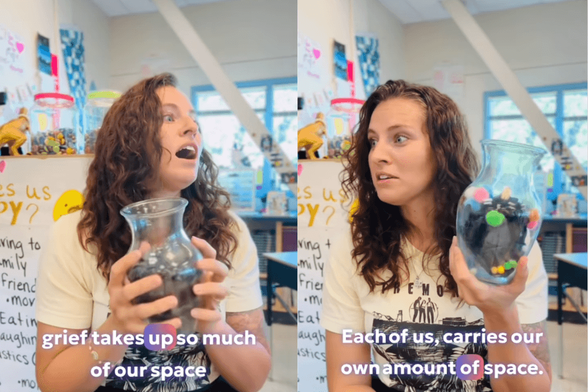
Fourth grade teacher beautifully explains what grief is to her students using a vase
A month ago my dog got diagnosed with #cancer. At the time we didn't want a lab test find out what kind as the purpose of testing is to find out effective treatment
We decided not to treat him because we didn't wanna put him through chemo and he's already 11, which is pretty old for a Labrador
A while ago when we knew the steroids failed, we realised it was lymphoma. They have 1-2 months left after diagnosis
Anyone have tips on processing pet #grief #grieftips
#MondayMourning: Stages of Grief - Expectations vs Reality
Most of us are aware of Elisabeth Kubler-Ross's DABDA grief model (denial, anger, bargaining, depression, acceptance) and take it to mean "the stages of grief."
However... the stages are a collection of anecdotal experiences from dying people, NOT the people grieving!
Kubler-Ross studied over 200 terminally ill patients, but amassed a collection of case studies rather than empirical evidence or systematic investigation. Newer studies don't really support her findings.
Still, we steadfastly cling to the prescribed grief journey and compare our own experiences to that example of normality. We crave direction and validation in times of emotional upheaval, and following a guideline gives us a lifeline. Otherwise, how do we know if we're grieving "right?"
In reality, the grief journey doesn't make linear stops. It's a mishmash of conflicting emotions, like a rollercoaster that sometimes goes forward, sometimes goes backward, and sometimes falls off the rails completely. Judging your experience by the metrics of societal expectations will lead you to believe that you're failing at grieving properly. Don't do that.
Instead, get to know the variety of emotions that may pass through you while you navigate your loss. Accept them as normal and valid, then let them go. If any particular feeling becomes overwhelming and you're unable to cope, you're allowed to ask for guidance, counseling, support groups etc.
No one's grief will be the same as yours, so don't compare! Grieve on your own timeline and whatever way suits your needs.
#HisAndHearsePress #Grief #StagesOfGrief #GriefAndLoss #Emotions #Death #MentalHealth #ElisabethKublerRoss #OnDeathAndDying #GriefTips #GriefSupport

On National “Get Over It” Day, you might be tempted to push yourself to get over your grief.
Don’t do that.
Societal expectations pressure us to return to normal ASAP, but it’s not realistic or helpful. Grief is, unfortunately, a journey with no finish line. You don’t get to “end” grief.
Does the death of a loved one continue to impact you for the rest of your life? Yes.
Does it help for you to pretend you’re “better,” ignoring your emotions and refusing further help and support? No.
Are there ways to make life livable again, despite continuing to feel the pain and loss? Yes.
If you’re grieving a loss and someone tells you (or even implies) that you should get over it, assume it’s meant with good intentions (they don’t want to see you suffering). Then take that sentiment and drop it in the trash. It’s not a healthy mindset.
Continue to grieve. Learn to live beside your loss.
#HisAndHearsePress #NationalGetOverItDay #GetOverIt #Death #Loss #Grief #GriefAndLoss #GriefSupport #GriefTips #BadAdvice

#MondayMourning: Grieving = Exhausting
Why does grief make you tired and weak, as if suffering from a flu-like physical ailment?
- Insomnia, possibly from anxiety or changes to your routine. Your circadian rhythm is off.
- Sleeping too much, which ironically makes you more tired. Your bed is warm and safe and allows you to avoid dealing with your problems. The "can't-get-out-of-bed" feeling is often associated with depression. Naps can affect your nighttime sleep too.
- Bad dreams (self explanatory).
- Your mind is perpetually in overdrive navigating regular responsibilities plus new tasks and emotions. Having a completely full brain (or an entirely empty and numb brain) is emotionally exhausting.
- You're in a state of hypervigilance (fight or flight), which is meant for short bursts or else it taxes your nervous system. This response to trauma may help in the moment, but it's not a sustainable state for your body. You may have PTSD-like responses and live in fear of being triggered. The anticipation is exhausting.
- You become hyper-independent, doing everything on your own without asking for or accepting help. You're taking on too much, planning a funeral, settling an estate, plus grieving and attempting to keep your "normal" life on track.
- You're not caring for your body or you're using unhealthy coping mechanisms. Eating only comfort food/not eating at all, avoiding physical activity, not drinking enough water, and consuming too much caffeine or alcohol all affect your energy level.
How can you fix this?
A lengthy to-do list can feel too daunting to tackle. Instead, take small, simple steps. Keep your goals realistic. Can you get your body moving for a few minutes a day? Can you eat better foods at better intervals? Can you try to limit caffeine/alcohol? Can you delegate some tasks? Can you maintain good sleep hygiene (limit your screen time and optimize your sleep environment)?
It's okay to seek additional help (supplements, sleep aids, therapy). If you've been suffering for a long time or you feel you have no solutions, speak to a doctor or professional. Grief physically affects the human body!
#HisAndHearsePress #Grief #GriefSupport #GriefTips #MentalHealth #Exhausted
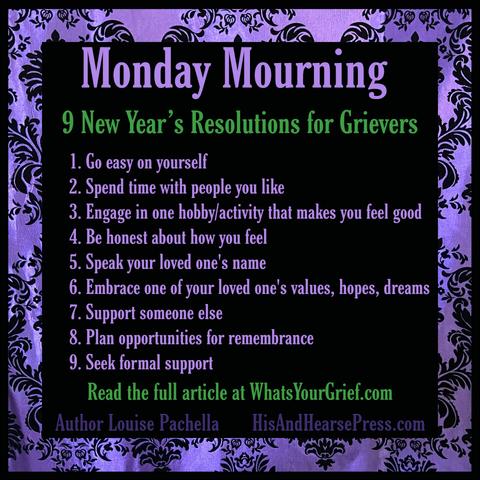
#MondayMourning: 9 New Year's Resolutions for Grievers
Everyone around you is brimming with hope, inspiration, and vigor as we start a fresh, new year... but you're not feeling it. If you've suffered a loss, the new year may feel daunting instead of uplifting. Here are some ways to tackle it one day at a time:
(courtesy of "What's Your Grief" with some thoughts of mine mixed in)
1. Go easy on yourself - forget goals, time deadlines, and the pressure to return to normalcy quickly
2. Spend time with people you like - try not to withdraw into isolation, but it's okay to avoid unsupportive people
3. Engage in one hobby or activity that makes you feel good - anything you do for YOU will give you self satisfaction and an outlet for expression (bonus points for being physically active, though focus on the way movement makes your body and mind feel instead of adopting exercise as a weight loss regimen)
4. Be honest about how you feel - again, don't rush to return to normalcy and pretend that you're "better"
5. Speak your loved one's name - don't be shy or worried about saying their name; encourage others to say the name too (they might be avoiding it for fear of upsetting you - give them permission)
6. Embrace one of your loved one's values, hopes, or dreams - honor their legacy by continuing to pursue something they started or cared deeply about
7. Support someone else - of course you ought to wait until you're ready, but helping someone through their loss can be tremendously satisfying and show you how much you've progressed along your own grief journey
8. Plan opportunities for remembrance - from scholarships and 5ks to scrapbooks and journaling, you can continue to recognize and celebrate your loved one
9. Seek formal support - whether your loss was recent or not, you can choose to find a support group or counselor to help you get "unstuck" on your grief journey
Read the original article at https://whatsyourgrief.com/8-new-years-resolutions-for-grievers/ (and buy their amazing new book!)
#HisAndHearsePress #GriefAndLoss #GriefSupport #GriefTips #WhatsYourGrief #NewYear #NewYearsResolution #DeathPositive #GriefCounseling #GriefTherapy
Not feeling it this year? That’s okay. You can take a raincheck on the holidays. You’re also allowed to enjoy the season and feel happiness, even if you think you shouldn’t. Does that make you feel guilty?That’s normal. You can feel conflicting emotions at the same. Want some tips on how to cope with grief during the holidays? Read this resource from What’s Your Grief:
https://whatsyourgrief.com/64-tips-grief-at-the-holidays/
#HisAndHearsePress #GriefAndLoss #Mourning #GriefTips #HolidayGrief #GriefSupport

 Shepherd
 His & Hearse Press
