1/ I'm sympathetic to #NIH-funded authors who want to publish in certain #APC-based #OpenAccess journals and can't find the money to pay the APCs. But it's false to say that they must publish in those journals, in any other APC-based OA journals, or even in OA journals. Shame on _Inside Higher Ed_ for leaving this false impression..
https://www.insidehighered.com/news/faculty-issues/research/2025/12/05/nih-policy-holding-researchers-hostage

PS: I repeat: Compliance with the NIH OA policy is free of charge. Moreover, compliance is all about depositing in a certain repository, not publishing in a certain journal or kind of journal. The NIH has a #GreenOA policy, not a #GoldOA policy. The same is true for all the other federal agencies with OA policies, not just the NIH. When a journal charges NIH-funded authors an APC to publish, the fee is to publish in that particular journal, not to comply with the NIH policy. Don't be fooled by the widespread misunderstanding that compliance with these policies requires paying any kind of fee. Don't be fooled by journals and publishers that cynically spread this myth themselves or leave it uncorrected. You can help by correcting this falsehood wherever you see it. You can also help by working with hiring, promotion, tenure, and funding committees to care more about the quality of research than the journals in which it is published.

🧵

#APCs #NelsonMemo #NIH #OpenAccess #OAintheUSA #PublicAccess #Repositories

The NIH Policy Holding Researchers “Hostage”

An effort to make NIH-funded research immediately accessible to the public has led to disruption and financial strain for scientists already navigating a precarious funding environment. It also spotlights the power of corporate publishers.

Inside Higher Ed | Higher Education News, Events and Jobs

The preprint went through open peer review on @MetaROR and was later published, after additional blind review rounds, in the partner Journal of Data and Information Science #JDIS – a demanding but very useful experience.

 https://doi.org/10.70744/MetaROR.179.2.ea

#OpenAccess #publishing #Ukraine #bibliometrics #GoldOA

APC waivers and Ukraine’s publishing output in Gold OA journals: Evidence from five commercial publishers - MetaROR

MetaROR

My new paper on Ukrainian researchers’ publishing activity in Gold Open Access journals during the war has just been published. I focused on five major publishers (Elsevier, Springer Nature, Wiley, Taylor & Francis, and SAGE):

 https://doi.org/10.2478/jdis-2025-0059

Ukrainian papers in fully Gold OA journals of these publishers grew by more than 50% in 2023, with further growth in 2024.

#OpenAccess #publishing #Ukraine #bibliometrics #GoldOA

Mathdoc : 30 années au service de la communauté mathématique | Canal U

Mathdoc : 30 années au service de la communauté mathématique

Canal-U
Hier, intervention à la conférence "Collaborations in Algebra, Representation theory and Ethics" organisée à l'UMPA de l' @ENSdeLyon pour parler #openscience et #openaccess avec F. Codet et Filippo A.E. Nuccio devant de jeunes mathématiciens, dans le cadre des débats sur l'éthique en sciences. Super expérience. Merci aux organisateurs !
🔗 https://sites.google.com/uniroma1.it/caremath/home-page
#ethics #maths #APC #academicpublishing #GreenOA #GoldOA #DiamondOA
CARE

more than math

The opening of the #NOSF2025 is what I'm here for in conferences nowadays - warnings against reliance on big tech and highlighting that #DiamondOA is the way forward instead of filling the pockets of publishers that charge wild prices for #GoldOA by Casper Albers.

(I'm attending online - there is a livestream available here: https://opensciencefestival.nl/news/watch-the-livestream-of-the-plenary-sessions-on-24-october)

Watch the livestream of the plenary sessions on 24 October | Open Science Festival

The Open Science Festival 2025 will stream live from Groningen on 24 October, offering a chance to watch the three plenary sessions: the opening session, the panel discussion, and the closing session.

Open Science Festival

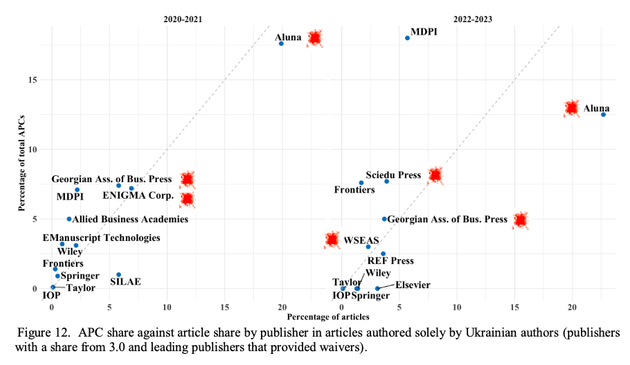
A new preprint on Ukrainian publications in Gold Open Access has a very telling Figure 12. And you know what? It’s a total disaster.

👉 https://arxiv.org/abs/2508.08850

It turns out that the largest shares of our APC spending go to MDPI and the Polish Aluna Publishing House. Even worse — the top list also includes “famous” players like WSEAS, Sciedu Press, and the Georgian Association of Business Press = dubious publishers.

#OpenAccess #PredatoryPublishing #Ukraine #Science #APC #GoldOA

New study: "Open access publishing: is urology ready? A survey of authors, readers, and editorial board’s knowledge, impressions and satisfaction."
https://link.springer.com/article/10.1007/s00345-025-05928-3
(#paywalled)

Not a good way to run a survey or report the results.

* The results are paywalled.
* The article does not include the survey questions.
* The survey defines #GoldOA, #GreenOA, #DiamondOA, and #HybridOA. But the article only reports the attitudes toward APC-based gold OA. No surprise, they're negative. Yet disdain for #APCs only strengthens the reason to ask about green and diamond OA. If the survey did ask, then what are the answers? If it didn't ask, then why not?
* The survey gives a false definition of green OA, saying that it's always embargoed. That's especially odd since under current US federal agency policies, it's never embargoed.

#Embargoes #ScholComm

Open access publishing: is urology ready? A survey of authors, readers, and editorial board’s knowledge, impressions and satisfaction - World Journal of Urology

Purpose To report the level of knowledge, impressions, and satisfaction of Urology readers, authors, and editorial boards regarding Open Access (OA) publishing in the field of Urology and to determine their satisfaction with the current OA models. Methods We developed an online, five-section cross-sectional survey including 23 questions. To recruit participants, we used mixed methods to obtain responses based on a simple random sampling and convenience sampling. Herein we present descriptive outcomes of the responses. Results 157 participants from 21 countries responded to the survey between May 2023 and October 2024. The majority of respondents (80.2%) reported having “Acceptable” to “Excellent” knowledge regarding OA publishing. However, of those that responded they were familiar with the concepts, only a minority knew the definitions of Gold, Green, Diamond, and Hybrid OA publishing models. Of all respondents, 49.7% reported having a “Positive” to “Strongly positive” impressions toward OA publishing, whereas 16.6% had “Negative” to “Strongly negative” impressions. Although a majority agreed that OA publishing can offer several advantages, 40.8% thought that the quality of peer-review is lower for OA journals compared to traditional publishing models. The vast majority (82.2%) agreed that articles processing charge (APC) can be overly burdensome for authors. Members of a Urology journal editorial board are more incline to not publish in an OA journal. Conclusion Results from this anonymous, international survey among urologists, show high awareness of OA publishing with low knowledge regarding details. Participants are pessimistic regarding the quality of OA journals and peer-review.

SpringerLink

The _Journal of Clinical Monitoring and Computing_ is converting from #hybrid to #APC-based #OpenAccess. One of its motives to escape the #DoubleDipping of the hybrid model. "Although this hybrid approach was well-intentioned, it created a paradoxical situation where institutions pay [and publishers receive] both subscription fees and publication charges."
https://link.springer.com/article/10.1007/s10877-025-01342-7

PS: Glad to see it acknowledge the double dipping. Too many hybrid journals don't do that. Next step, escape the inequity and author-side barriers of the APC model.

#APCs #GoldOA #ReadAndPublish #ScholComm #SpringerNature

The transition to fully open access: a new era for the Journal of Clinical Monitoring and Computing - Journal of Clinical Monitoring and Computing

SpringerLink

@Luke_Drury @deevybee

In my field, #DigitalHumanities, MDPI is a very minor player. A healthy ecosystem of #DiamondOA exists, alongside a small number of #GoldOA options other than MDPI.

The journal I help run, @jcls, is also DiamondOA and entirely scholar-led. While we are recent and small, we are very happy with international uptake and quality of submissions.

I also help run a DH collection on ORE, and it is doing ok but not great, I guess.