“Don’t look away. Look straight at everything. Look it all in the eye, good and bad.”*…

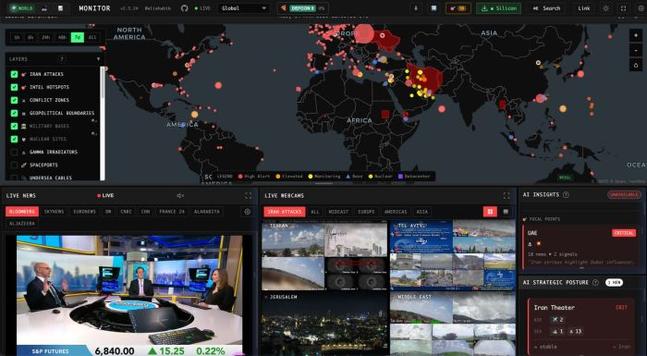
Frustrated by fragmented war news, Elie Habib built World Monitor, a platform that fuses global data– everything from military activity and intel hotspots to climate events and cyber threats– to track trouble as it unfolds. Lilian Wagdy reports…

Elie Habib doesn’t work in the defense or intelligence industries. Instead, he runs Anghami, one of the Middle East’s largest music streaming platforms. But as missiles began flying across the region, a side project he coded earlier this year suddenly became something bigger: an open-source dashboard people around the world were using to track the war in real time…

… The idea emerged as headlines began colliding in ways that felt impossible to follow. “The news became genuinely hard to parse,” he says. “Iran, Trump’s decisions, financial markets, critical minerals, tensions compounding from every direction simultaneously.”

Traditional media wasn’t solving the problem he had in mind. “I didn’t need a news aggregator,” he says. “I needed something that showed me how these events connect to each other in real time. The existing OSINT tools that did this cost governments and large enterprises tens of thousands of dollars annually.”…

… The platform processes a messy stream of global data, bypassing social media noise to pull facts directly from the source.

“The system ingests 100-plus data streams simultaneously,” Habib notes. The result is a constantly updating map of global tensions: conflict zones with escalation scores, military aircraft broadcasting positions through ADS-B transponders, ship movements tracked through AIS signals, nuclear installations, submarine cables, internet outages and satellite fire detections.

“Everything is normalized, geolocated and rendered on a WebGL globe capable of displaying thousands of markers without frame drops,” Habib says.

The underlying architecture wasn’t built from scratch. Much of it draws on the same principles used to process massive volumes of streaming data…

… Processing hundreds of live data streams during a military conflict raises a question: How do you verify information fast enough to keep the system moving?

Habib’s answer was to remove human editors entirely. “Zero editorializing,” he says. “No human editor makes a call.”

Instead, Habib says the platform relies on a strict source hierarchy. Wire services and official channels such as Reuters, AP, the Pentagon and the UN sit at the top tier. Major broadcasters including the BBC and Al Jazeera follow, along with specialist investigative outlets such as Bellingcat. In total, he says the system processes about 190 sources, assigning higher confidence scores to more reliable ones.

Software then scans incoming reports for major events and emerging patterns. If multiple credible sources report the same development within minutes, the system flags it as a breaking alert. But headlines alone are not enough.

Because online claims can be unreliable, the platform also looks for physical signals on the ground. It tracks disruptions such as internet blackouts, diverted military flights, halted cargo ships and satellite-detected fires. “A convergence algorithm then checks how many distinct signal types activate in the same geography simultaneously,” Habib says.

“One signal is noise. Three or four converging in the same location is the signal worth surfacing,” Habib says. If an internet outage coincides with diverted aircraft and a satellite heat signature in the same area, the map flags a potential escalation.

Habib acknowledges that removing humans from the loop carries risks. “The multi-tier source-credibility system and convergence algorithm [are a] substitute for editorial judgment,” he says. “Whether that creates blind spots in genuinely novel scenarios, an event with no historical baseline, is a real architectural question the system doesn’t fully resolve.”…

… Habib does not plan for the platform to become a business. “World Monitor started as a personal learning project,” he says. But the experiment quickly grew beyond that. Developers from around the world began contributing code and ideas, helping expand the system’s capabilities.

Now the project is shifting toward a broader goal. “The direction shifts from pure conflict tracking toward broader world signal understanding and acting on these signals,” Habib says.

Instead of simply mapping events after they happen, the platform is increasingly designed to detect patterns before they become headlines, Habib says. “The architecture is moving toward predicting where signals converge before events become news.”…

More at: “How a Music Streaming CEO Built an Open-Source Global Threat Map in His Spare Time,” from @lilianwagdy81.bsky.social and @wired.com. (JIC of paywall trouble, here is an archived link.)

Then, try out World Monitor yourself.

* Henry Miller

###

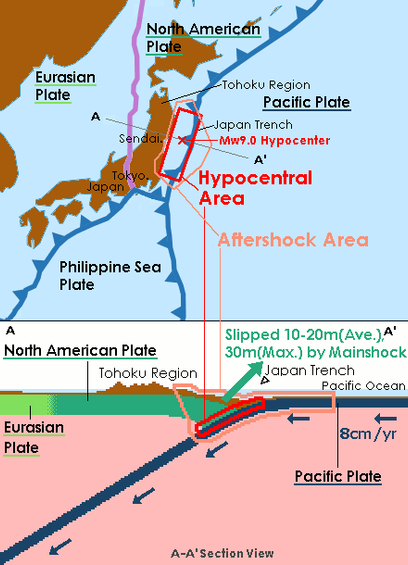
As we pay attention, we might recall that today is the anniversary of an event that would surely have made Wolrd Monitor’s map if that tool hasd been around back then: on the this date in 2011, Tōhoku earthquake (a 9.0–9.1 undersea megathrust earthquake occurred in the Pacific Ocean, 45 mi east of the Oshika Peninsula of the Tōhoku region— the most powerful earthquake ever recorded in Japan, and the fourth most powerful earthquake recorded in the world since modern seismography began in 1900.

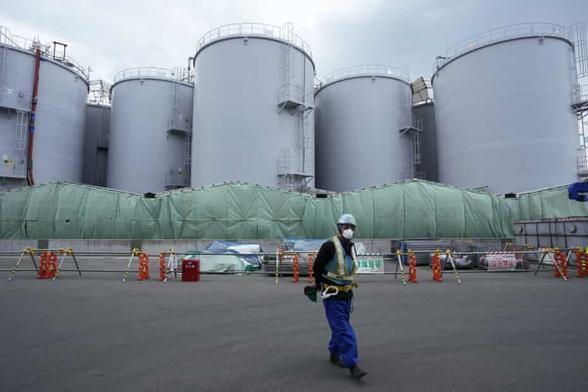
The quake was followed by a tsunami that killed thousands and caused the devastation of whole cities. Together, they did damage estimated to have cost well into the tens of billions of US dollars. Famously, the quake and subsequent tsunami caused the shutdown of eleven nuclear reactors in power plants in the region. The Fukushima reactors were especially heavily damaged, and leaked radioactive waste water, leading to radiation levels outside the plant that were up to eight times normal levels.

Mechanism of 2011 Tōhoku earthquake (source) #climateAnomalies #climateEvents #conflict #culture #cyberThreats #earthquake #ElieHabib #Fukushima #FukushimaDisaster #history #infographics #intelligence #maps #politics #Science #Technology #TohokuEarthquake #tsunami #TōhokuEarthquake #war
Extremely late to this but 14/15 years ago, the Fukushima Nuclear thingy exploded in Japan. March 11th 2011. Also when the tsunami hit. The ghost town is basically stuck in 2011. This is very sad. #FukushimaDisaster #SadNews #FukushimaDaiIchi #Fukushimanucleardisaster
Extremely late to this but 14/15 years ago, the Fukushima Nuclear thingy exploded in Japan. March 11th 2011. Also when the tsunami hit. The ghost town is basically stuck in 2011. This is very sad. #FukushimaDisaster #SadNews #FukushimaDaiIchi

#FukushimaDiary was a mainstay of news about what was / is going on at #Fukushima. The author, #IoriMochizuki, fled Japan, but still reported on #TEPCOLies and provided a valuable service by translating TEPCO documents and inconsistencies in #RadiationLevels. #Mochizuki is still active (though not as much as he used to be), and posted this story back in November 2024.

Former TEPCO Chairman #Katsumata’s Passing Sparks Reflections on Accountability in the #FukushimaDisaster

Katsumata’s Legacy as “The Emperor” of TEPCO

"Tsunehisa Katsumata, former chairman of Tokyo Electric Power Company (TEPCO), passed away at age 84 on October 21. Known as the 'Emperor' within TEPCO due to his powerful influence, Katsumata led the company through significant periods, including the 2011 Fukushima Daiichi nuclear disaster. However, despite his long-standing authority, he left without resolving key decommissioning issues at Fukushima​.

Awareness of Tsunami Risk Without Action

"In February 2009, a critical internal meeting—later known as the 'Gozen Kaigi' (御前会議) —highlighted the risk of a tsunami exceeding the plant’s protective barriers. Despite this, Katsumata refrained from directing immediate countermeasures, even as the potential threat to Fukushima loomed.

Legal Challenges and Unpaid Compensation

"Following the Fukushima disaster, Katsumata and other former executives faced multiple lawsuits, including a landmark shareholder derivative suit that ordered him and three other former executives to pay over 13 trillion yen (around 100 billion USD). Despite this ruling, compensation had yet to be paid by the time of his passing.

"In July 2022, a civil court held TEPCO executives accountable for negligence regarding tsunami countermeasures, noting that if measures had been implemented, the disaster’s impact could have been significantly reduced. This marked the first time former management was deemed financially responsible on such a large scale.

Mixed Reactions to His Death

"The news of Katsumata’s death has triggered complex responses, especially among Fukushima survivors. Many feel unresolved anger, recalling his persistent denial of responsibility during trial testimonies, where he often claimed ignorance on technical matters. Katsumata’s departure symbolizes the long-standing challenges of achieving justice and closure for the victims of Fukushima."

https://fukushima-diary.com/2024/11/former-tepco-chairman-katsumatas-passing-sparks-reflections-on-accountability-in-the-fukushima-disaster/

#NoNukes #TEPCOLied
#TEPCOLies #JGovLies
#FukushimaIsntOver #RethinkNotRestart #JapanPol #NoNukesJapan

Former TEPCO Chairman Katsumata’s Passing Sparks Reflections on Accountability in the Fukushima Disaster

Safe to discharge? Then can you drink it?

Fukushima Diary
2/2 ☢️
"Last year, a tube containing #radioactive Caesium-137 went #missing from the National #PowerPlant 5A Company's facility in #PrachinBuri.. What the #public fears is the ability -- or lack thereof -- of #officials to handle #nuclear #reactor #safety issues and highly #dangerous radioactive #waste"
#Thailand
#safetyfirst VS #HurtFirstFixLater
#FukushimaDisaster #threemileisland
#NuclearPower #NotGreen
#nuclearwastemanagement

Ignoring science, #environmental protection and international law – #G7 endorses Japan’s #Fukushima water discharge plans

Legacy of #FukushimaDisaster shows #NuclearEnergy is no solution to energy and #ClimateCrisis

#GreenpeaceInternational, April 16, 2023

Sapporo, Japan – "The nations of the G7 have chosen politics over science and the protection of the #MarineEnvironment with their decision today to support the Japanese government’s plans to discharge Fukushima #RadioactiveWaste water into the Pacific Ocean.

"The 1.3 million cubic meters/tons of radioactive waste water at the #FukushimaDaiichi plant, currently in tanks, is scheduled to be discharged into the Pacific Ocean this year. Nations in the Asia Pacific region, led by the Pacific Island Forum, have strongly voiced their opposition to the plans. Some of the world’s leading oceanographic institutes and marine scientists have criticised the weakness of the scientific justification applied by #TEPCO, the owner of the #NuclearPlant, warned against using the #PacificOcean as a #DumpingGround for radioactive contaminated water, and called for alternatives to discharge to be applied.

“'The Japanese government is desperate for international endorsement for its Pacific Ocean radioactive water dump plans. It has failed to protect its own citizens, including the vulnerable fishing communities of Fukushima, as well as nations across the wider #AsiaPacific region. The aftermath of the nuclear disaster at Fukushima is still strongly felt, and the Japanese government has failed to fully investigate the effects of discharging multiple #radionuclides on #MarineLife. The government is obligated under international law to conduct a comprehensive environmental impact assessment, including the impact of transboundary marine pollution, but has failed to do so. Its plans are a violation of the UN Convention Law of the Sea.

"'The marine environment is under extreme pressure from #ClimateChange, #overfishing and #ResourceExtraction. Yet, the G7 thinks it’s acceptable to endorse plans to deliberately dump nuclear waste into the ocean. Politics inside the G7 at Sapporo just trumped science, environmental protection, and international law,' said Shaun Burnie, Senior Nuclear Specialist at Greenpeace East Asia.

"'#GreenpeaceEastAsia analysis has detailed the failures of liquid waste processing [ALPS] technology at the Fukushima Daiichi plant and the environmental threats posed by the releases. There is no prospect of an end to the nuclear crisis at the plant as current decommissioning plans are not feasible. Furthermore, the report finds the nuclear fuel debris in the reactors cannot be completely removed and will continue to contaminate the ground water over many decades. Claims that the discharges will take 30 years is inaccurate as in reality, it will continue into the next century. Viable alternatives to discharge, specifically long term storage and processing, have been ignored by the Japanese government.

"'The Japanese government’s attempt to normalise the Fukushima nuclear disaster is directly linked to its overall energy policy objective of increasing the operation of nuclear reactors again after the 2011 disaster. 54 reactors were available in 2011 compared to only ten reactors in 2022, generating 7.9% of the nation’s electricity in FY21 compared to 29% in 2010. Meanwhile, five of the other six G7 governments led by France, the US and the UK are also aggressively promoting nuclear power development.

"'The idea that the nuclear industry is capable of delivering a safe and sustainable energy future is delusional and a dangerous distraction from the only viable energy solution to the climate emergency which is 100% #RenewableEnergy. The global growth of low cost renewable energy has been phenomenal – but it has to be much faster and at an even greater scale if carbon emissions are to be reduced by 2030. Approval for nuclear waste dumping and nuclear energy expansion sound like the 1970’s but we have no time for such distractions. We are in a race to save the climate in the 21st century, and only renewables can deliver this,' said Shaun Burnie.

https://www.greenpeace.org/international/press-release/59193/science-environmental-protection-international-law-g7-japans-fukushima-water-discharge/

#FukushimaAnniversary #FukushimaIsntOver #RethinkNotRestart
#NoNukes #Japan #TEPCOLies #WaterIsLife #Bioaccumulation

Ignoring science, environmental protection and international law – G7 endorses Japan’s Fukushima water discharge plans - Greenpeace International

The nations of the G7 have chosen politics over science and the protection of the marine environment with their decision today to support the Japanese government’s plans to discharge Fukushima radioactive waste water into the Pacific Ocean. 

Greenpeace International

"The controversial release of more than a million tonnes of water from the wrecked #Fukushima Daiichi nuclear plant will begin in the northern spring or summer, Japan’s government has said – a move that has sparked anger among local fishing communities and countries in the region."

#FukushimaWater to be released into ocean in next few months, says #Japan | #FukushimaDisaster #NuclearWaste | The Guardian
https://www.theguardian.com/environment/2023/jan/13/fukushima-water-to-be-released-into-ocean-in-next-few-months-says-japan

Fukushima water to be released into ocean in next few months, says Japan

Authorities to begin release of a million tonnes of water from stricken nuclear plant after treatment to remove most radioactive material

The Guardian
Opinion piece: More than a decade after the #FukushimaDisaster, controversial plans are in place to release treated water into the #ocean. We need all affected parties weighing in the treated-water debate. https://www.pnas.org/doi/10.1073/pnas.2205431119 #fisheries #fishers #radiation #NuclearPower