Redirecting
A quotation from Bertrand Russell
In fact the whole antithesis between self and the rest of the world, which is implied in the doctrine of self-denial, disappears as soon as we have any genuine interest in persons or things outside ourselves. Through such interests a man comes to feel himself part of the stream of life, not a hard separate entity like a billiard-ball, which can have no relation with other such entities except that of collision.Bertrand Russell (1872-1970) English mathematician and philosopher
Conquest of Happiness, Part 2, ch. 17 “The Happy Man” (1930)
More about this quote: wist.info/russell-bertrand/819…
#quote #quotes #quotation #qotd #bertrandrussell #body #engagement #externalities #interest #life #living #meaningoflife #relationship #self #selfabsorption #selfcenteredness #selfdenial #selfsufficiency #separation #spirit #worldliness

In fact the whole antithesis between self and the rest of the world, which is implied in the doctrine of self-denial, disappears as soon as we have any genuine interest in persons or things outside ourselves. Through such interests a man comes to feel himself part of the stream of…
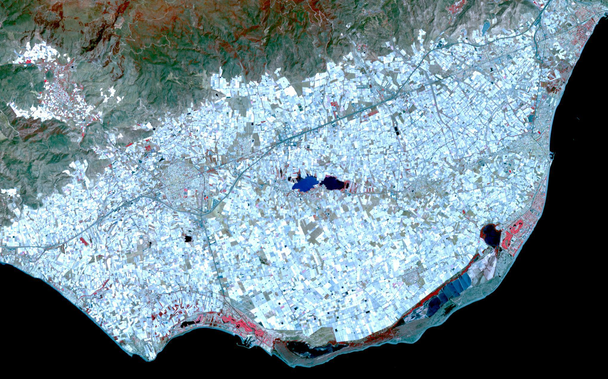
Let's cover the Mid North Coast of NSW in plastic..
Image:
"Surrounding the town of El Ejido, Almeria Province, southern Spain is a sea of greenhouses, stretching for tens of kilometers. Millions of tons of vegetables are exported to other European countries and other parts of the world. The image covers an area of 19 x 30.5 km, was acquired July 20, 2008, and is located at 36.75 degrees north latitude, 2.75 degrees west longitude."
https://science.nasa.gov/photojournal/almeria-spain/
NSW - Traumatic landscapes of plastic, pollution and exploitation
https://mastodon.au/@Bellingen/115991606657243814
#NSW #industrialisation #SeaOfPlastic #plastic #MidNorthCoast #blueberries #agribusiness #plantations #externalities #EcologicalViolence
@Susan60
Also true. The fetish for the private sector!! 🤑Why can’t we move on? Time & time again we learn through bad experience that the private sector provision of essential goods & especially services, has to be regulated, monitored, & experience consequences when it does the wrong thing. Perhaps when all that is added together, in some ‘Social Economics’ or ‘cost benefit analysis’ that actually includes all the externalities, it will be found to be a more effective use of public monies to offer services through public sector structures. 🤔
Oooo now I feel I’m ranting!!
#SocialEconomics #PrivateSector #PublicSector #essentialGoods #essentialServices # CostBenefitAnalysis #externalities #PublicMonies #Taxation
"Lemon Socialism" just like American Healthcare!
Actually, most (all?) "extractive" industries are socialized in this way. They "lease" access to public lands or resources like water... do their extractive thing... produce toxins and/or environmental damage... then move on and the public (taxpayers) either have to pay for clean up or live with the degradation. 😠
#PR move or not, this is the right thing to do
Not taking into account #externalities just distorts the true #economics anyway
#AI #energy
https://arstechnica.com/ai/2026/01/microsoft-vows-to-cover-full-power-costs-for-energy-hungry-ai-data-centers/
“No man is an island, / Entire of itself; / Every man is a piece of the continent, / A part of the main.”*…
Individualism has been been a growing force in cultures around the world since the Enlightenment; it picked up momentum in the 20th century (c.f., e.g., Adam Curtis’ masterful Century of Self [and here]); and has become a– if not the— foundational concept in liberalism. But, Nils Gilman argues, the biological discovery of the holobiont gives the lie to “the autonomous individual” in a way that has massive implications not only for how we think about, but also how we govern ourselves…
We like to believe we end at our skin. This is the primary hallucination of modern political philosophy in the West, the foundational axiom upon which we have erected our laws, our economics, and our sense of self-worth. Philosophical liberalism imagines human individuals as discrete, bounded entities — monads moving through space, contained entirely within a fleshy envelope that separates “self” from “other.” This architectural model of the human being underpins the political concept of the autonomous liberal subject, just as it grounds the social scientific commitment to methodological individualism. It asserts that the basic unit of human reality is the singular actor, the “I” that thinks, chooses, and owns.
However, this model is a biological fiction. It is a map that corresponds to no territory found in nature. Over the last three decades the life sciences have undergone a quiet revolution that renders the classical liberal view of the subject not merely philosophical debatable, yet factually incorrect. The concept of the holobiont, coined by Adolf Meyer-Abich in 1943 but popularized in the anglophone world by Lynn Margulis in the 1990s, has shattered the idea of the unitary organism. We now know that every macro-organism is actually a dynamic ecosystem, a chimera composed of a host and billions of symbiotic microbes that function as a distinct, integrated biological unit. You are not a single entity. You are a walking coral reef, a plural assemblage of human and non-human cells negotiating a fragile, continuous existence. Roughly half the cells in your body are not human; they are bacterial, fungal, and viral. They do not merely hitch a ride. They digest your food, regulate your immune system, modulate your mood, and structure the development of your brain.
The implications of this biological reality for political theory are cataclysmic. The entire edifice of Liberalism, from Hobbes and Locke to modern libertarianism, rests on the assumption of the “atomic individual” — a sovereign state of one. This core concept of liberal political theory posits a world of separate, self-governing agents who enter into contracts and demand rights to protect their private sphere from intrusion. The liberal subject claims (and demands) to be walled off, protected, and kept clean of the influence of others.
Biology exposes this desire for total autonomy as not just false, but a death wish. In the logic of the holobiont, absolute immunity is not health; it is starvation. A body hermetically sealed against the “other” dies. Our physical existence requires constant contamination and collaboration with foreign agents. We cannot be “self-made” because we are constitutively “made-with.” Donna Haraway describes this shift as moving from autopoiesis (self-making) to sympoiesis (making-with). We do not precede our relationships; our relationships constitute us. If the political subject is physically constituted by “others,” the concept of self-sovereignty collapses. One cannot be the sole monarch of a kingdom occupied by foreign powers that provide the essential infrastructure for the kingdom’s survival…
[Gilman elaborates on the implications both for our political and management systems and for the social sciences that study them. And he explores why this new perspective is hard to internalize and embrace…]
The resistance to this holobiontic perspective is fierce because it is terrifying. As Rudyard Kipling observed (in a quote often misattributed to Nietzsche), “The individual has always had to struggle to keep from being overwhelmed by the tribe. If you try it, you will be lonely often, and sometimes frightened. But no price is too high to pay for the privilege of owning yourself.” The autonomous liberal subject offers psychological safety. It promises control. It tells us that we are captains of our souls. Embracing the holobiont requires admitting that we are porous, vulnerable, and inextricably entangled with things we cannot control. It demands that we surrender the fantasy of the impermeable border. The skin is not a wall; it is a heavily trafficked interface. The state is not a fortress; it is a metabolic node in a planetary flow.
We are living through the friction between our laws and our biology. We legislate for individuals, yet we live as assemblages. We worship independence while our bodies are grounded in interdependence. The future of political theory cannot simply be an adjustment of liberal categories. It requires a fundamental ontological revision that starts with relation rather than separation. We must stop trying to protect the self from the world and begin understanding the self as a spatially intensified instantiation of the world.
Clinging to the myth of the autonomous subject is a massive act of collective denial. It represents a refusal to look at the microscope and see the legions teeming inside us. We construct our societies around a myth of being that does not correspond to biogeochemical reality. The cost of this error is everywhere apparent — in the degradation of our ecology, the polarization of our politics, and the isolation of our private lives. We try to seal ourselves off, creating sterile environments that make us sick, physically and politically. The holobiont offers a different path, one that acknowledges that to be one is always to be many. We are not solitary thinkers looking out at nature. We are nature looking at itself, through a lens made of billions of other lives. The sovereign is dead. Long live the swarm…
“The Sovereign Individual Does Not Exist,” from @nilsgilman.bsky.social.
Further complicating the issue: “Externalities, Rights, and the Problem of Knowledge,” from Cyril Hédoin:
Very short summary: This essay explains how the knowledge problem [the challenge of a central authority having the information needed to make rational decisions for a complex system like a society] applies to the definition of jurisdictional rights. Jurisdictional rights define spheres of individual sovereignty. Rights are appropriately defined if they internalize all potential externalities. However, individuals may disagree about what counts as an externality. This disagreement stems from individuals’ preferences, which are typically dispersed and local. I discuss various solutions to this problem, including the use of polycentricity...
[Image above: source]
* John Donne
###
As we incorporate the interconnected, we might recall that it was on this date in 1859 that our perspective was shifted in a different kind of way: Charles Darwin published The Origin of the Species. Actually, on that day he published On the Origin of Species by Means of Natural Selection, or the Preservation of Favoured Races in the Struggle for Life; the title was shortened to the one we know with the sixth edition in 1872.
Title page of the 1859 edition#charlesDarwin #culture #darwin #externalities #history #holobiont #individualism #individuality #interconnection #interdependence #philosophy #politics #reason #rights #society #theOriginOfTheSpecies
Rare Earth Elements and Mining Externalities
"For every tonne of rare-earth oxide produced, roughly 2,000 tonnes of acidic wastewater are left behind." >>
https://www.abc.net.au/news/2025-11-15/australia-refining-rare-earths-environmental-challenges/105969994
The new Australian-American $US8.5bn critical minerals deal. >>
Push to reopen old mines in The Dorrigo Plateau ,NSW in global race for critical minerals >>
Not So “Green” Technology: The Complicated Legacy of Rare Earth Mining
"But as much as technology is hailed as the panacea of the future, most of these innovations have a dirty underside: production of these new technologies requires companies to dig up what are referred to as rare earth elements (REEs). " >>
https://hir.harvard.edu/not-so-green-technology-the-complicated-legacy-of-rare-earth-mining/
#mining #RareEarth #externalities #water #waste #pollution #CriticalMinerals #ICT #cars #ElectricVehicles #EV #energy #transition #panacea #weapons #REEs #MiningExternalities #regulations #Dorrigo #NSW