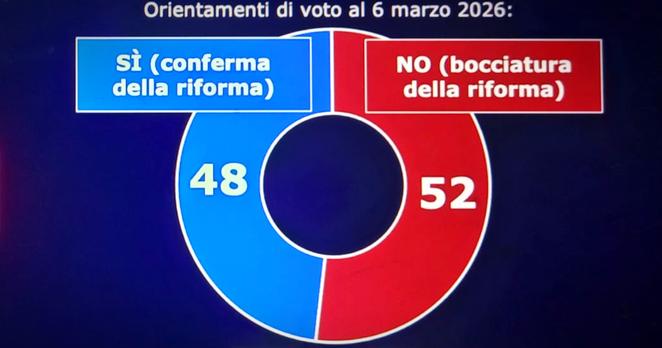
Il Fatto Quotidiano: Referendum, il No consolida il sorpasso. Secondo il sondaggio SWG, ha guadagnato 14 punti in tre mesi

Secondo la rilevazione di SWG per il programma Otto e mezzo, gli italiani pronti a bocciare la riforma della giustizia sono il 52 per cento, mentre i Sì sono dati al 48 per cento. Un sorpasso avvenuto nella seconda metà di febbraio e consolidato ora dalla rilevazione condotta tra il 2 e il 5 marzo. In totale, dal sondaggio condotto lo scorso 24 novembre, i No avrebbero guadagnato ben 14 punti, passando dal 38 per cento all’attuale 52. Il contrario dei Sì che a novembre erano dati al 62%.
Percentuali che però cambiano tenendo conto dei “propensi ad andare a votare”, che oggi si attesterebbero tra il 46 e il 51%, con la quota di indecisi, in parte assorbita soprattutto dal fronte del No, attualmente al 17%. “Il margine d’errore statistico dei dati riportati è del 2,8% al livello di confidenza del 95%”, avverte SWG, che ha condotto l’indagine “su un campione di 1.200 soggetti maggiorenni residenti In Italia (4284 non rispondenti)”. Secondo Demopolis, invece, l’attuale propensione al voto sarebbe del 40%, con i No al 43%, i Sì al 41 e il 16% di indecisi. Un’ipotetica affluenza del 54%, invece, farebbe scendere i No al 41% mentre i Sì guadagnerebbero un punto e la percentuale di indecisi sarebbe del 17%.
Durante la trasmissione sono stati presentati anche i risultati della rilevazione di Demopolis sulle preoccupazioni degli italiani per il conflitto in Medio Oriente, con la possibilità di risposte multiple. Il 75% si è detto preoccupato per “il rischio di ulteriore allargamento del conflitto“, mentre l’aumento di bollette ma anche del prezzo di benzina e gasolio preoccupa il 68%. Per il 60% di chi ha risposto la preoccupazione va per le vittime civili. Minori i pensieri per la ripresa di atti terroristici (37%) e il possibile coinvolgimento nel conflitto delle basi Nato presenti in Italia (34%).
L'articolo Referendum, il No consolida il sorpasso. Secondo il sondaggio SWG, ha guadagnato 14 punti in tre mesi proviene da Il Fatto Quotidiano.

Referendum: No consolidates lead. According to the SWG poll, it gained 14 points in three months.

According to SWG’s survey for the “Otto e mezzo” program, Italians ready to reject the judicial reform are 52 percent, while those in favor are at 48 percent. This lead emerged in the second half of February and has now been solidified by a survey conducted between March 2 and 5. In total, since the survey conducted on November 24, the “No” side has gained a remarkable 14 points, rising from 38 percent to the current 52 percent. The opposite is true for the “Yes” side, who were at 62 percent in November.

Percentages that, however, change when taking into account the “proponents of voting,” which today would stand between 46 and 51 percent, with the proportion of undecided, largely absorbed primarily by the “No” front, currently at 17 percent. “The margin of statistical error of the data reported is 2.8% at the confidence level of 95%,” warns SWG, which conducted the survey “on a sample of 1,200 adult residents in Italy (4284 non respondents).” According to Demopolis, instead, the current propensity to vote would be 40 percent, with the “No” at 43 percent, the “Yes” at 41 percent, and 16 percent undecided. A hypothetical turnout of 54 percent would bring the “No” down to 41 percent while the “Yes” would gain a point and the percentage of undecided would be 17 percent.

During the broadcast, the results of Demopolis’ survey on Italians’ concerns about the conflict in the Middle East were also presented, with multiple-choice responses. 75 percent said they were concerned about “the risk of further escalation of the conflict,” while the increase in utility bills as well as the price of gasoline and diesel worries 68 percent. For 60 percent of those who responded, the concern is for civilian victims. Fewer concerns about the resumption of terrorist acts (37%) and the possible involvement of NATO bases present in Italy (34%).

The article “Referendum, the No consolidates the lead. According to the SWG survey, it gained 14 points in three months” comes from Il Fatto Quotidiano.

#Italians #52percent #48percent #38percent #62percent #51percent #17percent #Italy #Demopolis #40percent #43percent #41percent #16percent #54percent #theMiddleEast #75percent #68percent #60percent #Referendum #IlFattoQuotidiano

https://www.ilfattoquotidiano.it/2026/03/06/referendum-il-no-consolida-il-sorpasso-secondo-il-sondaggio-swg-ha-guadagnato-14-punti-in-tre-mesi/8316190/

Referendum, il No consolida il sorpasso. Secondo il sondaggio SWG, ha guadagnato 14 punti in tre mesi

I "propensi ad andare a votare" si attesterebbero tra il 46 e il 51%, mentre la quota di indecisi, in parte assorbita soprattutto dal fronte del No, sarebbe attualmente del 17%

Il Fatto Quotidiano

LA NOTIZIA: Sondaggi politici, cosa succederà davvero al referendum: continua il testa a testa

Siamo entrati nel mese del referendum sulla giustizia. Tra venti giorni i cittadini saranno chiamati alle urne per decidere se confermare o meno la riforma voluta dal governo e dal ministro Carlo Nordio. Ma cosa dicono i sondaggi in vista del voto referendario?
La prima certezza è che il vantaggio del Sì alla riforma si è nettamente assottigliato. Il distacco di oltre dieci punti stimato fino a che poche settimane fa è evaporato e ora si prefigura un testa a testa. Nella maggior parte dei sondaggi il Sì resta in testa, ma alcune rilevazioni hanno già evidenziato il sorpasso del No.
Sono diversi i fattori che cambiano completamente l’esito dei sondaggi, a partire anche dalle stime sugli indecisi. Un’altra certezza è che tutte le rilevazioni sostengono che più sarà alta l’affluenza e più è probabile una vittoria del Sì. Il Sole 24 Ore ha raccolto alcuni degli ultimi sondaggi: vediamo cosa dicono davvero le rilevazioni a venti giorni dal voto.
Cosa dicono davvero i sondaggi in vista del referendum sulla giustizia
Il primo sondaggio che consideriamo è quello di Tecnè per Rti, che risale al periodo tra il 17 e il 19 febbraio. Tra chi dice che andrebbe a votare, ovvero il 43%, il Sì sarebbe tra il 54% e il 56% e il No tra il 44% e il 46%. Ben diversa la situazione analizzata da Demopolis per Otto e Mezzo, su La7. Anche questo sondaggio risale a qualche giorno fa (tra il 18 e il 19 febbraio): in questo caso il Sì sarebbe al 40% ma il No sarebbe avanti con il 41%. Ampia la fetta degli indecisi, pari al 19%. L’affluenza sarebbe al 42%.
Il sondaggio realizzato da BidiMedia per First, invece, ipotizza tre scenari. Con affluenza al 47% il Sì vincerebbe con il 51,5% contro il 48,5% del No. Se l’affluenza scendesse al 44%, il Sì vincerebbe con il 51%. In caso di affluenza più alta, al 51%, la vittoria del Sì sarebbe più larga con il 52,5% dei voti. Diverso lo scenario ipotizzato dall’Istituto Ixè: in questo caso il No sarebbe in vantaggio con una forbice tra il 51,3% e il 54,3%. Il Sì, invece, sarebbe tra il 45,7% e il 48,7%. Decisivo potrebbe essere l’impatto del 40% degli intervistati che si ritiene indeciso o non risponde.
L'articolo Sondaggi politici, cosa succederà davvero al referendum: continua il testa a testa sembra essere il primo su LA NOTIZIA.

Polls, what will really happen with the referendum: head-to-head continues

We have entered the month of the referendum on justice. In twenty days, citizens will be called to the polls to decide whether to confirm or reject the reform sought by the government and Minister Carlo Nordio. But what do the polls say in the run-up to the referendum vote?

The first certainty is that the lead of Yes to the reform has narrowed significantly. The lead of over ten points estimated just a few weeks ago has evaporated and now a head-to-head is emerging. In most polls, Yes remains in the lead, but some surveys have already highlighted the overtake of No.

Several factors are changing the outcome of the polls, starting with estimates of the undecided. Another certainty is that all surveys show that the higher the turnout, the more likely a victory for Yes. *Il Sole 24 Ore* has collected some of the latest polls: let’s see what the surveys really say twenty days before the vote.

What do the polls really say in the run-up to the justice referendum?

The first survey we consider is that of Tecnè for Rti, dating back to the period between February 17th and 19th. Among those who say they would vote, namely 43%, Yes would be between 54% and 56% and No between 44% and 46%. The situation analyzed by Demopolis for Otto e Mezzo, on La7, is also very different. This survey also dates back a few days (February 18th and 19th): in this case, Yes would be at 40% but No would be ahead with 41%. A large slice of the undecided is 19%. Turnout would be at 42%.

The survey carried out by BidiMedia for First, instead, hypothesizes three scenarios. With a turnout of 47%, Yes would win with 51.5% against the 48.5% of No. If the turnout fell to 44%, Yes would win with 51%. If the turnout were higher, at 51%, the victory of Yes would be wider with 52.5% of the votes. A different scenario is hypothesized by Istituto Ixè: in this case, No would be in the lead with a range between 51.3% and 54.3%. Yes, on the other hand, would be between 45.7% and 48.7%. The impact of the 40% of interviewees who are considered undecided or do not respond could be decisive.

The article Political polls, what will really happen at the referendum: a head-to-head continues to be the first on LA NOTIZIA.

#CarloNordio #first #between54%and56% #between44%and46% #Demopolis #OttoeMezzo #BidiMedia #First #the485% #IstitutoIxè #between513% #between457% #the40% #LANOTIZIA

https://www.lanotiziagiornale.it/sondaggi-politici-cosa-succedera-davvero-al-referendum-continua-il-testa-a-testa/

Sondaggi politici, cosa succederà davvero al referendum: continua il testa a testa | LA NOTIZIA

Cosa dicono davvero i diversi sondaggi in vista del referendum sulla giustizia: continua il testa a testa tra Sì e No.

LA NOTIZIA