
Democracy is inherently dynamic. Change for the worse generally occurs when we fail to make change for the better.

Neglect of structural reform does not lead to stability: it leads to stasis.

Thus democratic societies are now being out-competed by China & Russia.

#auspol #political science #deliberative democracy #direct democracy
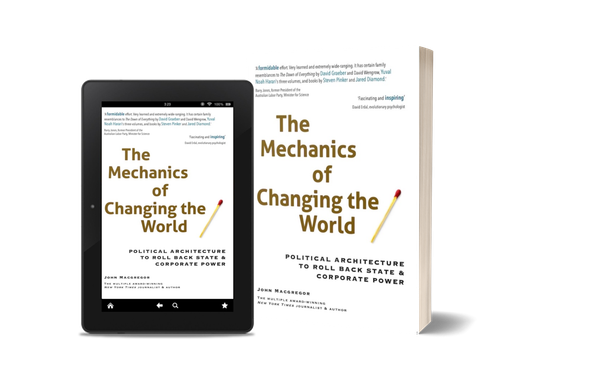
Post-viral government:

Our mood has sobered since COVID. Decades-old narratives have collapsed. Our elites (left & right) are secretive, unaccountable. We want structural change.

Thanks to many, living & dead, the tools for populist governance exist.

#politics #politicalscience #Democracy #DirectDemocracy #Deliberative Democracy

Attention-Worthy Links for November 26th, 2024

https://bit.ly/awl112624

#kgotla #dikgotla #Citizens #deliberative democracy #good governance #husking trays #communal consumption #focaccia #Cereal #Syria #Turkey #insulin #homeostasis #Inceptor #degradation #beta Cells #Forest 4.0 #Deforestation #blockchain, #Internet of Things #AI #Self-assembling proteins #skincare #eco-friendly #Q5 #PSCPs#ether #ETFs #Ethereum blockchain #stronger ETH#muscle #regenerate #ALS #myokines

Inbox | Substack

RT @EESC_LiaisonG: What a great kick-off!

Vibrant energies and a packed room for our 1st meeting co-chaired by @EESC_President Oliver Röpke & @BrikenaXhomaqi.

Thanks to all of you for a lively debate on #participatorydemocracy and #deliberative processes! https://t.co/5sAdvZYqr5

🐦🔗: https://n.respublicae.eu/EESC_President/status/1658868918239240201

Civil Society Liaison Group on Twitter

“What a great kick-off! Vibrant energies and a packed room for our 1st meeting co-chaired by @EESC_President Oliver Röpke & @BrikenaXhomaqi. Thanks to all of you for a lively debate on #participatorydemocracy and #deliberative processes!”

Twitter

RT @EESC_LiaisonG: What a great kick-off!

Vibrant energies and a packed room for our 1st meeting co-chaired by @EESC_President Oliver Röpke & @BrikenaXhomaqi.

Thanks to all of you for a lively debate on #participatorydemocracy and #deliberative processes! https://t.co/5sAdvZYqr5

🐦🔗: https://n.respublicae.eu/EU_EESC/status/1658848590112882693

Civil Society Liaison Group on Twitter

“What a great kick-off! Vibrant energies and a packed room for our 1st meeting co-chaired by @EESC_President Oliver Röpke & @BrikenaXhomaqi. Thanks to all of you for a lively debate on #participatorydemocracy and #deliberative processes!”

Twitter

RT @EESC_LiaisonG: What a great kick-off!

Vibrant energies and a packed room for our 1st meeting co-chaired by @EESC_President Oliver Röpke & @BrikenaXhomaqi.

Thanks to all of you for a lively debate on #participatorydemocracy and #deliberative processes! https://t.co/5sAdvZYqr5

🐦🔗: https://n.respublicae.eu/WorkersEESC/status/1658844821052706819

Civil Society Liaison Group on Twitter

“What a great kick-off! Vibrant energies and a packed room for our 1st meeting co-chaired by @EESC_President Oliver Röpke & @BrikenaXhomaqi. Thanks to all of you for a lively debate on #participatorydemocracy and #deliberative processes!”

Twitter

Great news on a Friday: our critical review of design choices in #deliberative #monetary #valuation studies is out! Great collaboration led by Eva Wanek and including @Mar_Schaafsma

Free access until 5 May 2023: https://authors.elsevier.com/c/1gm543Hb~0aR04

J. Lee, J. Alkan-Olsson and I suggest how to deliberate a '#sustainable #welfare-#work nexus' in #degrowth / #postgrowth contexts in #Sweden. We combine #deliberative #CitizenEngagement and a representative survey on ecosocial policies. Comments welcome! https://link.springer.com/article/10.1007/s11615-023-00454-6
Deliberating a Sustainable Welfare–Work Nexus - Politische Vierteljahresschrift

Very few countries have managed to decouple economic growth from resource use and greenhouse gas emissions in absolute terms and at rates to meet the climate targets of the Paris Agreement. To achieve this, technological solutions would need to be combined with sufficiency-oriented policies in a postgrowth context. This paper develops policy ideas for a sustainable welfare–work nexus via citizen engagement and examines the level of democratic support for such ideas. Theoretically, it employs “sustainable welfare” to understand welfare and wellbeing within planetary and social limits. The paper first sketches the welfare–work nexus as developed in the postwar circumstances in Western Europe, highlighting that this model was at no point in time ecologically generalizable to the rest of the world, and then briefly reviews the existing debate on sustainable welfare. The empirical analyses start with qualitative data from 11 deliberative forums on sustainable needs satisfaction, with emphasis on policies targeted at respecting the upper and lower boundaries of a “safe and just operating space” for economic and social development. The qualitative data are then triangulated with quantitative data from a representative survey, which was constructed based on the policy suggestions from the forums, hence allowing for an exploration of their popularity in the Swedish population as a whole. We find a considerable gap between the far-reaching policy measures that forum participants consider necessary and the measures that the general public in Sweden are prepared to support, especially when it comes to policies targeting maximum levels of needs satisfaction.

SpringerLink

RT @ColinScic: Big day for #Team @dubravkasuica : 1. adoption of communication on Harnessing Talent in EU Regions, 2. publication of 2nd Report on Impact of #DemographicChange in the #EU ; & 3. launch of the #Deliberative #democracy cohort of the #Summit for Democracy!

🐦🔗: https://n.respublicae.eu/DanielFerrie/status/1615235824957652992

Daniel Ferrie 🇪🇺 (@DanielFerrie)

RT @ColinScic: Big day for #Team @dubravkasuica : 1. adoption of communication on Harnessing Talent in EU Regions, 2. publication of 2…

Nitter
Adam Zable, S. Aaronson new paper on public participation in #AI strategies --not #deliberative democracy and not likely to build #trust in #AI https://globaldatagovernancemapping.org/
Global Data Governance Mapping

The Digital Trade and Data Governance Hub seeks to better understand what nations are doing to govern data and help others assess the principles, policies, standards, laws, regulations, and agreements designed to control, manage, share, protect, and extract value from various types of data.