Weekly Update from the Open Journal of Astrophysics – 25/04/2026

So here we are again, on a Saturday morning, with another update of activity at the Open Journal of Astrophysics. Since the last update we have published a further five papers, bringing the number in Volume 9 (2026) to 87 and the total so far published by OJAp up to 535.

I will continue to include the posts made on our Mastodon account (on Fediscience) to encourage you to visit it. Mastodon is a really excellent service, and a more than adequate replacement for X/Twitter (which nobody should be using); these announcements also show the DOI for each paper.

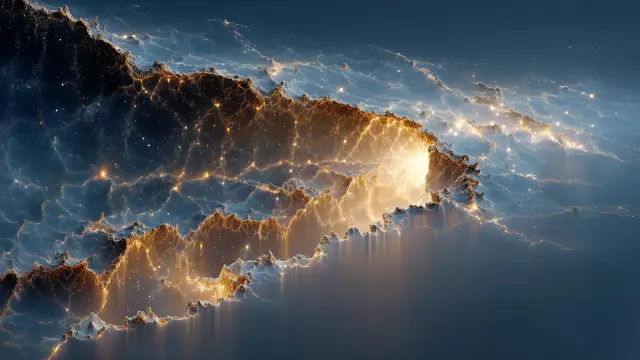
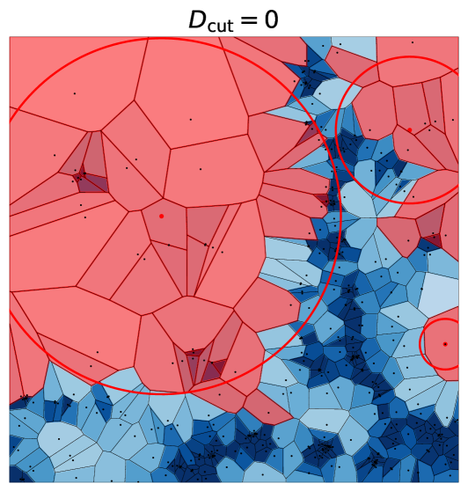
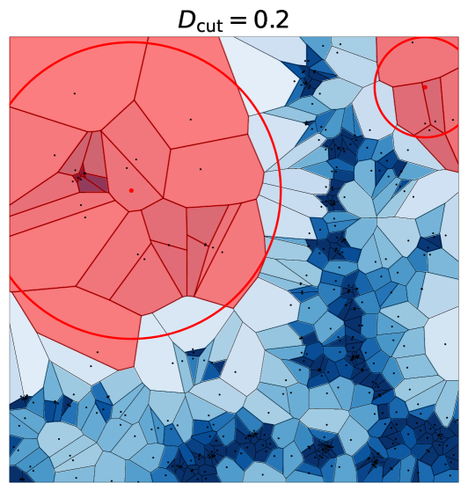
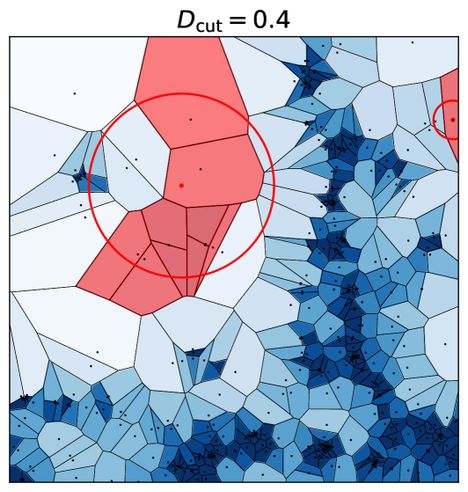
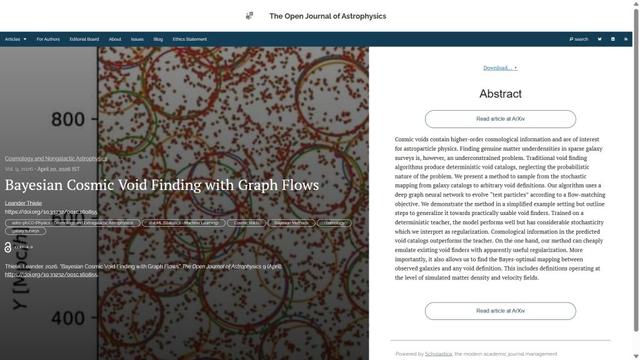
The first paper to report this week is “Bayesian Cosmic Void Finding with Graph Flows” by Leander Thiele (U. Tokyo, Japan). This was published on Monday 20th April in the folder Cosmology and Nongalactic Astrophysics. The paper presents a method using a deep graph neural network to identify cosmic voids in sparse galaxy surveys, improving upon traditional deterministic algorithms by considering the problem’s probabilistic nature. The overlay is here:

You can find the officially accepted version on arXiv here and the announcement on Fediverse here:

https://fediscience.org/@OJ_Astro/116435864086025246

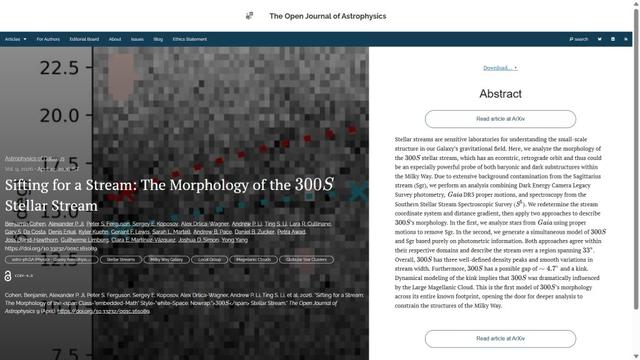
The second paper for this week, published on Wednesday 22nd April in the folder Astrophysics of Galaxies, is “Sifting for a Stream: The Morphology of the 300S Stellar Stream” by Benjamin Cohen (U. Chicago, USA) and 20 others distributed around the world. This study analyzes the morphology of the $300S$ stellar stream, revealing three density peaks, a possible gap, and a kink, suggesting significant influence from the Large Magellanic Cloud on its structure.

The overlay for this one is here:

The official version of the paper can be found on arXiv here and the Fediverse announcement here:

https://fediscience.org/@OJ_Astro/116447005556180402

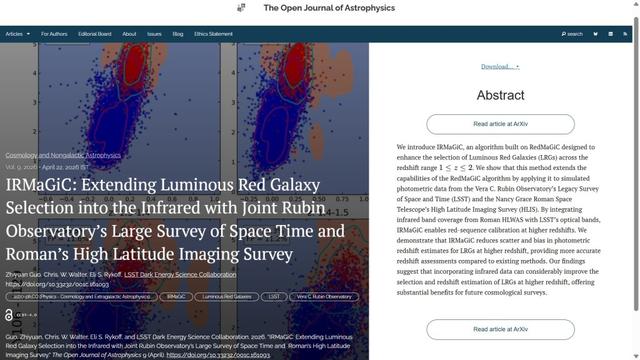
Next one up, the third paper of the week, is “IRMaGiC: Extending Luminous Red Galaxy Selection into the Infrared with Joint Rubin Observatory’s Large Survey of Space Time and Roman’s High Latitude Imaging Survey” by Zhiyuan Guo & Chris. W. Walter (Duke U., USA) and Eli S. Rykoff (Stanford U., USA) on behalf of the LSST Dark Energy Science Collaboration. This was published on Wednesday April 22nd in the folder Cosmology and Nongalactic Astrophysics. The paper introduces IRMaGiC, an algorithm that improves the selection and redshift estimation of Luminous Red Galaxies (LRGs) by incorporating infrared data, enhancing future cosmological surveys.

The overlay for this one is here:

The final, accepted version can be found on arXiv here and the Mastodon announcement is here:

https://fediscience.org/@OJ_Astro/116447067337351283

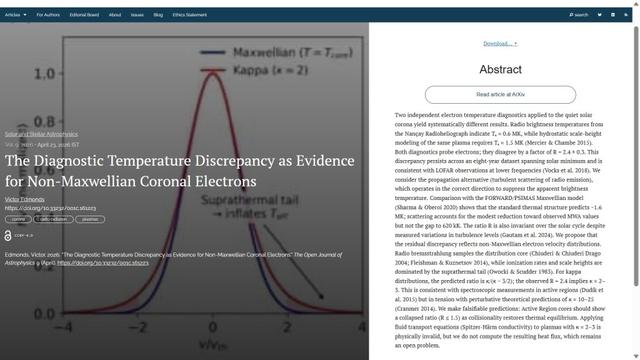
The fourth paper this week, published on Thursday April 23rd, is “The Diagnostic Temperature Discrepancy as Evidence for Non-Maxwellian Coronal Electrons” by Victor Edmonds (Final Stop Consulting, USA). This paper, in the folder Solar and Stellar Astrophysics, presents two methods of measuring electron temperature in the quiet solar corona yielding different results, suggesting non-Maxwellian electron velocity distributions may be responsible for the discrepancy.

The overlay is here:

The finally accepted version of this paper can be found here and the Mastodon announcement follows:

https://fediscience.org/@OJ_Astro/116452775389963618

The fifth and final paper for this week was published on Friday 24th April in the folder Astrophysics of Galaxies. The title is “Galaxy evolution in the post-merger regime. IV – The long-term effect of mergers on galactic stellar mass growth and distribution” by Sara L. Ellison (U. Victoria, Canada) and Leonardo Ferreira (Universidade Federal do Rio Grande, Brazil). This study uses a large sample of post-merger galaxies to demonstrate that galaxy mergers trigger significant and extended stellar mass growth in their central regions, independent of stellar population modelling.

The overlay is here:

You can find the authorized version of this paper on arXiv here and the Fediverse announcement is here:

https://fediscience.org/@OJ_Astro/116458316824739014

The overlay for this one is here:

You can find the officially-accepted version on arXiv here and the Mastodon announcement here:

https://fediscience.org/@OJ_Astro/116458316824739014

And that concludes this week’s update. I’ll do another one at the end of next week.

P.S. Thanks to the efforts of a member of our Editorial Board, the Open Journal of Astrophysics now has a Wikipedia page.

#300SStellarStream #arXiv250621410v2 #arXiv251121512v2 #arXiv260114554v2 #arXiv260214630v2 #arXiv260310040v3 #AstrophysicsOfGalaxies #BayesianMethods #CosmicVoids #CosmologyAndNonGalacticAstrophysics #DiamondOpenAccess #DiamondOpenAccessPublishing #EarthAndPlanetaryAstrophysics #GAIA #galaxyEvolution #galaxyFormation #galaxyMergers #InstrumentationAndMethodsForAstrophysics #IntergalacticMedium #IRMaGiC #LargeMagellanicCloud #LSST #LSSTDarkEnergyScienceCollaboration #MilkyWay #OpenAccess #OpenAccessPublishing #SolarAndStellarAstrophysics #SolarCorona #VeraCRubinObservatory #wikipedia
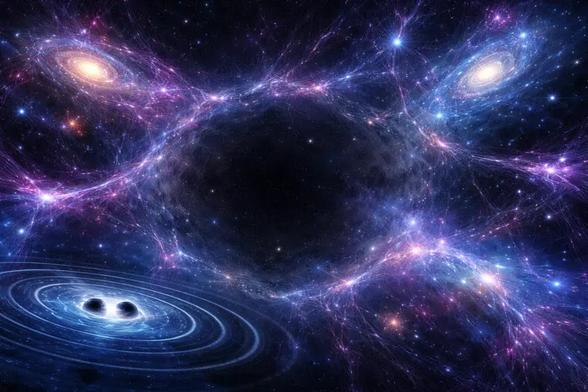
Discover how vast cosmic voids — the universe’s largest empty regions — influence galaxy formation and ripple through space-time as gravitational waves. Explore cutting-edge astrophysics uncovering the hidden role of emptiness in shaping cosmic evolution.
#CosmicVoids #GalaxyFormation #GravitationalWaves #Astrophysics
https://www.scientificworldinfo.com/2026/04/cosmic-voids-affect-galaxy-formation-and-gravitational-waves.html
Do Cosmic Voids Affect Galaxy Formation and Gravitational Waves?

Cosmic voids significantly affect galaxy formation, evolution, and the propagation of gravitational waves, acting as distinct environments t...

Blogger
This Is the Scariest Place in The Universe

YouTube

Cosmic Voids: Where Dark Energy Dominates and Drives Universe Expansion

📰 Original title: Cosmic voids look empty but they may be tearing the universe apart

🤖 IA: It's clickbait ⚠️
👥 Usuarios: It's clickbait ⚠️

View full AI summary: https://killbait.com/en/cosmic-voids-where-dark-energy-dominates-and-drives-universe-expansion/?redirpost=6098156e-df6d-476b-b6f2-3200710c688c

#astronomy #cosmicvoids #darkenergy #universeexpansion

Cosmic Voids: Where Dark Energy Dominates and Drives Universe Expansion

Cosmic voids, the vast empty regions between galaxies and cosmic structures, appear devoid of matter, radiation, dark matter, and other components. However, they are not truly empty.

KillBait Archive

While the holy grail of #InhomogeneousCosmology is to explain #DarkEnergy as an epiphenomenon of the cosmologically recent formation epoch of #CosmicVoids and other #LargeScaleStructure, #YonadavBarryGinat and #PedroGFerreira have gone for a more modest goal: keeping the #CosmologicalConstant but tacking on void formation to get a sort-of #BeyondLCDM inhomogeneous model that better matches #DES and #DESI results [1].

#ArXiv_2601_20633
@cosmology #Cosmology #LCDM

[1] https://arxiv.org/abs/2601.20633

Apparent Dark-Energy Evolution from Cosmic Inhomogeneities

A mildly inhomogeneous universe with a cosmological constant may look like it contains evolving dark energy. We show that could be the case by modelling the inhomogeneities and their effects in three different ways: as clumped matter surrounded by voids, as back-reaction of small-scale structure on the overall expansion of the Universe, and, finally, as a large-scale curvature inhomogeneity. In all of these cases, the propagation of light is affected, and differs from that in a homogeneous and isotropic universe. The net result is that cosmological observables, such as angular diameter and luminosity distances, become distorted. We find, in all three models, that the inclusion of these effects pushes the distance-redshift relation towards closer agreement with recent data from both supernovae Ia from the Dark Energy Survey, and from baryon acoustic oscillations from the Dark Energy Spectroscopic Instrument. The amount of inhomogeneity in these models might not be enough to explain the entirety of the deviation from a cosmological constant, but is found to be of a similar order of magnitude, hinting that these data may be consistent with a universe dominated by a cosmological constant.

arXiv.org

in the #arXiv

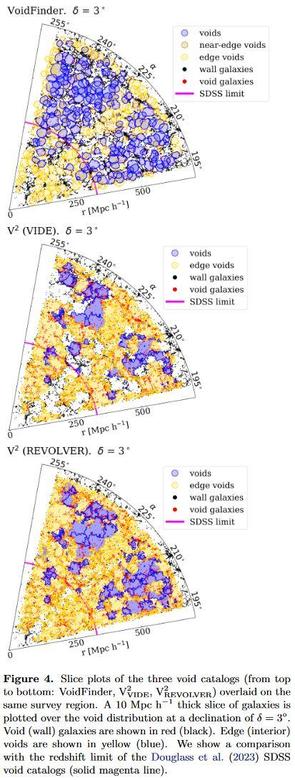
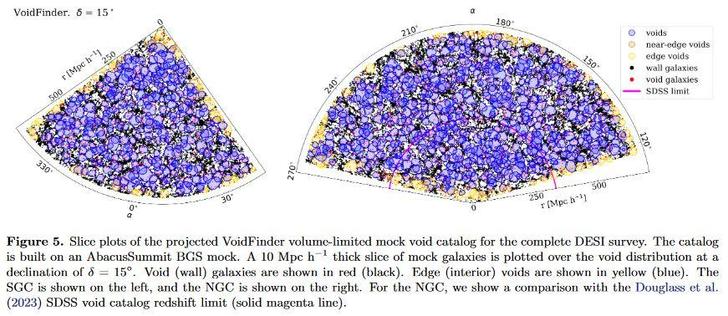
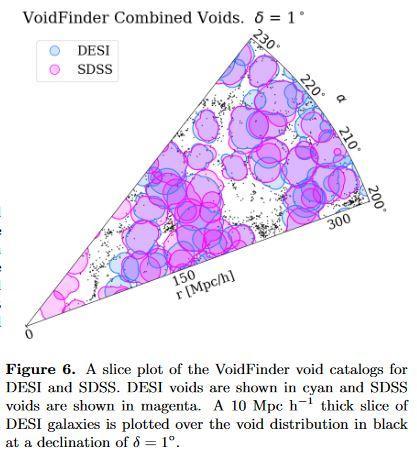
DESIVAST: A Catalog of Low-Redshift Voids using Data from the DESI DR1 Bright Galaxy Survey

by Hernan Rincon and co-authors
https://arxiv.org/abs/2411.00148

#Cosmology #Astronomy #Astrophysics #Astrodon #DESI #survey #DESIsurvey #galaxies #catalog #void #voids #cosmicvoids #voidfinder #SDSS #science #STEM #research

DESIVAST: A Catalog of Low-Redshift Voids using Data from the DESI DR1 Bright Galaxy Survey

We present three separate void catalogs created using a volume-limited sample of the DESI Year 1 Bright Galaxy Survey. We use the algorithms VoidFinder and V2 to construct void catalogs out to a redshift of z=0.24. We obtain 1,461 interior voids with VoidFinder, 420 with V2 using REVOLVER pruning, and 295 with V2 using VIDE pruning. Comparing our catalog with an overlapping SDSS void catalog, we find generally consistent void properties but significant differences in the void volume overlap, which we attribute to differences in the galaxy selection and survey masks. These catalogs are suitable for studying the variation in galaxy properties with cosmic environment and for cosmological studies.

arXiv.org

in the #arXiv

2D watershed void clustering for probing the cosmic large-scale structure

by Yingxiao Song and co-authors
https://arxiv.org/abs/2410.04898

#Cosmology #universe #voids #cosmicvoids #CosmicWeb #astronomy #astrophysics #astrodon #physics #space #science #research #STEM #watershed #clustering

2D watershed void clustering for probing the cosmic large-scale structure

Cosmic void has been proven to be an effective cosmological probe of the large-scale structure (LSS). However, since voids are usually identified in spectroscopic galaxy surveys, they are generally limited to low number density and redshift. We propose to utilize the clustering of two-dimensional (2D) voids identified using Voronoi tessellation and watershed algorithm without any shape assumption to explore the LSS. We generate mock galaxy and void catalogs for the next-generation Stage IV photometric surveys in $z = 0.8-2.0$ from simulations, develop the 2D void identification method, and construct the theoretical model to fit the 2D watershed void and galaxy angular power spectra. We find that our method can accurately extract the cosmological information, and the constraint accuracies of some cosmological parameters from the 2D watershed void clustering are even comparable to the galaxy angular clustering case, which can be further improved by as large as $\sim30\%$ in the void and galaxy joint constraints. This indicates that the 2D void clustering is a good complement to galaxy angular clustering measurements, especially for the forthcoming Stage IV surveys that detect high-redshift universe.

arXiv.org
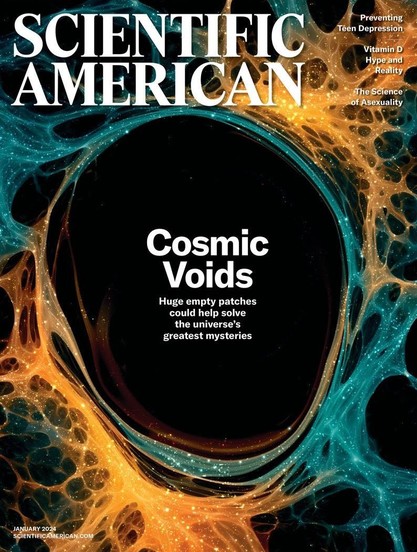
Scientific American Magazine Vol. 330 No. 1 | Scientific American

Scientific American is the essential guide to the most awe-inspiring advances in science and technology, explaining how they change our understanding of the world and shape our lives.

Scientific American

@civodul @khinsen

We use #CosmicVoids in [1][2], which in N-body sims are traced by low num-densities of particles => high noise. Full #Maneage controls + fixed seed rng's. We still have intramachine + (higher) intermachine randomness. Statistical upper limits to results OK. But still untraced sources of randomness.

Any clues for remaining randomness [2]?

#Reproducibility #ArXiv_2304_00591 #OpenScience

[1] Frozen record: https://zenodo.org/record/7792910

[2] Live git: https://codeberg.org/mpeper/lensing

Detecting cosmic voids via maps of geometric optics parameters

lensing-e4f7af0.pdf  - article in pdf format void_matches*.dat - plain text results files corresponding to Table 3 and Figures 2, 4, 6, 8. lensing-e4f7af0-journal.tar.gz - source package for producing the article pdf, together with the reproducibility package, but without the git history; appropriate for ArXiv lensing-e4f7af0-git.bundle - git source package that can be unbundled with 'git clone lensing-e4f7af0-git.bundle' and used for reproducibility: to download data, do calculations, analyse them, plot them and produce the article pdf software-e4f7af0.tar.gz - this should contain all the software, apart from a minimal POSIX-compatible system and LaTeX packages, needed for compiling and installing the software used in producing this paper lensing-e4f7af0-snapshot.tar.gz - source files of the project; these should be enough, provided that external software packages can be downloaded, to reproduce the full project The authors grant a perpetual, non-exclusive licence to distribute this pdf preprint. All the other materials here are free-licensed, as stated in the individual files and packages.

Zenodo