At #ICCG14 in Princeton (huge thanks to Adele Goldberg & team for a brilliant conference!) we announced our plans for the International #ConstructionGrammar Association (ICGA), to be officially founded at #ICCG15 in Kiel in 2028. See here for more information: https://construction-grammar.org/

International Construction Grammar Association

Welcome to the website of the International Construction Grammar Association (ICGA)! Like the association itself, the website is very much under construction. See the About page to learn more about the (envisaged) association. Become a member

International Construction Grammar Association
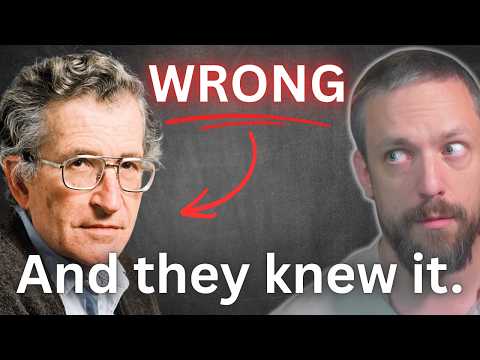
Chomsky was wrong.They taught me a lie.

YouTube

Book recommendation! 📖

Earlier this year, Vassiliki Geka published an excellent book on Imperative-Based Dialogic Constructions and Discourse Units: https://www.jbe-platform.com/content/books/9789027244918

Later this year, Journal of Pragmatics published my review of the book, which you can access freely for 50 days (now 49 days!) via this link: https://authors.elsevier.com/a/1mDE41L-nhbDYW

I'm very passionate about #ConstructionGrammar taking #dialogicity seriously and this book does exactly that! 👍

#AcademicPublishing #Linguistics #Pragmatics #Philosophy

Imperative-Based Dialogic Constructions and Discourse Units | John Benjamins

This book weaves together constructions, imperatives, dialogicity, and discourse units. How can that be? This is precisely the question it sets out to answer by working at the crossroads of Construction Grammar (CxG), Corpus Linguistics (CL), and Interactional Linguistics (IL). Profiting from this cross-fertilising synergy, the book singles out BELIEVE (YOU) ME, BELIEVE IT OR NOT, THINK AGAIN and MIND YOU as its objects of study, offers an empirical analysis of their properties and situates them within an entrenched and far-reaching, yet conveniently ‘camouflaged’, network of dialogic perspectivisation. In so doing, the book provides novel insights into the mental state verbal fillers of the constructions alongside their imperative-induced non-compositionality and dialogicity which motivate their function as discourse unit framing agents and, per extension, discourse operators. The book thus makes a case for CxG’s ability to go beyond its word-, or phrase-based ‘comfort zone’ and address phenomena at a micro-, meso- and macro-discourse level with across-the-board benefits.

YouTube analysis with GenKI: No more tedious searching for linguistic phenomena for the analysis of language in multimodal contexts! #ConstructionGrammar #GenKI #linguistics #linguistik youtube.com/shorts/6bJrZ...

Youtube-Analyse und GenKI #Kon...
Youtube-Analyse und GenKI #Konstruktionsgrammatik

YouTube
Schedule - CxGsNLP2.pdf

Google Docs

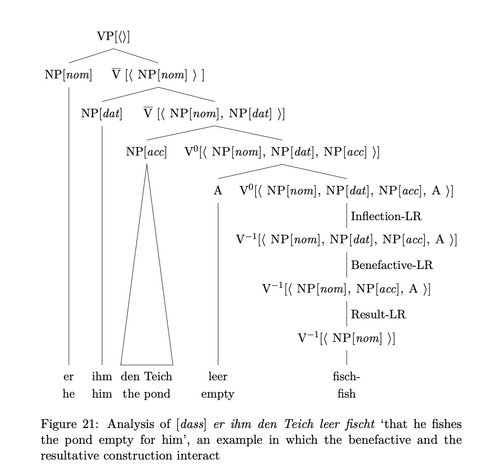
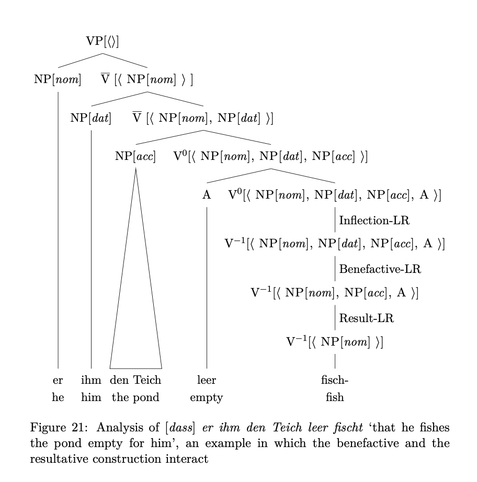
At this years #LFG conference, I will talk about #TAG and what it shows us for the old phrasal vs. lexical discussion:

https://lingbuzz.net/lingbuzz/009130

I think valence information has to be encoded lexically and lexical rules or empty heads or transformations should be used to derive resultative constructions or caused motion constructions. They can not be related to other constructions in inheritance networks.

Comments welcome!

#ConstructionGrammar #CxG #HPSG #Syntax #grammar

I’ve started reading William Croft’s “Morphosyntax” (2022). Only on ch. 2 now, but finally a #syntax book I’m enjoying! And actually based on varied cross-linguistic data, not completely English-centric.

#linguistics #cxg #ConstructionGrammar #linguistic_typology

Just in time for Christmas, the #snowclones are back! In our new #OpenAccess paper, part of a cool special issue on new approaches to #ConstructionGrammar, Tobias Ungerer and I compare the [X is the new Y] construction in English, German and Spanish https://turia.uv.es/index.php/qfilologia/article/view/28712
Contrastivo es el nuevo negro: un estudio translingüístico de un “snowclone” en inglés, alemán y español | Quaderns de Filologia - Estudis Lingüístics