 Stefan Müller
Hm. So #ConstructionGrammar is about #LLMs now? I think this is the wrong way to go.
https://drive.google.com/file/d/1MnyaPhopxCGZgH7iWAwbmx4X4N7xY759/view
Hm. So #ConstructionGrammar is about #LLMs now? I think this is the wrong way to go.
https://drive.google.com/file/d/1MnyaPhopxCGZgH7iWAwbmx4X4N7xY759/view
New version of my paper on phrasal constructions in TAG.
https://ling.auf.net/lingbuzz/009130
#Grammatik #Linguistik #Argumentstruktur #CxG #Konstruktionsgrammatik #ConstructionGrammar #HPSG #Lexikalismus .
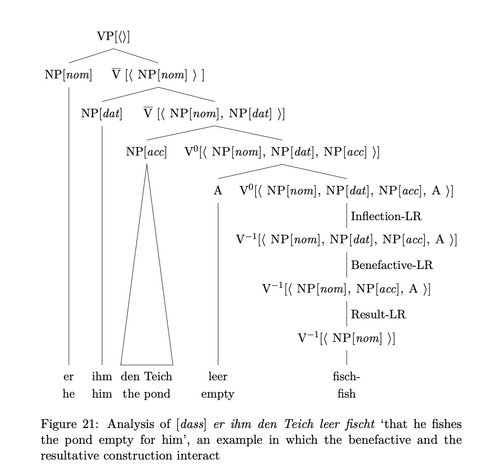
Neue Version meines Aufsatzes zu phrasalen Konstruktionen in TAG.
https://ling.auf.net/lingbuzz/009130
#Grammatik #Linguistik #Argumentstruktur #CxG #Konstruktionsgrammatik #ConstructionGrammar #HPSG #Lexikalismus .
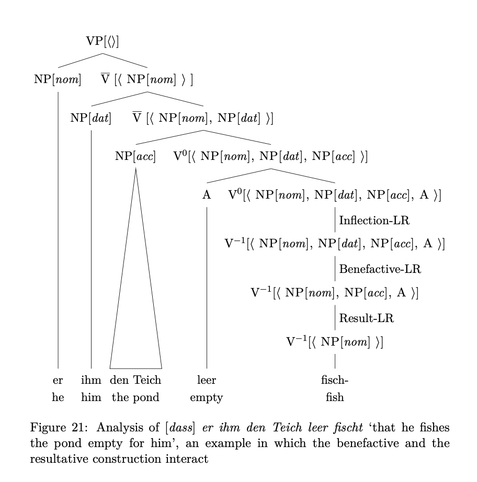
At this years #LFG conference, I will talk about #TAG and what it shows us for the old phrasal vs. lexical discussion:
https://lingbuzz.net/lingbuzz/009130
I think valence information has to be encoded lexically and lexical rules or empty heads or transformations should be used to derive resultative constructions or caused motion constructions. They can not be related to other constructions in inheritance networks.
Comments welcome!
I’ve started reading William Croft’s “Morphosyntax” (2022). Only on ch. 2 now, but finally a #syntax book I’m enjoying! And actually based on varied cross-linguistic data, not completely English-centric.
1/2 This is speculative but there may be some merit & foundation in Construction Grammar #CxG for using substitution tables (in some more meaningful way) for language learning.
See: Nation, I. S. P. (2024). Chapter 19 Substitution tables. In The Twenty Most Effective Language Teaching Techniques (pp. 238–245). Routledge. https://doi.org/10.4324/9781003496151
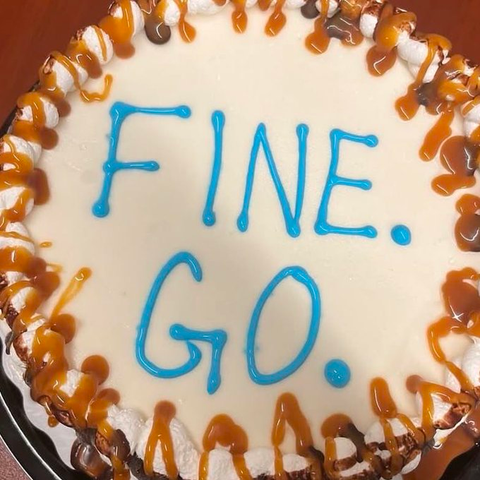
Two contructions #CxG that speak volumes in the given context. How can so much meaning & attitude be condensed into just two words?!
(OK, I'm officially a linguistics nerd 🤓)
1/ Did you know that #ConstructionMorphology was developed by Susanne Z. Riehemann? It was her masters thesis in 1993, which was later published in a journal article in 1998. Very good work about -bar derivation in German (like able derivation in English). It is type-based, captures lexical idiosyncrasies and regularities and sub-regularities. Susanne's work was corpus-driven. Empirically and formally very good. Gert Booij never cites her appropriately.
 Stefan Müller
 Tanja Säily

 silmeth 🇺🇦
 Matt Bury