 Leipziger Boy
RE: https://mastodon.social/@nixCraft/116780494584602899
For humanity to reach its potential, financial resources must be prioritized for collective needs rather than billionaire wealth.
RE: https://mastodon.social/@nixCraft/116780494584602899
For humanity to reach its potential, financial resources must be prioritized for collective needs rather than billionaire wealth.
The Common Good, in Milliseconds
On the pitch, you pass the ball to whoever is best positioned. Everything else about them is irrelevant. What if we lived that way?

𝗛𝘂𝗺𝗮𝗻𝗶𝘁𝘆 𝗛𝗮𝘀 𝗡𝗼 𝗦𝗲𝗮𝘁 𝗼𝗻 𝘁𝗵𝗲 𝗕𝗼𝗮𝗿𝗱
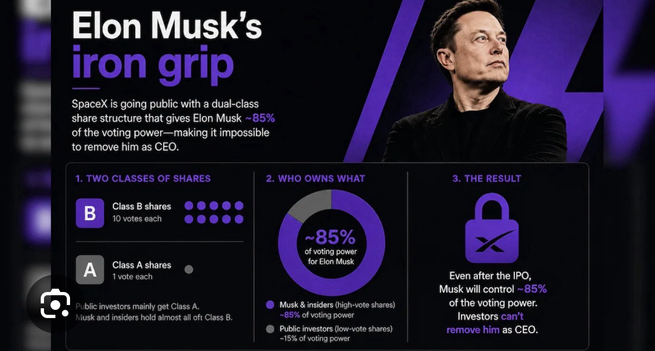
SpaceX speaks for the future of the species. Its IPO shows how that mission is governed: Musk holds 85% of the votes with 42% of the equity, on a board he picks, with no independent majority required.
The grander the appeal to a shared good, the more completely the structure is built around a single will.
And we finance it, quietly, through index funds we never read.
Who, inside it, is allowed to tell it no?
#commongood #elonsucks
Technology and dominance in the recent
First Encyclical Letter of His Holiness Leo XIV Magnifica Humanitas, 15 May 2026
* Chapter 3: TECHNOLOGY AND DOMINANCE
Some of the topics discussed are:
Automation, dignity of work
Protecting freedom against dependencies and commercialization
Breaking the chains of new forms of slavery
The normalization of war
Force without limits
The military-industrial complex
Weapons and artificial intelligence
The crisis of multilateralism
The need to disarm words
Justice >>
https://www.vatican.va/content/leo-xiv/en/encyclicals/documents/20260515-magnifica-humanitas.html#CHAPTER_THREE
* Existential risk from artificial intelligence >>
https://en.wikipedia.org/wiki/Existential_risk_from_artificial_intelligence
* Martin Heidegger, The Question Concerning Technology, 1954 >>
https://en.wikipedia.org/wiki/The_Question_Concerning_Technology
#humanism #human #performance #enhancement #RemainingHuman #transhumanism #PostHumanism #AI #algorithms #machines #governance #regulation #humanity #fallibility #automation #commercialisation #transformation #dehumanisation #slavery #CommonGood #war #multilateralism #justice #TechnologyAssessment #TA #TechnologicalWorldview #techne #technologies #ScientificConsensus #PublicSphere #FLI #risks #existence #nature #RawMaterials
Breathing into God’s Reign
“‘Dear Lord God, I wish to preach in your honor. I wish to speak about you, glorify you, praise your name. Although I can’t do this well of myself, I pray that you may make it good.’”[i]
Introduction
While all the events marking key and signature moments in the life and death of Christ must be equally emphasized in the life of the church, it is his ascension and thus the sending of the divine Holy Spirit that establishes and motivates the church, the body of Christ, the ecclesia, the union of people committed to the message of Jesus Christ crucified and raised. Without the Spirit there would be no church. As the Iona Abbey creed proclaims, the Holy Spirit,
God within us,” is the life-giving breath of the church. The Spirit is the one who plows and prepares hearts and minds to hear and receive the proclamation of the gospel; it is the Spirit who opens ears and eyes to see God and Christ in others; it is the Spirit who motivates recalcitrant limbs and high-inertia bodies to participate in God’s mission of the divine revolution of love, life, and liberation; and, it is the Spirit who causes the church to be and assures that the church will always be in the world, even if it means taking on different shapes and forms as it moves through the ages, adapting.
And it’s this last portion that is crucial for us today. The Spirit will always be the source and foundation of the church, despite us. While this is a comforting notion, removing the burden from our backs to “save the church,” it must also be our wake-up call urging us to press into the Spirit more and more, living in a way expressing our divinely ordered dependence on the Spirit not only for the life of our church or the life of our denominational expression of church, but as the unified body of Christ who represents Christ in the world individually and corporately through our words and deeds for the well-being of the our neighbors to the glory of God.
1 Corinthians 12:3b-13
In our Epistle text this morning, Paul begins with a declaration regarding what can be said by the divine Holy Spirit,[ii] Wherefore I am imparting to you this knowledge that … no one is able to confess, “Jesus [is] Lord” if not through the agency of the Holy Spirit (v3a, 3c). Paul is making a strong distinction between what is and is not said by the Spirit of God.[iii] Too often, we incorrectly credit the divine Spirit with things that the Spirit would not say, things that have emotional energy behind them and things that carry depth of insight; but, not all of it is of the Spirit. For Paul, the principal declaration of the Spirit in the life of believers is the confession that “Jesus is Lord.” To say this is to be inspired by the Spirit. In fact, for Paul, it is the Spirit speaking through the one who says it. For no one concludes that a crucified man is the Messiah unless their ears and eyes have been opened by the Spirit to hear and see what God has done in Christ in the Easter event. Thus, the Spirit declares through the believer that Jesus IS Lord. (This is more than saying “Jesus lived” or “Jesus was Crucified” or “Jesus was raised”.)
Paul then discusses the acts of the believers motivated by the divine Holy Spirit. First, Paul emphasizes divine unity amid human diversity.[iv]
Now there are apportionings of the gifts of grace, but the same Spirit; and there are apportionings of servanthoods, and the same Lord; and there are apportionings of what activates effects, but the same God, the one who brings about/causes all things in all people (vv4-6).
The point Paul is making is that the various gifts of grace that believers have and express are from the same source and, thusly, do not allow for hierarchy to be created—the same God is behind each gift to each believer. [v] While the gifts are different from each other,[vi] they come from the same source and share in the same portion, God’s grace is freely distributed to all by God’s will.[vii] This automatically, for Paul, shifts the focus from the way things are done in the kingdom of humanity to the way things are done within the reign of God;[viii] there are no “special” apportionings, no one is singled out for being better or lesser in this divine economy of the distribution of spiritual gifts of God’s grace.[ix] All people and all gifts of grace are for the body of Christ and not to bring this or that one person fame and glory in the kingdom of humanity. This is why Paul then says, Now to each one the public manifestation of the Spirit is given toward the common advantage of others (v7).
Then Paul lists what type of gifts of God’s grace are distributed and apportioned to believers.
For to one is given the articulate utterance of “wisdom”, and to another rational statement of “knowledge” according to the same spirit. To a different person, a special endowment of faith by the same Spirit, to another gifts of healing by the one Spirit, to another the working of miraculous power, to one prophecy, to another the discernment of spirits, to another sorts of tongues, to another the explanation of tongues (vv.8-10).
This is not an inventory by which to create some test to discern who has what “spiritual gift.” What Paul is demonstrating is where and when the divine Spirit moves and is at work for the wellbeing of the body. Paul does not say that any of these gifts of grace participate as one time distributions but that the Spirit, in their orientation toward democracy and egalitarianism, distributes the gifts across the body of Christ so that the believers may, together, build each other up, encourage each other, and work toward and participate in the mission of the reign of God as Jesus did. In other words, the believers are to live in the world and among their neighbor eagerly using the gifts of grace they have received in that moment to the neighbor’s wellbeing and to the glory of God.[x] No one person gets all the gifts; no one gift carries more power or importance. Each person and all gifts function to benefit others. (Full stop.)
To have “wisdom” and “knowledge” is not to have sudden and special insight into others or events; rather, it’s about seeing and perceiving events and people through the lens of God’s grace,[xi] and to do so in a way that benefits others and the gospel.[xii] To be wise and knowledgeable in the economy of God is to see God at work everywhere through the Cross of Christ and by the power of the Holy Spirit. Same goes for the gifts of “faith,” the (separate gift[xiii]) “healing,”[xiv] and “strength.” To have a special endowment of faith isn’t to believe blindly whatever the authority tells you to believe, but to believe in such a way that the common good is lifted and encouraged.[xv] Same, too, with healing and power which can (both) occur in various ways and by differing means (i.e. it’s not always spiritual, miraculous healing and power but could be done by temporal means[xvi]). Both “Prophecy” and the “discerning of Spirits” is about speaking rightly and seeing through false doctrine, being able to say what is and what is not of the reign of God. Both prophecy and discerning of spirits participate in furthering God’s reign as God’s truth is proclaimed and the lies of the kingdom of humanity are exposed.[xvii] The gift of “kinds of tongues” and the “interpretation of tongues” reflects deep spiritual groans that come from the subterranean self of believers; these groanings are unintelligible by the one groaning and another is needed to help to understand.[xviii] This unintelligible groaning and interpretation benefit everyone involved because, if we are honest, we all have deep subterranean desires and pleas that we cannot utter with regular words and need help in understanding and accessing those deep desires and please.[xix] (The gift and interpretation of tongues is not about new prophecy in the world or about speaking other languages, per se; it’s about participating in the birthing of the reign of God as both midwife and child-bearer.) The point of all this discussion, for Paul, is that the divine Spirit gives gifts of grace for the common good of all, to assist in the proclamation of the gospel, and to push back the evil forces of the kingdom of humanity eager to destroy human beings. [xx]
Conclusion
Paul concludes with,
Now all these things God works by the one and the same Spirit who distributes to each one distinctly just as the Spirit wills. For just as the body is one and has many members, and all the members of the body, being many, are one body; this is the case with Christ. For also by one Spirit we, we all are baptized into one body, whether Jewish or Greek, whether slave or free, namely we were all given to drink one Spirit (vv.11-13).
Just as Christ is one, so too is the body of Christ one even though there are many members and many apportionings of gifts of grace. All of this diversity and difference is to serve the body of Christ so that this body of Christ can go into the world and allow God’s love and grace to spill over into the world, making the world a better place for those who are the beloved of God, our neighbors, those who are currently suffering in body and mind. We, as the body of Christ, are a body politically speaking, [xxi] thus we are Christ’s representative in the world as he is absent and only by the power of the Holy Spirit. We are one by our baptism into Christ,[xxii] by our shared faith in Christ, and by the power of the Spirit bringing us together to be the body of Christ and to bring us into union with God so that wherever we go and wherever we are, there, too, is God… just as is the case with Christ. As Christ breathed his last on the cross, we, by faith in Christ and in union with God by the power and presence of the Holy Spirit, take up that breath and participate in the breathing into God’s reign through our words and deeds for the wellbeing of our neighbor to the glory of God. In other words, we participate in the Spirit’s life-giving breath of the church no matter where we find ourselves in history. Thus, there will always be church wherever there are those who can, by the power of the Spirit, confess Jesus is Lord.
[i] LW 54:157-158; Table Talk 1590.
[ii] Anthony C. Thiselton, The First Epistle to the Corinthians, NIGTC, eds. I. Howard Marshall and Donald A. Hagner (Grand Rapids: Eerdmans, 2000), 917. “On this basis Paul is asking what content of human speech may be said to count as what is spoken by the Spirit or through the agency of the Spirit of God.”
[iii] Thiselton, The First Epistle to the Corinthians, 917. “…what experiences and actions, as well as words, will count as manifestations of the Holy Spriit, rather than self-induced experiences, acts, or words, or even those induced by other agencies?”
[iv] Thiselton, The First Epistle to the Corinthians, 928. “…in these verses, at least, Paul places his emphasis on the unit of source which lies behind a diversity of phenomena.”
[v] Thiselton, The First Epistle to the Corinthians, 928. “The cohesive bestowal of the gifts ensures their fundamental unity.”
[vi] Thiselton, The First Epistle to the Corinthians, 929-930. “Paul’s change of the Corinthian term πνευματικά, spiritual things, to χαρίσματα, spiritual gifts, ‘gifts of grace,’ calls attention to God’s generous act of freely apportioning different gifts to different recipients. Once again, grace through the cross governs ecclesiology and ministry.”
[vii] Thiselton, The First Epistle to the Corinthians, 930. “By the application of persuasive definition or code switching Paul redefines what counts as spiritual by talking about what God freely gives, on his own initiative, and in his own sovereign choice (12:11) as empowerments …through the agency of the Holy Spirit for practical service of God and of other persons…”
[viii] Thiselton, The First Epistle to the Corinthians, 939. “The background which controls the exegesis, therefore, derives from the contrast between the pretentiousness and competitive status-seeking of humans wisdom…and the gift of divine wisdom…”
[ix] Thiselton, The First Epistle to the Corinthians, 930. “The lexicographical convention of distinguishing ‘general’ from ‘special’ gifts already imports distorting pre-judgments into a subtle rhetorical strategy on the part of Paul which intended to shift the focus form human status claims about πνεῦμα to more humbling realities about God’s different apportionings of gifts…”
[x] Thiselton, The First Epistle to the Corinthians, 936. “The Spirit produces visible effects for the profit of all, not for self-glorification. If the latter is prominent, suspicion is invited. δἰδοται reflects both continuous process of giving, and the sovereignty of God in choosing and in freely giving.”
[xi] Thiselton, The First Epistle to the Corinthians, 939. “Wisdom, in this context, becomes an evaluation of realities in the light of God’s grace and the cross of Christ. I s part of a response to grace.”
[xii] Thiselton, The First Epistle to the Corinthians, 944. “Paul does not seek the wisdom of the Sophists, but neither does he disparage practical reflection and judicious evaluation. Gifts of articular communicative utterance may draw on wisdom and knowledge from God especially when this serves both ‘the common good’ of all and the proclamation of the cross. (This is a far cry from some modern notions about coded messages for the welfare of individuals.)”
[xiii] Thiselton, The First Epistle to the Corinthians, 947. “It is not necessarily the healer who receives the gift of special faith.”
[xiv] Thiselton, The First Epistle to the Corinthians, 947. “But if the majority associate healing with the faith cited in the first part of the verse, and if this faith is a sovereign gift given to specific, chosen persons and not to all believers, Paul may not expect that all believers who need various kinds of healing will necessarily manifest the gift of faith with which healing may be associated. This is given to ἐτέρῳ, a different person, or another.”
[xv] Thiselton, The First Epistle to the Corinthians, 946. “…rather than focus on the category of miracle, it is more helpful to consider the conceptual entailments of faith in the God who is Almighty and sovereign in relation to his own world. This links faith here with λόγος γνώσεως…”
[xvi] Thiselton, The First Epistle to the Corinthians, 950. “An exegetical scrutiny leaves open the possibility of gifts of various kinds of healings in whatever mode, through whatever instrument or human agent, and at whatever time God may choose, as one of many specific gifts…”
[xvii] Thiselton, The First Epistle to the Corinthians, 967. “The basic criterion for assessing the difference between the Spirit and forces of evil appears to operate more broadly in the public domain, having to do with whether the phenomena in question promote and witness to the sovereign Lordship of Jesus Christ (v.3).”
[xviii] Thiselton, The First Epistle to the Corinthians, 988. “Tongues may then be viewed as ‘the language of the unconscious’ because it is unintelligible (unless it is ‘interpreted’) not only to others but also to the speaker.”
[xix] Thiselton, The First Epistle to the Corinthians, 988. “…Paul sees tongues as a genuine gift of the Spirt which can help the individual…”
[xx] Thiselton, The First Epistle to the Corinthians, 956. “It is therefore essential to regain the collective and corporate framework of these gifts ‘to some…to another.’ Specific human agents (not all) may receive a particular gift from the Spirit to advance the gospel against oppressive forces, for the benefit of all.”
[xxi] Thiselton, The First Epistle to the Corinthians, 996. “It is the use of the political body—rhetoric that is the object of comparison; Christ remains the main subject whom the rhetoric serves, as an analogy which later will be given an unexpected twist by ‘code switching’ what appears to be an unqualified hierarchy.”
[xxii] Thiselton, The First Epistle to the Corinthians, 997. “The previous verse had concluded with ὀ Χριστός as the focus of unity. Paul amplifies this unity by speaking of the common agency and experience of one Spirit and one body as focused in the very baptism that proclaimed and marked their turning to Christ and their new identity as people of the Spirit.”
#1Corinthians #1Corinthians12 #AnthonyThiselton #BodyOfChrist #CommonGood #DivineLove #GodSReign #HolySpirit #Jesus #JesusTheChrist #KingdomOfHumanity #Liberation #Life #Love #Pentecost #PentecostSunday #Representation #SpiritualGiftsEpiscopal priest beautifully explains patriotism vs. nationalism and what sets them apart
https://fed.brid.gy/r/https://www.upworthy.com/patriotism-vs-nationalism-meaning-explained-ex1/

"A nation is formed by the willingness of each of us to share in the responsibility for upholding the common good."
Barbara Jordan
#quoteoftheday #NationBuilding #InItTogether #Responsibility #CommonGood
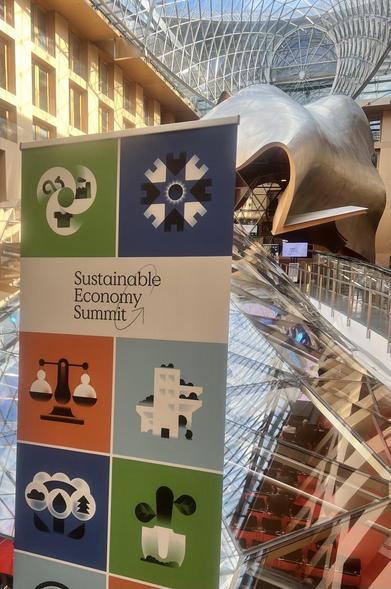
Inspiration vom #SustainableEconomySummit! 🚀
Es war großartig zu sehen, wie prägend die Frauen aus unserem Netzwerk die Diskussionen in Berlin mitgestaltet haben. Mit ihrer Expertise und ihrem Blick für echte Transformation machen sie den Summit zu einem wichtigen Impulsgeber für das Gemeinwohl. 🌱✨
Ein starkes Signal für eine Wirtschaft, die Kooperation und Zukunftswert vereint.


 Henrique Iamarino
 antoinetteprof
 BellingenNSW
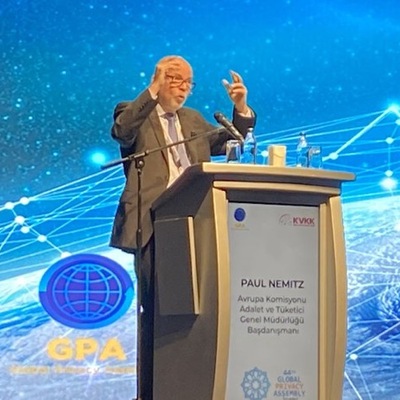 Paul Nemitz
 LaurenRELarkin.com
 Ash Manson ♦️ Queen of Ravens
 Front Page [Unofficial]
 Tim Mocarski
 GWU Netzwerk