For the past 60 days, I have been intensively studying the Italian language. I want to learn Italian in order to better serve our ASL Opera project since 50% of the most popular operas were written in Italian (25% were written in German, and 15% were written in French). I understand modern Italian isn’t the same as “original opera Italian” — but learning something new only helps deepen the appreciation of the comprehension of the context of the original aesthetic. In this article, I will share with you some of the treasures, and techniques, I have been using to apply a greater understanding to my Italian learning.
Learning a new language can be a challenge. When I first met my beloved Janna more than 35 years ago, one condition of our dating was that I learn her language — American Sign Language. Since that time, Janna — who happens to be Deaf — and I have written ASL books, performed together, and taught ASL together many times!
As ASL teachers, Janna and I believe in total immersion, and we also believe that in our real lives and in our classrooms. No English! No PSE! Just use pure ASL. You’ll learn, and sustain, a language better and faster that way.
I have done my best to apply that immersion thinking to my Italian learning. Complete and total immersion whenever possible. Some believe adults have a harder time learning a new language than a child, but I disagree. Adults know how to make associations with existing grammar, and syntax, and that gives adults the power of leveling up faster than our infant contemporary language learners!
Here is my Italian learning plan. When I’m not directly studying in my Apps, I am using the following methods to provide immersion as often as possible.
TV. Comcast offers two Italian channels for an extra monthly fee. They also offer other foreign language channels like German and French!Radio App — talk and music. The iPhone store is filled with Italian streaming Apps. You can also stream directly from the internet.iPhone Language. I changed the language on my iPhone and iPad from English to Italian. Sure, it’s a little scary, but I have Janna’s English iPhone to help me out if I get stuck. I also changed the time to a 24-hour clock.Keyboard language on phones and computers. I use an Italian keyboard whenever I can. That’s my new default. Force it to learn it!Apple Watch. I changed the language on my Apple Watch to Italian. Force it to learn it!Podcasts. Listening to podcasts can also really help you learn Italian fast.Music. Singing along is a great, modern, way to learn a musical language to a beat. Melody sharing makes the learning less traditional, and more exciting!TV shows. YouTube has a lot of Italian learning shows. They are helpful! Episodic television is also a wonderful way to add familiar context to the Italian overdubbing.Movies. Netflix has Italian content with English captions.CiborTV. This is a box you buy, like an Apple TV, that provides subscription content for Italian television channels. CiborTV is my greatest secret weapon for ongoing daily passive immersion.One of the biggest blockades to learning Italian is the four years I spent learning Spanish 45 years ago. When I “think” in my target language of Italian, the dark memory of the Spanish word first creeps to mind. I never became fluent in Spanish! I regret not studying harder all those years ago. Senorita Byrd: “I apologize for not being a more apt student!”
For my Italian study, I subscribe to several Italian language newspapers, but my main weapon in learning is my Apps. Here is a review — on a scale of 1-10, with 10 being the best — of the Italian language learning Apps I use every day. I study a minimum of 90 minutes a day using these Apps. I have, probably 25 Apps in total, but these particular Apps provide a lifetime subscription: Buy once, learn forever! That, to me, is important in learning a new language, because you will always, for your lifetime, be working on learning the language. Apps that charge only a monthly, or a yearly fee, are not included in this review.
Babbel (3/10)
Babbel does a lot of television advertising. Their learning quit on me when a lesson I was studying stopped working. The problem was repeatable. I reported to Babbel the trouble I was having, along with steps to reproduce the bug, and screenshots — you can’t move on until you finish a lesson, and I was forever stuck on a blank screen for Lesson 7 — and Babbel support brushed me off! They told me to restart my browser. I stopped right there and gave up on Babbel. That is the danger of paying once with access forever. If you can’t access the lessons, there is no forever — and the company, after being paid, has zero incentive to keep you actively learning! There are also no study guides you can print out for each lesson to help you memorize the work. The problem was 100% confirmed on the Babbel side, and they did not care.
LingoDeer (5/10)
LingoDeer sells itself as an Asian language learning App, but they do offer a few other languages, like Italian. So far, their strict learning style is often effective. Their printable notes are comprehensive and helpful. The teaching style is raw, though. I call LingoDeer the “meaner sister of Duolingo.” The early lessons were super difficult and unforgiving, now the later lessons are a little more relaxed and fun to “play.”
Rosetta Stone (4/10)
Rosetta Stone is the old dude in the room and uses a visual learning approach. There are no printable lessons. You look at images and divine vocabulary and grammar all on your own. Alone, Rosetta Stone would not be a great way to learn a language, but adding it to the ganglia of other learning tools I have employed, it’s a definite winner in making one “think different” in real time. Their spoken language recognition engine is pitiful. It does not work. I have, unfortunately, turned off its voice feature after week 6.
Lingopie (8/10)
Lingopie is super interesting and immersive. They provide videos with both English and Italian captions. You can turn off the captions if you don’t want to see them. If you don’t know a word, you click on it, and that word gets defined for you and added to your Pop Quiz queue. There’s also a Netflix browser plugin that will “Lingopie” Italian content on Netflix that will help you learn even faster. Lingopie will only get better with time!
Clozemaster (10/10)
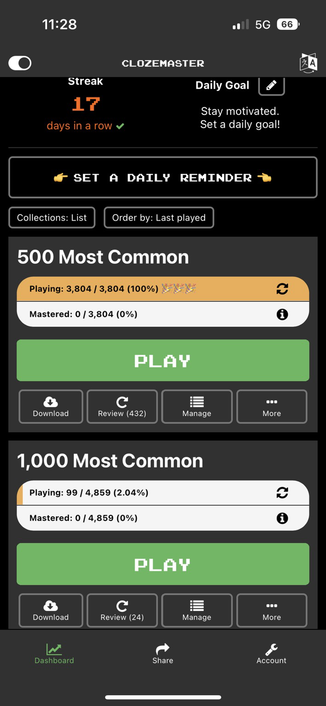
Clozemaster is my favorite learning tool — it thinks, and processes information, just as I do — and that’s a rare thing to find in the real world! Designed like a retro-style 80s video game, Clozemaster helps you quickly close in on your target language goals. ChatGPT-4 explains the idea behind “cloze” learning:
A “cloze” test is used in language learning and pedagogy to assess an individual’s comprehension, vocabulary, and grammar skills. It is a valuable tool for both educators and students in various language learning contexts.
In a cloze test, certain words or phrases within a text are systematically removed and replaced with blanks. The learner is then asked to fill in the blanks with appropriate words or phrases to complete the sentences. The omitted words are usually chosen based on specific criteria, such as every nth word or specific grammatical structures.
Here’s how the cloze method is applied in language learning:
1. **Assessment of Vocabulary and Grammar**: By strategically removing certain words or phrases, teachers can assess a student’s grasp of vocabulary and grammatical structures. For example, removing verbs can test understanding of verb tenses.
2. **Reading Comprehension**: Cloze tests can be tailored to evaluate a student’s ability to understand context and meaning within a text. By choosing which words to omit, a teacher can measure specific reading comprehension skills.
3. **Promoting Contextual Learning**: Unlike isolated word lists, cloze tests promote learning words and structures in context, allowing students to understand how they are used in real communication.
4. **Differentiated Instruction**: Teachers can modify the difficulty of a cloze test based on the needs and abilities of individual students, making it a flexible tool for different learning levels.
5. **Integration into Various Language Skills**: Cloze tests can be integrated into reading, listening, writing, and speaking exercises, making them a multifaceted tool for comprehensive language learning.
6. **Feedback and Reflection**: The immediate feedback provided by cloze tests helps students recognize their mistakes and reflect on their understanding, thus fostering continuous improvement.
In summary, cloze tests provide a practical, adaptable, and effective way to evaluate and enhance various aspects of language learning. They promote contextual learning and provide a multi-dimensional approach that can be tailored to individual student needs.
For a scholarly insight into the subject, you may refer to the book “Cloze Procedure: An Alternative Approach to Reading in Foreign Language Training” by J.H. Robinson (1980), which provides an in-depth analysis of the application of cloze in foreign language training.
Drops (9/10)
Drops was a magnificent surprise. Drops focuses on helping you learn Italian vocabulary in just 5 minutes a day. You can study for a longer period of time if you pay. Drops is fun to use, beautiful to look at, and a wonder at teaching. It’s just fun! I start my day with Drops to give myself a boost of confidence, and joy, before the harder work of learning begins.
Memrise (6/10)
Memrise is a strange beast. I’m not completely certain I understand what it is or what the goals are of the App. You sometimes get video clips of phrases — some are just silly, and I skip them — which you then get tested on in multiple choice boxes. They also provide a strange “video” conversation with people talking to themselves — like a TikTok story — that I find more annoying than engaging. Memrise does have a ChatGPT-3 dialogue interaction that can be fun, but even that feels just a little old and limited.
edX (1/10)
I was super excited to take the Italian lessons on edX, but the teaching is really old — the expert Italian language folks on Reddit told me many of the words being taught on edX were no longer colloquial, and they urged me to dump the lessons, and I did. The learning interface feels like a 1990s website project gone wrong. There was so much unlimited promise here that just failed to deliver.
Anki (3/10)
People either seem to love Anki flashcards or they hate them. I’m sort of in the middle. I get how Anki can be helpful for repetition in learning, but the interface is super ugly, and many of the “study decks” for download don’t appear to be well-formatted. The idea is right, but the execution feels stilted and raw.
That’s my review of my “lifelong learning Italian Apps” with a lifetime subscription. I look forward to learning Italian. My goal is to be at least B2 certified and I’m currently a rising A1. Yes, I have a long way to go, but that’s okay. Good things take time, and fluency demands dedication. I know I have at least one of both right now.
Share this:
#anki #asl #asl-opera #babbel #chatgpt #cloze #clozemaster #drops #e4e4e4 #edx #fluency #immersion #italian #lingodeer #lingopie #memrise #opera #opera-project #rosetta-stone
https://bolesblogs.com/2023/08/14/learning-italian-lifetime-immersion-style/
 Leah
Leah
 dpplggr
 asomer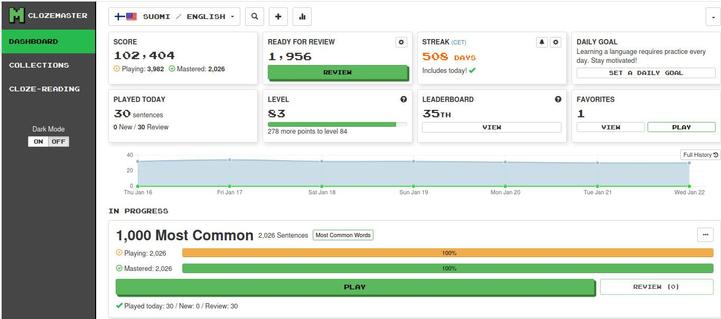


 Deykun
 Boardda Mihkkal
 David Boles
 Neverfadingwood 🇺🇦
 Ryan Bigg