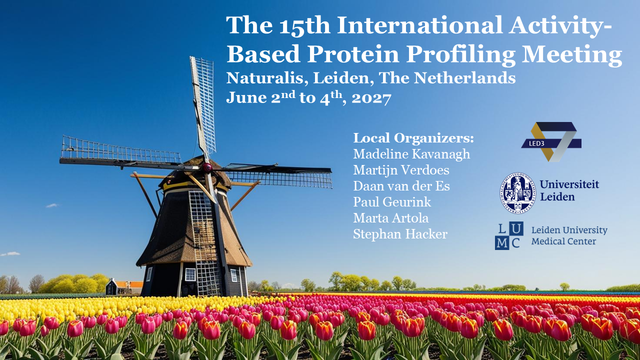
We are super excited that the 15th Activity-based protein profiling conference #ABPP2027 will take place in the Naturalis in Leiden on June 2nd to 4th, 2027.
Mark your agendas for this exciting event!
To not miss anything, sign up for our mailing list here: https://www.universiteitleiden.nl/en/science/led3/abpp2027
#ABPP #ChemoProteomics #ChemPro #ProteoProbes #Chemistry #ChemBio #DrugDiscovery
Interesting paper by the group of Rolf Breinbauer in Organic & Biomolecular Chemistry. They synthesized three α-fluoromethyl naphthoquinone-based probes as potentially reduction-activated probes for oxidoreductases, but found promiscuous reactivity.
https://pubs.rsc.org/en/content/articlelanding/2025/ob/d5ob01320h
#Chemistry #ChemBio #ABPP #ChemPro #ProteoProbes #ChemicalProteomics
Very excited to see this study by the group of David Konrad out in JACS Au.
Ortho-dichloroacrylophenone is a highly reactive, cysteine-directed electrophile for peptide and protein labeling as well as chemoproteomic profiling. Glad that our group could make a small contribution.
https://pubs.acs.org/doi/10.1021/jacsau.5c00692
#ChemBio #Chemistry #ChemPro #ProteoProbes #CovalentInhibitors
Interesting bioRxiv preprint by the groups of Liron Bar-Peled and A. John Iafrate. They introduce COUPLrs - structurally diverse molecules with 2 electrophilic warheads and an alkyne - to identify proteins that can be linked to other proteins.
https://www.biorxiv.org/content/10.1101/2024.07.16.603666v1#Chemistry #ChemBio #ChemPro #InducedProximityInteresting
@[email protected] by the group of Michael Taylor. They designed new derivatives of N-substituted pyridinium salts for tryptophan labeling that allow labeling of the proteome with green light.
www.biorxiv.org/cont...
#ChemSky #ChemBio #ABPP #ChemPro #ProteoProbes
Designer Aromatic Cations for ...Designer Aromatic Cations for Photo-Induced Protein Ligation, Imaging, and Intracellular Labelling at Extended Wavelengths
Photo-induced protein labelling strategies have become essential tools in chemical biology, but most strategies require high energy wavelengths of light as input to drive reactivity. Recently, we reported a biocompatible method for engaging photo-induced electron transfer to drive protein labelling using biaryl pyridinium salts and, here, we report the design of a series of aromatic cation salts that trigger this process using longer wavelengths of light while maintaining a sterically minimal profile. We achieved this through the systematic study of structure-reactivity relationships of various donor-acceptor pyridinium salts possessing extended conjugation, and these studies revealed the need of a constrained trans-stilbene relationship between the probes donor and acceptor substituents in order to achieve protein labelling. Probes with chromene-based donor groups in particular showed either robust protein labelling, significant fluorescence quantum yields, or state-dependent photophysical properties; in turn enabling the same probes to be used for both photo-induced protein labelling and wash-free live-cell imaging. We also demonstrate that these enhanced probes possess robust reactivity in complex biological environments through green light-triggered intracellular labelling in live HeLa cells, resulting in the identification of 659 enriched proteins. This series of experiments not only demonstrates the ability of this latest generation of probes to engage in photo-induced labelling using lower energy light in complex proteomes, but also reveals new capabilities for photophysical state-dependent reactivity and measurements.
### Competing Interest Statement
The authors have declared no competing interest.
National Institute of General Medical Sciences, R35 GM143120
U.S. National Science Foundation, https://ror.org/021nxhr62, 1920234, 840336, 9214383, 9729350
bioRxivInteresting bioRxiv preprint by the group of Michael Taylor. They designed new derivatives of N-substituted pyridinium salts for tryptophan labeling that allow labeling of the proteome with green light.
https://www.biorxiv.org/content/10.1101/2025.10.13.681063v1
#Chemistry #ChemBio #ABPP #ChemPro #ProteoProbes
Designer Aromatic Cations for Photo-Induced Protein Ligation, Imaging, and Intracellular Labelling at Extended Wavelengths
Photo-induced protein labelling strategies have become essential tools in chemical biology, but most strategies require high energy wavelengths of light as input to drive reactivity. Recently, we reported a biocompatible method for engaging photo-induced electron transfer to drive protein labelling using biaryl pyridinium salts and, here, we report the design of a series of aromatic cation salts that trigger this process using longer wavelengths of light while maintaining a sterically minimal profile. We achieved this through the systematic study of structure-reactivity relationships of various donor-acceptor pyridinium salts possessing extended conjugation, and these studies revealed the need of a constrained trans-stilbene relationship between the probes donor and acceptor substituents in order to achieve protein labelling. Probes with chromene-based donor groups in particular showed either robust protein labelling, significant fluorescence quantum yields, or state-dependent photophysical properties; in turn enabling the same probes to be used for both photo-induced protein labelling and wash-free live-cell imaging. We also demonstrate that these enhanced probes possess robust reactivity in complex biological environments through green light-triggered intracellular labelling in live HeLa cells, resulting in the identification of 659 enriched proteins. This series of experiments not only demonstrates the ability of this latest generation of probes to engage in photo-induced labelling using lower energy light in complex proteomes, but also reveals new capabilities for photophysical state-dependent reactivity and measurements.
### Competing Interest Statement
The authors have declared no competing interest.
National Institute of General Medical Sciences, R35 GM143120
U.S. National Science Foundation, https://ror.org/021nxhr62, 1920234, 840336, 9214383, 9729350
bioRxiv