 damian entwistle
Today's Flickr photo with the most hits; the Avar gold horde, in the Hungarian National Museum.
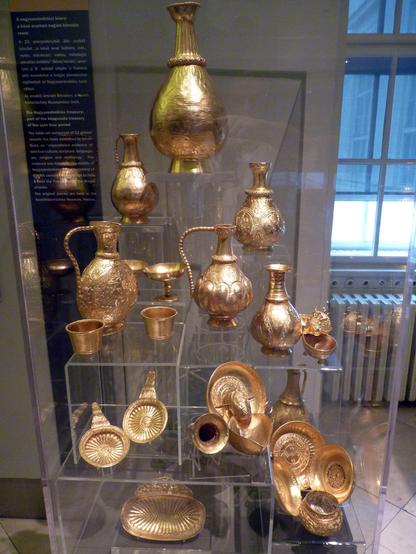
Today's Flickr photo with the most hits; the Avar gold horde, in the Hungarian National Museum.
Four previously unavailable languages of the Caucasus
— Abkhaz, Avar, Chechen, and Ossetian
— have been made available on Google’s translation service.
Friday’s addition of 110 new languages was the first time new languages of the Caucasus have been included in Google Translate since May 2010,
when Armenian, Azerbaijani, and Georgian were added.
It is also the first time the four new languages have been made available through any machine translation service.
The addition is the latest step in Google’s 1,000 Languages Initiative,
the development of an AI model that Google says will support the 1,000 most spoken languages around the world.
According to Google, the latest additions ‘represent more than 614 million speakers, opening up translations for around 8% of the world’s population’.
The inclusion of Abkhaz, Avar, Chechen, and Ossetian in Google Translate is a major step forward in the efforts to develop digital support for the indigenous languages of the Caucasus, which has so far remained limited.
Very few apps or other software are available in languages other than Armenian, Azerbaijani, and Georgian.
Except for Abkhaz, the four languages are also seldom used in media, administration, or commerce.
Google’s move comes soon after an announcementby Russian technology firm Yandex that they are working to include Abkhaz and the languages of the North Caucasus in their own translation service.
These include Abaza, Circassian, Karachay–Balkar, Nogay, Ossetian, Chechen, and Ingush.
#Abkhaz #Avar #Chechen #Ossetian #Caucasian #translation
https://oc-media.org/abkhaz-avar-chechen-and-ossetian-hit-google-translate/
#DNA study of #Avar cemetery remains reveals network of large pedigrees and social practices.
https://phys.org/news/2024-04-dna-avar-cemetery-reveals-network.html

An international team of archaeologists and archaeogenetics specialists, working with the Hungarian National Museum, has discovered a network of Avar pedigrees and community social practices after conducting a DNA study of the remains of people who once lived in what is now a part of Hungary.
Original study:
G. A. Gnecchi-Ruscone et al., Network of large #pedigrees reveals social practices of #Avar communities, @Nature 24 April 2024. 🔓

Analysis of ancient DNA from 424 individuals in the Avar period, from the sixth to the ninth century AD, reveals population movement from the steppe and the prolonged existence of a steppe nomadic descent system centred around patrilineality and female exogamy in central Europe.
The case of the missing daughters - how the longest #aDNA based family tree yet published (spanning 9 generations) reveals patterns of #patrilocality marriages to nonlocal women among 6th century #Avar communities:
https://www.science.org/content/article/massive-dna-study-reveals-mating-customs-mysterious-medieval-horse-riders by @spoke32 via Science
A HUN-AVAR-MAGYAR ROKONSÁG BIZONYÍTÉKAI ÁTÍRJÁK A HONFOGLALÁSRÓL TANULT ISMERETEINKET

 Chuck Darwin
 CellBioNews
 Jens Notroff
 Kara Finance
 Faeri
Faeri Melczer Jenő