 Steven Sandner
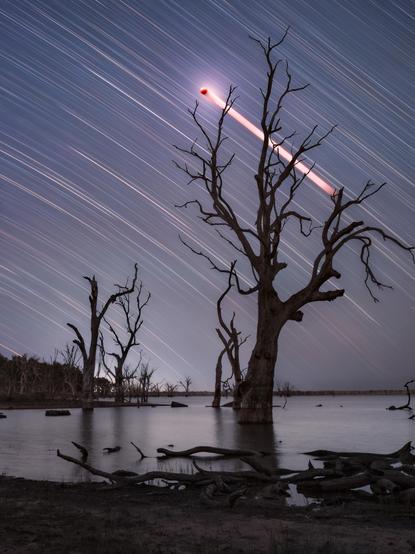
Bright Moon surrounded by stars, captured against the night sky with subtle star trails adding a sense of motion and time.
Over 12 images were used in making this composite.
More about me and prints
https://linktr.ee/steven.sandner
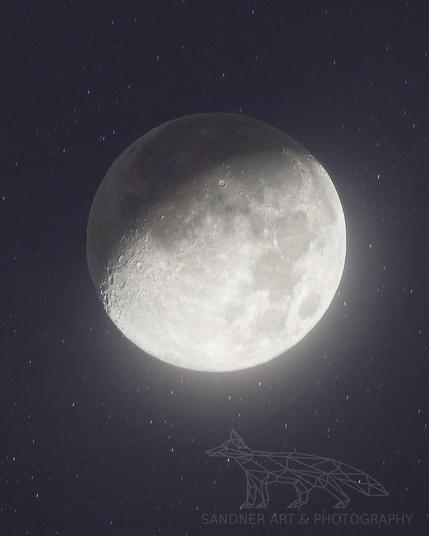
Bright Moon surrounded by stars, captured against the night sky with subtle star trails adding a sense of motion and time.
Over 12 images were used in making this composite.
More about me and prints
https://linktr.ee/steven.sandner
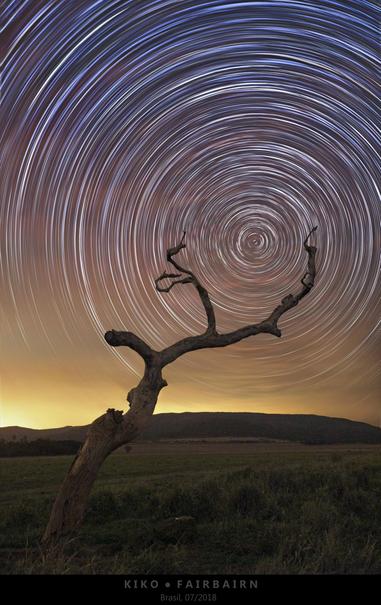
2026 April 16
South Celestial Tree
* Image Credit & Copyright: Kiko Fairbairn
https://app.astrobin.com/u/kiko.fairbairn?i=362508
* Text: Cecilia Chirenti (NASA GSFC, UMCP, CRESST II)
https://science.gsfc.nasa.gov/sci/bio/cecilia.chirenti
Explanation:
If you live in the northern hemisphere, you may have learned how to locate the North Star, Polaris, in the night sky. It can be used to find north, and it approximately marks the northern celestial pole. If you live in the southern hemisphere, there is no bright star marking the southern celestial pole, but the Southern Cross can be used to find south. The featured image was taken in Padre Bernardo (GO), Brazil. It shows the apparent motion of the stars around the apparently empty southern celestial pole over 2 hours, on August 20, 2018. Each star takes about 24 hours to make a complete turn around the pole in the sky. Padre Bernardo is located in the Cerrado region, a tropical savanna that occupies most of central Brazil and supports rich biodiversity. The dry branch that apparently supports this sky wheel of rotating stars is a common sight there in the dry season during the southern winter.
https://www.timeanddate.com/geography/southern-northern-hemisphere.html
https://science.nasa.gov/solar-system/what-is-the-north-star-and-how-do-you-find-it/
https://apod.nasa.gov/apod/ap250114.html
https://apod.nasa.gov/apod/ap220728.html
https://en.wikipedia.org/wiki/Crux
https://en.wikipedia.org/wiki/Padre_Bernardo
https://www.britannica.com/place/Goias-state-Brazil
https://en.wikipedia.org/wiki/Brazil
https://astronomy.swin.edu.au/cosmos/s/Sidereal+Day
https://science.nasa.gov/earth/earth-observatory/a-cerrado-above-it-all-154336/
https://en.wikipedia.org/wiki/Giant_anteater#/media/File:Myrmecophaga_tridactyla_345917023_(cropped).jpg
https://en.wikipedia.org/wiki/Cerrado#Climate
https://apod.nasa.gov/apod/ap260416.html
#space #earth #astrophotography #photography #astroart #art #science #nature #education #apod
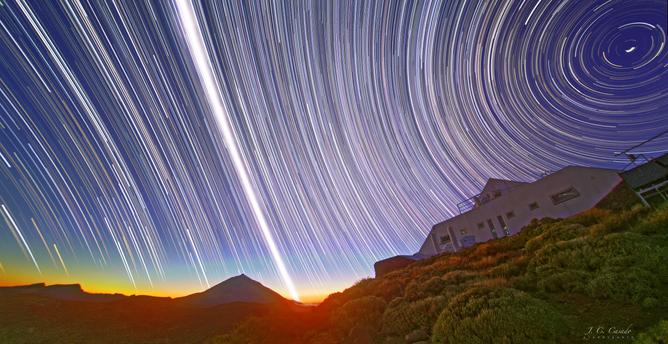
2026 March 20
Spring Equinox at Teide Observatory
* Image Credit & Copyright: Juan Carlos Casado (Starry Earth, TWAN)
https://twanight.org/profile/juan-carlos-casado/confirmed-photos/#tab-content
Explanation:
The defining astronomical moment of the equinox today is at 14:46 UTC (March 20). That's when the Sun crosses the celestial equator moving north in its yearly journey through planet Earth's sky, marking the beginning of spring for our fair planet in the northern hemisphere and fall in the southern hemisphere. Then, day and night are nearly equal around the globe. In fact, both day and nighttime exposures from a spring equinox at the Observatorio del Teide in Tenerife, Canary Islands, Spain, are used in this composited skyscape. Over 1,000 images were taken with a fisheye lens, later corrected for distortion and merged for the ambitious equinox project. The apparent motion of the Sun setting along the celestial equator on the equinox date follows the bright linear, diagonal track from the sequence of daytime exposures taken over 6 hours. After sunset, nighttime exposures recorded startrails, with the celestial equator as a linear track and concentric arcs circling the north celestial pole near Polaris at upper right and the south celestial pole beyond the lower left edge (and below the Teide horizon). The foreground includes the distant Teide volcano peak and the observatory's pyramid-shaped solar laboratory building.
https://science.nasa.gov/solar-system/skywatching/night-sky-network/embracing-the-equinox/
https://www.timeanddate.com/calendar/march-equinox.html
https://svs.gsfc.nasa.gov/11353
https://www.iac.es/en/observatorios-de-canarias/teide-observatory
https://apod.nasa.gov/apod/ap260320.html
https://apod.nasa.gov/apod/ap021115.html
https://apod.nasa.gov/apod/ap231203.html
https://apod.nasa.gov/apod/ap121213.html
https://apod.nasa.gov/apod/ap260320.html
#space #earth #astrophotography #photography #astroart #art #science #nature #education #apod
2026 March 13
Toolondo Totality Trails
* Image Credit & Copyright: Jason Perry
https://www.pdogastrophotography.com/about-the-photographer
Explanation:
In this composited night skyscape, stacked exposures trace graceful star trails above Lake Toolondo, Victoria, Australia, planet Earth. Captured while the lunar eclipse of March 3 was in progress, the exposures used were made during the hour-long total eclipse phase. So faint star trails are easily visible along with the trail of the reddened Moon in the eclipse-darkened skies above the lake and trees. Of course, the apparent motion of Moon and stars revealed in the timelapse composite reflect the Earth's daily rotation around its axis. Dramatically punctuating the Moon's trail as totality ended, a single, separate telephoto image of the totally eclipsed Moon was scaled and blended into the scene.
https://science.nasa.gov/moon/eclipses/
https://svs.gsfc.nasa.gov/5604
https://apod.nasa.gov/apod/ap260307.html
https://apod.nasa.gov/apod/ap260305.html
https://apod.nasa.gov/apod/ap230922.html
https://apod.nasa.gov/apod/ap240817.html
https://apod.nasa.gov/apod/fap/ap260313.html
#space #earth #astrophotography #photography #astroart #art #science #nature #education #apod
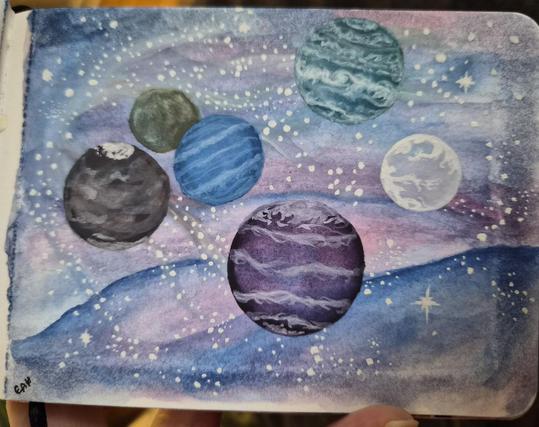
One of my favorite things about #astronomy is how well it goes with #art and spacing out generally. Since I can't go into the telescopes atm, had a bit of fun. Def recommend #watercolour paints for #planets .
Obviously these ones are destined for a fabulous collision due to their proximity but it makes for some fun #scifi thoughts. Please imagine at least 1 is traveling escape velocity and will get away.
#Astrodon #sciart #science #saturday #AstroArt #fediart #astro
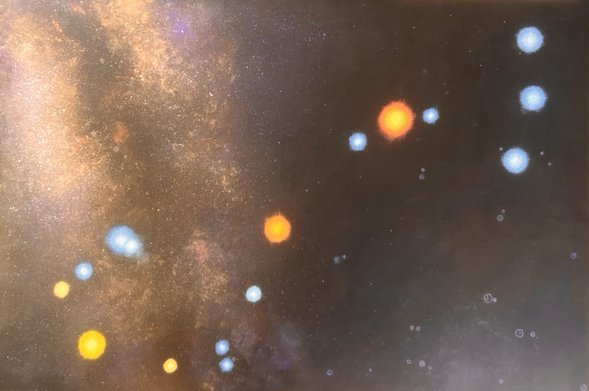
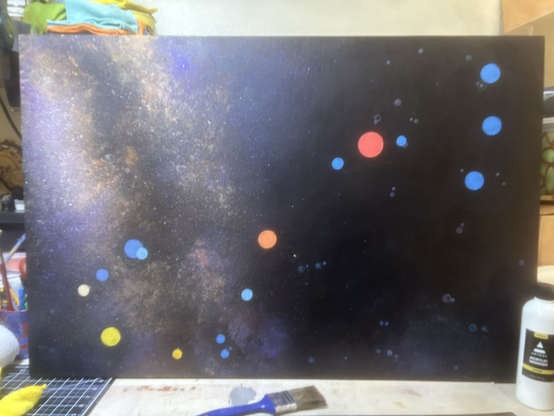
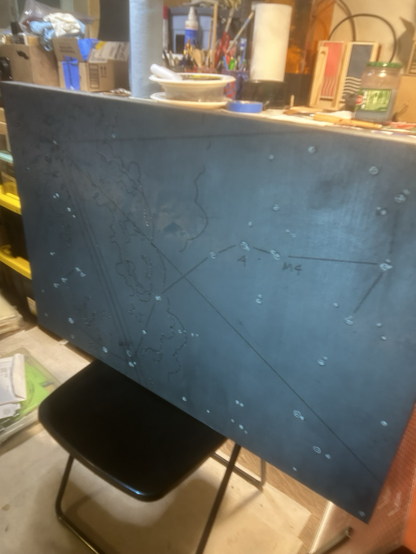
Well I think this looks suitably galactic, eh?
#MastoArt #spaceart #space #galaxy #stars #scorpius #constellation #painting #zodiac #astronomy #astroart #wip
2025 September 13
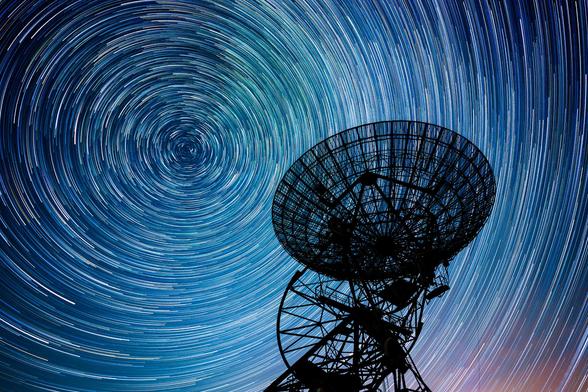
Star Trails over One-Mile Radio Telescope
* Image Credit & Copyright: Joao Yordanov Serralheiro
https://www.joaoysphotography.com/about
Explanation:
The steerable 60 foot diameter dish antenna of the One-Mile Telescope at Mullard Radio Astronomy Observatory, Cambridge, UK, is pointing skyward in this evocative night-skyscape. To capture the dramatic scene, consecutive 30 second exposures were recorded over a period of 90 minutes. Combined, the exposures reveal a background of gracefully arcing star trails that reflect planet Earth's daily rotation on its axis. The North Celestial Pole, the extension of Earth's axis of rotation into space, points near Polaris, the North Star. That's the bright star that creates the short trail near the center of the concentric arcs. But the historic One-Mile Telescope array also relied on planet Earth's rotation to operate. Exploring the universe at radio wavelengths, it was the first radio telescope to use Earth-rotation aperture synthesis. That technique uses the rotation of the Earth to change the relative orientation of the telescope array and celestial radio sources to create radio maps of the sky at a resolution better than that of the human eye.
https://apod.nasa.gov/apod/ap250913.html
#space #earth #astrophotography #photography #astroart #science #nature
 steven.sandner
 grobi
grobi AstroHyde
 Jeff Zugale - Z Factory