Thanks for the tip. I just put her book on hold at my library.

She has TONS of videos on the web. Here's one.
Dr. Sara Imari Walker has a cool (LONG) conversation with Dr. Kuhn in a "Closer To Truth" YouTube video:
https://www.youtube.com/watch?v=uvmYSxxlNn0

Here's a short article from about a year ago:
https://theconversation.com/life-modern-physics-cant-explain-it-but-our-new-theory-which-says-time-is-fundamental-might-203129

#Life #Emergence #Astrobiology #Physics #Science #Consciousness #Memory #AssemblyTheory https://sunny.garden/@SolaciAlien/114267737083994545

Sara Imari Walker on Physics, Emergence, and Life on Other Planets | Closer To Truth Chats

YouTube
Book Review - Life as No One Knows It

Great ideas, bad writing.

Expand your minds, kids. Don't need no drugs. Nope. Combinatorics? Might help.

Theoretical physicist and astrobiologist Sara Imari Walker takes on biology, life, the universe, machines, and more.

https://www.youtube.com/watch?v=XcJz2F-O_ek

#science #physics #StarTalk #life #AssemblyTheory

Scientists Discuss New Theories on The Origins of Life in the Universe

Go to https://ground.news/startalk to stay fully informed on the latest Space and Science news. Save 40% off through our link for unlimited access to the Van...

YouTube
Sara Imari Walker: Using physics to rethink the definition of life

"Life as No One Knows It" explores Assembly Theory, a framework that measures molecular complexity in an effort to define life.

Big Think
Added this to my reading list:

On the salient limitations of the methods of assembly theory and their classification of molecular biosignatures
We demonstrate that the assembly pathway method underlying assembly theory (AT) is an encoding scheme widely used by popular statistical compression algorithms. We show that in all cases (synthetic or natural) AT performs similarly to other simple coding schemes and underperforms compared to system-related indexes based upon algorithmic probability that take into account statistical repetitions but also the likelihood of other computable patterns. Our results imply that the assembly index does not offer substantial improvements over existing methods, including traditional statistical ones, and imply that the separation between living and non-living compounds following these methods has been reported before.
From https://www.nature.com/articles/s41540-024-00403-y

"Assembly theory" has been receiving a lot of buzz lately as a method for detecting life in novel places. I first encountered assembly theory two years ago and from the beginning had the impression the authors were overclaiming (smelled hype-y to me), but so far I haven't sat down to sort out why I had that impression. I've seen some critical commentary about it (e.g., https://hectorzenil.medium.com/the-8-fallacies-of-assembly-theory-ba54428b0b45 ), but assessing all the arguments and counterarguments is a lot of work. I'm hoping this paper will help since the claims regarding AT's equivalence to certain compression algorithms is pretty straightforward to assess.

Oh, I just noticed the last author of the Nature article is the person who wrote the Medium article.

#AssemblyTheory #ExoBiology #ArtificialLife

On the salient limitations of the methods of assembly theory and their classification of molecular biosignatures - npj Systems Biology and Applications

We demonstrate that the assembly pathway method underlying assembly theory (AT) is an encoding scheme widely used by popular statistical compression algorithms. We show that in all cases (synthetic or natural) AT performs similarly to other simple coding schemes and underperforms compared to system-related indexes based upon algorithmic probability that take into account statistical repetitions but also the likelihood of other computable patterns. Our results imply that the assembly index does not offer substantial improvements over existing methods, including traditional statistical ones, and imply that the separation between living and non-living compounds following these methods has been reported before.

Nature

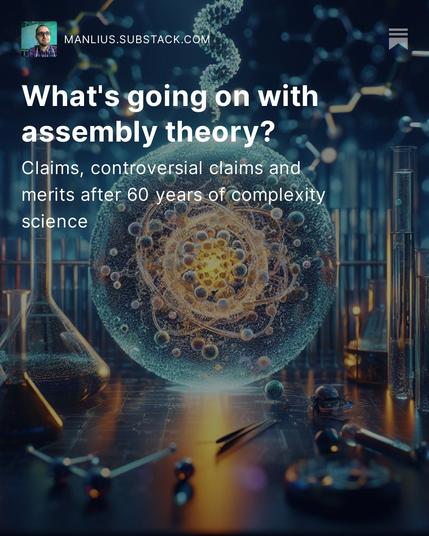
A new #ComplexityThougths short essay is out: this time I write about the ongoing debate around the Nature paper on assembly theory. The essay features comments by Sara Imari Walker, Ricard Solè and Hector Zenil, and it's an attempt to provide a balanced overview of what's going on.

https://manlius.substack.com/p/whats-going-on-with-assembly-theory

#ComplexSystems #ComplexityScience #Complexity #AssemblyTheory

What's going on with assembly theory?

Claims, controversial claims and merits after 60 years of complexity science

Complexity Thoughts
My plan for the weekend is to apply #assemblytheory to a Lego castle!
I get the sense that #AssemblyTheory doesn't have the same kind of malicious intent behind it as #EA. Feels like some guys indentified a promising analytical approach & then tried to reason back from that to universal significance. But I can see it having broad, transformative, & devastating impact, as it's used to manufacture certainty by miscasting probability as destiny.
To me the most interesting un-addressed question about #AssemblyTheory is what are the ways we can imagine its assessments being wrong? Assembly Index is already being framed as a determinative value, when it's really a chain of hypotheticals. In that way it strongly resembles the #EffectiveAltruism trick (& in #EA it is absolutely a trick) of following a quasi-Socratic chain to claiming that we will "likely" populate the universe with scadzillions of simulated human brains in a jar.

Also, the reference section of this #AssemblyTheory paper is a joke. 29 entries, four of which cite Darwin’s Origin of Species, Newton’s Principia, Arora/Barak’s Computational Complexity, and Bennett’s Universal Touring Machine *as entire books*. You gotta be kidding me.

https://www.nature.com/articles/s41586-023-06600-9

Assembly theory explains and quantifies selection and evolution - Nature

Assembly theory conceptualizes objects as entities defined by their possible formation histories, allowing a unified language for describing selection, evolution and the generation of novelty.

Nature