Scientists built a quantum battery that breaks the rules of charging. Via @sciencedaily_official #Science #Physics #QuantumPhysics #QuantumMechanics 🔭🔬🧪🥼🧑‍🔬 #RenewableEnergy ♻️⚡🌎

Scientists built a quantum bat...
Scientists built a quantum battery that breaks the rules of charging

Scientists have taken a major step toward futuristic energy tech by building a working prototype of a quantum battery—one that can charge, store, and release energy using the strange rules of quantum physics instead of chemistry. This tiny, laser-powered device hints at a future where energy storage is not only faster but actually improves as systems get larger, flipping the rules of conventional batteries.

ScienceDaily
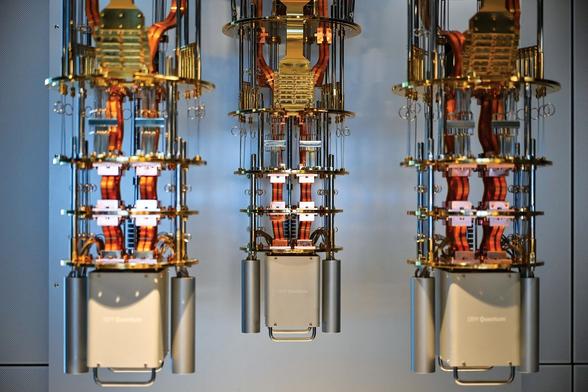
IBM quantum processor achieves highest fidelity calculations for the longest period of time on record. Via @live_science #Science #Physics #QuantumPhysics #QuantumMechanics 🔭🔬🧪🥼🧑‍🔬 #ComputerSciences #QuantumComputers

IBM quantum processor achieves...
IBM quantum processor achieves highest fidelity calculations for the longest period of time on record

Scientists have developed a novel approach to error correction that resulted in the highest-ever fidelity of entangled, logical qubits on a superconducting quantum processor.

Live Science

Scientists Say They’ve Found “Dark Points” That Move Faster Than the Speed of Light

https://fed.brid.gy/r/https://futurism.com/science-energy/vortices-waves-moving-faster-than-light

Quantum computers need just 10,000 qubits — not the millions we assumed — to break the world's most secure encryption algorithms. Via @live_science #Science #Physics #QuantumPhysics #QuantumMechanics 🔭🔬🧪🥼🧑‍🔬 #ComputerSciences #QuantumComputers #CyberSecurity

Quantum computers need just 10...
Quantum computers need just 10,000 qubits — not the millions we assumed — to break the world's most secure encryption algorithms

Future quantum computers will need to be far less powerful than we thought to threaten the security of encrypted messages, banking information and other sensitive data.

Live Science

The latest issue of Europhysics News from the European Physical Society entirely relates to quantum physics, in honour of the 2025 physics Nobel Price. I particularly enjoyed the chronoquantistics article, which visually summarizes more than a century of discoveries in the quantum world. https://www.europhysicsnews.org/articles/epn/pdf/2026/01/epn2026571p22.pdf

#EPS #europhysicsNews #quantumphysics

Ars Technica: Google bumps up Q Day deadline to 2029, far sooner than previously thought. “Google is dramatically shortening its readiness deadline for the arrival of Q Day, the point at which existing quantum computers can break public-key cryptography algorithms that secure decades’ worth of secrets belonging to militaries, banks, governments, and nearly every individual on earth.”

https://rbfirehose.com/2026/04/01/ars-technica-google-bumps-up-q-day-deadline-to-2029-far-sooner-than-previously-thought/
Ars Technica: Google bumps up Q Day deadline to 2029, far sooner than previously thought

Ars Technica: Google bumps up Q Day deadline to 2029, far sooner than previously thought. “Google is dramatically shortening its readiness deadline for the arrival of Q Day, the point at whic…

ResearchBuzz: Firehose

Quantum Physics – things that make you go Hmm.

What happens when matter crosses the event horizon of a black hole? We don’t know is the quick answer.

Theory #1, all matter is compressed into an infinitely dense state at the black hole’s singularity. At that point, the laws of physics as defined by Einstein's general relativity no longer apply.

Theory #2, proposes the existence of opposite objects to black holes known as white holes. These would expel material rather than draw it in. Wormholes between the two could connect different locations in our universe or possibly connect our universe with other parallel universes.

There is no evidence for the existence of white holes, and none have ever been observed. Black holes have been observed through indirect and direct methods.

The question of what happens to matter that falls into a black hole remains unresolved. This problem is known as the black hole information paradox.

https://www.thebrighterside.news/post/the-physics-of-no-return-what-actually-happens-if-you-get-pulled-into-a-black-hole/ #Physics #QuantumPhysics #BlackHole #EventHorizon

This quantum computing breakthrough may not be what it seemed. Via @sciencedaily_official #Science #Physics #QuantumPhysics #QuantumMechanics 🔭🔬🧪🥼🧑‍🔬 #ComputerSciences #QuantumComputers

This quantum computing breakth...
This quantum computing breakthrough may not be what it seemed

A team of physicists set out to test some of the most exciting claims in quantum computing—and found a very different story. Instead of confirming breakthroughs, their careful replication studies revealed that signals once hailed as major advances could actually be explained in simpler ways. Despite the importance of these findings, their work initially struggled to get published, highlighting a deeper issue in science.

ScienceDaily
Silicon quantum computer performs logical operations for the first time Silicon is ubiquitous in modern electronics, and now it is becoming increasingly useful in quantum c... https://phys.org/news/2026-03-silicon-quantum-logical.html #PostSapiens #quantumphysics
Silicon quantum computer performs logical operations for the first time

Silicon is ubiquitous in modern electronics, and now it is becoming increasingly useful in quantum computing. In particular, silicon's compatibility with existing chip technology and its long coherence times in silicon-based spin qubits make it a promising material for scalable quantum computing. A new study, published in Nature Nanotechnology, has demonstrated silicon's use in a logical quantum processor, representing the first of its kind.

Phys.org